Women’s March on Washington Archives Project

This post does eventually relate to archives.

I live in California’s Central Valley, just 90 miles away from San Francisco. The Valley is a conservative part of the state. This weekend, I was amazed by our hometown. My husband and I had planned to march in Sacramento, but he got off work very late on Friday, so we opted to go to the march in our own city. The march was sponsored by The Progressive Voice and the Democratic Women’s Club of Stanislaus County. My good friend Joey from Merced joined us with her two teenage daughters, and when we got there, we met with other friends and family members. I did not expect 1,000 people to participate. I did not expect the huge show of support from people in cars as we walked down one of the busiest streets in town. Here is an article from our local paper, “Signs, Chants, Honks, and Cheers Mark Large, Upbeat Women’s March Modesto.”

When I got home from the march, I spent some time looking at photographs people were posting of marchers and their posters. Here are some interesting articles related to posters from marchers and photographs round the world and within the United States.

The Society of American Archivists’ Women Archivists Section is interested in archiving materials, including posters, photographs, and oral histories from the women’s marches. Their project is called the Women’s March on Washington Archives Project. Click here to find the Project’s Facebook group and here for their Twitter account.

I plan to contribute photos. Some friends also gave me their posters. I just have to find out if California has a repository for the physical materials. Please feel free to share about this archival project. This could be a potentially rich source of primary material for those studying about the marches in the future.

Here are some photos I took this weekend.

Presidential Reads

I wrote this for the CJCLS Blog. Earlier this week, I wrote about how to promote reading on the CJCLS Blog after we came across some incorrect reading stats that have been widely circulated on social media. Yesterday, a list of all the books President Obama has recommended during his presidency was released. What a great way to promote reading…and a great way to round out that earlier post.

Fake News & Media Literacy Syllabus

I have been collecting links related to fake news and media literacy for several weeks. The topic seems to have exploded since Stanford released its “Evaluating Information: The Cornerstone of Civic Online Reasoning” report in November.  Also in November, the California State Auditor’s office released its report “School Library Services: Vague State Laws and a Lack of Monitoring Allow School Districts to Provide a Minimal Level of Library Services,” in which I learned that “California has by far the poorest ratio of students to teacher librarians in the nation.” Somewhere along the road, it seems that librarians were equated to finding information, and in the “age of the Internet” where anyone can find things, I have often heard the obsolete speech. At my previous job, there was a committee set up to discuss whether the college’s AA and AS degrees (not for transfer) needed to fulfill an information and computer literacy requirement. One of the administrators thought that in the age of Google Chromebooks, there was “no need.” I left that job before a decision was made, and I discovered that the requirement was removed. Given the present state of information literacy, this is a mistake.

Interestingly, our library’s Deputy University Librarian Donald Barclay  wrote a piece called “The Challenge Facing Libraries in an Era of Fake News” in The Conversation a few days ago, and it has made the rounds in so many places! In the piece, he provides an overview of how librarians have helped progress information literacy historically, as well as the challenges facing students in today’s more ambiguous information landscape. My lament about our work is that as long as it’s taught on the periphery–no matter how worthy the Framework and lesson plans we develop may be–Donald is right, “Real progress in information literacy will require librarians, faculty and administrators working together…Indeed, it will require higher education, as well as secondary and primary education, to make information literacy a priority across the curriculum.”

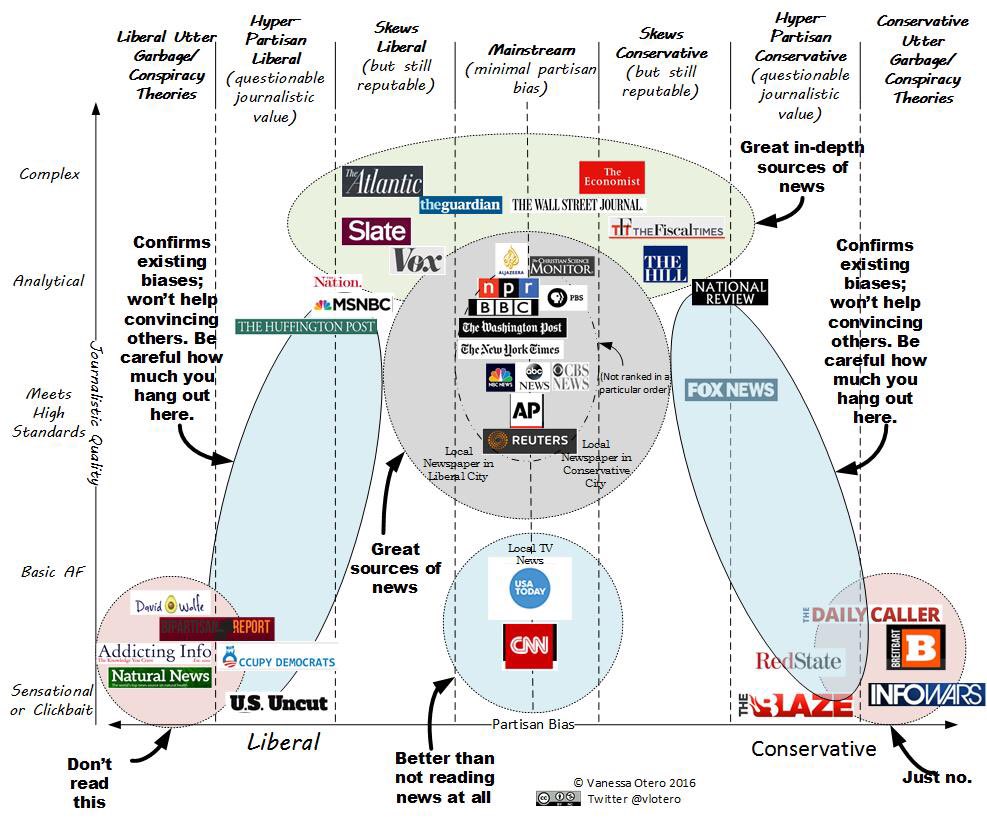
Since before the holidays, the instruction team and I at UC Merced have been developing a digital campaign for our social media accounts and digital signage related to becoming an informed news consumer. (The idea was sparked by this graphic you may have seen before.) Unrelated to this initiative, we’re also pitching a more robust instruction menu, and one of the options is about media literacy. My colleague developed a lesson plan, but I will need to get her permission to share it. Recently, there was a call from Linda Miles at Yeshiva University in the collib listserv for lesson plans related to media literacy. She’ll be sharing those findings soon.

If you’re interested, Programming Librarian will be offering a free 45-minute webinar “Post-Truth: Fake News and a New Era of Information Literacy” on Wednesday, Feb. 22 at 2 pm EST. Register by clicking on this link.

My goal for this post is to share the links related to fake news and media literacy that I have been collecting for the last few weeks. I’m sure this sort of project is already in the works (indeed, I even signed up for Twitter again specifically for this topic…), but this is my attempt at a Fake News and Media Literacy Syllabus that can help academic librarians who teach information literacy. The link takes you to a Google Doc that can be edited. Feel free to add articles, tools, lesson plans, LibGuides, etc. to the Syllabus or to this post. I would love for folks to add their names and affiliations as well. I plan to do official citations later, as well as some kind of organization that makes sense. There is tons of stuff I haven’t added, but we’ll get there.

Last updated on Jan. 17, 2017

This Is What a Librarian Looks Like

My Elephant and Piggie dreams have come true!

This is What a Librarian Looks Like

The absolute craziest thing happened yesterday. I found out that I’m on the cover of a book that will be published in May 2017. Sure, the photo is from 2.5 years ago (it will be a 3-year-old photo when it’s published) when I was a little rounder and pre-Invisalign, and the photo is not my personal best…blah blah blah…but it’s pretty darn cool.

In February of 2014, an article on Slate called “This is What a Librarian Looks Like,” which featured photography by Kyle Cassidy, went viral. In June, there was enough money in the Kickstarter campaign to “photograph and interview more than 300 Librarians at the ALA conference in Las Vegas [and] to also fund the stretch goals of creating a series of stock photographs for libraries to use, doing five hours of video interviews, and doing some photography for the new Joan of Dark book on knitting projects for book lovers” (Cassidy, 2014). Read more about the project here: http://kylecassidy.com/librarians/

Back in May 2014, I had just finished up my first year as a tenure track faculty librarian at a community college, and I decided to attend the American Library Annual Conference in Las Vegas that June (I paid for the whole trip out of pocket). I didn’t really intend to participate in the photo taking (I’m shyer and struggle with putting myself out there), but the initial librarians involved were encouraging. I filled out the model release and wrote up a statement answering one of these questions.

1) What are the greatest challenges facing libraries today?
2) What are the most important services that libraries provide?
3) What inspired you to do what you do?
4) What do libraries do that people might not know about?
5) What would happen in your community if all the libraries shut down tomorrow?
6) Why are libraries relevant when the Internet exists?

The thing is, I don’t remember which I answered or what I wrote! I had almost forgotten about this whole project. I suspect that I answered #3. I will find out in May. It may be that not everyone’s statement was included, but being on the cover is cool.

Anyway, my parents who don’t know much about what I actually do are super excited. My sister showed them my Facebook status update (they are not computer users…my mom doesn’t even have a mobile phone). This is what my whole family is getting for Christmas 2017. As I said on Instagram, Amazon, all of those pre-orders are from me. LOL! (P.S. You can pre-order a copy here.)

I’m looking forward to reading what everyone wrote!

Library Outreach in Public Health

I meant to do a check in regarding my new job for both September and October, which I will get to eventually, but I just had to share about my library outreach success story.

As you may recall, the UC Merced Library launched a liaison program in late August. We have a small staff, so we don’t have subject specialist roles that involve collection development in that area. Four us were assigned to the School of Social Sciences, Humanities, and Arts. There are a number of minors, undergraduate, and graduate degrees in these areas, so we split them up. My primary areas are public health, management, and economics. Public health has both an undergraduate and doctoral program.

Our task for the semester was to begin connecting with the graduate group chairs. A colleague and I met with the Social Science graduate group chair to explain about the liaison program and possibly get ideas for how to communicate with the faculty and graduate students working in public health, management, and economics. Since public health is the only social science program with a graduate program, the conservation leaned more towards public health. I had already talked with our Head of Collections and Deputy University Librarian about previous conversations the Library had had with public health faculty, so that gave me some history. The grad group chair also briefly went over these previous  conversations, mostly related around access to some specific journals and data services. The grad group chair gave me the contact name of a professor who teaches a professional seminar for first-year doctoral students and said he would send me an email list of all of the graduate students in public health. The list he sent me included not only student names and contact information but also had the name of each student’s faculty mentor. I made contact with the professor of the class the grad group chair had mentioned, asking if there was something we could do for her students. I sent out a couple of messages, knowing it was a busy time of year, and waited.

While waiting, I discovered that there is a Public Health Seminar Series. I had missed the first talk already, but I contacted the professor who coordinates this series, explaining who I was and that I thought it might be beneficial for me to come to these talks to learn more about public health research. She was very welcoming and seemed pleased about my interest. I wasn’t able to stay for the whole talk due to an appointment, but I took notes and followed-up with the coordinator about the featured researcher’s work. (If you’re interested, the researcher is Dr. Joan Casey, and she discussed her article “High-Density Livestock Operations, Crop Field Application of Manure, and Risk of Community-Associated Methicillin Resistant Staphylococcus aureus Infection in Pennsylvania.”)

A little more time passed, and I decided that I needed to contact the students directly. Rather than send out a text-heavy email, I opted for this simple Smore newsletter to introduce myself, the new liaison program, and offer some general services. I also included the link to the article that was discussed at the Public Health Seminar Series for those who, like me, may have missed the citation or were not able to attend the talk. I sent the newsletter to two groups–the students and faculty mentors. I was able to craft different introductory statements in the email that was sent via Smore, so I explained to the faculty mentors that their students had received this information from me. (P.S. The newsletter was viewed 120 times! I also found out that we have a subscription to Mail Chimp, so I will try that next semester.)

The professor I had been trying to contact got a hold of me within a couple of hours after sending out the newsletter! She asked if I could give a session on how the librarians might be able to support students conducting systematic reviews. Thankfully, my colleague, who is the secondary liaison for public health, had done a MOOC on systematic reviews. She sent me some of the materials, so I could look at them. I found a number of useful online guides other libraries have created, which helped me learn more about systematic reviews. After doing some more research on the topic, we created a lesson plan.  The online guides I had looked at also served as the foundation for an online guide we created for the students (below is a screenshot).

Screenshot of Systematic Reviews Guide

We gave the workshop last week, and, although there were parts I could have been better in, it was successful! Some of the students took notes and asked us several questions. We also got good feedback from the students as we were packing up. They seemed happy to have a guide to refer to when doing their own systematic reviews.

The happy story could end here, but it doesn’t. It gets even better.

I sent out a second newsletter with the link to the systematic review guide, information about signing up for an ORCID ID (this campaign had been part of our Open Access Week programming), a reminder about the third installation of the Public Health Seminar Series, and some videos related to using RefWorks. I got a thank you from the professor about coming into her class for the systematic reviews workshop after sending out this second newsletter.

The third installation of the Public Health Seminar Series was this past Tuesday. The talk was given by Dr. Kurt Schnier, an economics professor at UC Merced, who has done work related to organ donation. He spoke about an article under review, “Subsidizing Altruism in Living Organ Donation.” Almost all of the students who had been at the workshop were there, and they recognized me. After the talk, a student asked me about making an appointment to learn how to use RefWorks. When I first walked in, I had heard her talking to someone about some issues she was having accessing an article via Google Scholar, so I asked about that, too. As I was getting up to go, the students mentioned that they were staying to talk to the researcher about his work a bit more, and they asked me to stay!  As the students gave their introductions, I asked the series coordinator if it was okay if I stuck around; it was fine.

It was very interesting to hear some of the students’ concerns. For example, a student was worried that the research she was working on now might pigeon-hole her somehow. The economics professor gave a very good response–that the skills they are learning as graduate students can be applied to the research they will be doing in the future. His background is also varied–he looks at both environmental and health topics through the lens of economics–so that helped eased some of the concerns. I appreciated the connection to lifelong learning; as a librarian, I try to emphasize to freshmen students that the information literacy skills they are learning will help them not only in completing their immediate assignment but throughout their college career and beyond. Even if students aren’t writing papers in the future, they can use what they have learned about information in their work and daily lives.

At the end of this discussion, another student asked me if the library had any book clubs. We don’t, but I am going to look into this. When I got back to my office, I emailed the student who had asked about RefWorks, asking when she would like to come by, and I also asked her about the articles again. She got in touch with me this morning, and I was able to help her track down the articles.

I’m really excited about the the connections I have begun making with our public health graduate students.