A Genius Idea

I blame Star Trek Beyond. I feel like Public Enemy’s “Fight the Power” is haunting and taunting me! I went to see Star Trek with my husband last weekend, and when the song came on,  I was reminded of a really cool lesson on illustrating the “scholarship as conversation” frame.

As I was reading ACRL’s Instruction Section’s Spring 2016 Newsletter this past May, and I came across an intriguing lesson idea submitted by Tim Miller, a librarian at Humboldt State University, “Citations & Hip-Hop: Using Genius to Illustrate Scholarship as Conversation.” You can find the article at the link above on page 2, but I also have included it below.

This semester I’ve been participating in a book circle on Emery Petchauer’s Hip-Hop Culture in College Students’ Lives. Our first discussion coincided with an upcoming workshop that I facilitate on citations & plagiarism that I was also in the process of revamping. While discussing the symbolism behind Boogie Down Productions’ 1990 album, Edutainment, I was struck by the similarities between the asynchronous conversations within hip-hop and academic writing. I’m not a huge hip-hop fan, but I decided to delve in and put this idea to practice using another song from that era: Public Enemy’s “Fight the Power.”

Hip-hop music incorporates sampling (using audio snippets) and is filled with references to other songs, lyrics and imagery. Genius, the online song lyric knowledge base and annotation tool, provides a visual representation of these references by incorporating interactive features that allow users to create annotations alongside the text of the lyrics. These annotations provide explanations and context in the form of comments, hyperlinks and images. I purposely chose “Fight the Power” because it is particularly rich with samples, references and imagery that not only provide a background to the meaning behind the song but also point listeners to artists and individuals who inspired the song.

The imagery within Genius helps demonstrate that references in hip-hop create a conversation akin to scholarship: a conversation that is ongoing and unfinished. Just within the intro and first verse there is a variety of examples, including: a link to the music video (with its own visual references), an image of the single for James Brown’s “Funky Drummer,” a link to The Soul Children’s “I Don’t Know What This World Is Coming To,” and a movie poster to Spike Lee’s Do The Right Thing, for which the song was written. Genius makes these references come to life by incorporating comments, images and sound – all added by the various Genius users participating in the conversation. (Miller, 2016, p.2).

I would actually really love to do this as a workshop. I think it’s because of my history background; I did a lot of classes related to slavery and Civil Rights, and my interest in social justice. I will definitely keep this idea on my radar. I emailed Tim to let him know how much I enjoyed reading his piece in the newsletter. He let me know that he also uses Genius “to annotate an online article for my workshop on reading academic articles. It is a very easy way to add instructive elements into a webpage. I may explore using it with [LibGuides] to create virtual tours for our online programs” (T. Miller, personal communication, May 9, 2016).

Library Instruction West 2016 Conference Notes

In early June, I traveled with two of my new colleagues to the Library Instruction West 2016 conference in Salt Lake City, Utah. I hadn’t ever been to Utah before, nor this conference, so it was a neat experience, and it was nice to be among instruction-specific librarians. Here are my notes from the sessions I attended.

Teaching, Learning, and Vulnerability in Digital Places

I had the pleasure of listening to Donna Lanclos’ keynote address. Lanclos is an anthropologist at UNC Chapel Hill. Her work for the last few years has been in studying higher education and academic libraries. Although you can find a much better summary about her talk here, her keynote centered on the idea that online is a place, and we need to work towards making this learning place welcoming to our students, and, to do that, we need to have professional empathy. We need to work for the connection in our online spaces. Although our Moodle and Blackboard course shells have spaces for discussion boards, why are students still creating Facebook groups for their classes? Why are students leaving the course management system to find humanity elsewhere online?

Rather than have people fill out surveys, Lanclos, in her work as an anthropologist, had people annotate their emotions related to different online spaces. On one end of the spectrum are places in the online world that are used like a toolbox in which one acts as visitor. On the other end of the spectrum are the online places in which one is a resident engaging and communicating in community. This was a very revealing exercise. In my notes, I made quick note about my online world. There are times and places online in which I act as visitor, but there are other places in which I am a resident. For example, when I had Twitter, I was an occasional visitor. Facebook is where I engage, and this had to do with personal comfort. I did not feel comfortable engaging with librarians on Twitter. The most vocal people are the ones who are heard, and I don’t have a style that is bold, sarcastic, or witty. I didn’t feel like I belonged.

Lanclos is asking us to carefully examine how we can make online learning be more personal and human. Vulnerability, she argues, is mostly approached from a personal level. If we do not give away some personal things, we seem unapproachable. There is utility in sharing, but we need to examine vulnerability in other ways, as well. Vulnerability can be characterized negatively and positively, as risky or risk-taking. When one is part of the power structure, being vulnerable is seen as risk-taking. When one is not part of the power structure, vulnerability is seen as risky behavior. How much humanity do we put out there until it is deemed risky? This is what our students are negotiating. We need to think about the values we are expressing in our instruction.

In academia, we are asked to be more empathetic and vulnerable with our students, but Lanclos indicates that what we really owe students is professional vulnerability—flexibility and transparency. With regard to library services, the classroom, and the university, we are constantly finding ways to make the process more seamless, but there is something in showing students messiness, the seams (we need to be seam-y). Being transparent in our teaching is an act of professional vulnerability. Dave Cormier writes about rhizomatic learning in his article “Rhizomatic Education: Community as Curriculum” (2008). This type of learning and teaching is very challenging because it is centered on being vulnerable. In this inquiry-based environment, it is okay not to know the answer and engage in the half-formed ideas. We need to model to students that experimentation and not knowing are part of the learning process.

Our students will learn to challenge themselves if we model the messy process of learning, and librarians are uniquely positioned to model process given that are expertise is focused on process versus content. For the librarian, however, challenges remain in being a seam-y teacher. How do we work with low faculty expectations and a university that may view the library as a checkbox versus a partner? How do we develop relationships in the one-shot model?

I really liked Lanclos’ overview of the work she did in having people map their emotions related to online environments. You can read more about the visitors and residents continuum here.

In which environments do you act as a visitor? Where are you a resident? What is the reason for the difference? How might this exercise be adapted in your classroom? I feel like it pairs really well with Kuhlthau’s ISP model, because there are also emotions researchers experience in the research process. How might you create an online learning environment that is safe for students to be human?

Demonstrating Dialogue: Using the ACRL Framework to Teach Scholarship as a Conversation

This active learning workshop was conducted by Sarah LeMire of Texas A&M University. Before the activity portion of the workshop, LeMire and the participants discussed the scholarship as conversation frame, addressing the challenges and opportunities and strategies in teaching this concept.

Opportunities include engaging with multiple viewpoints, recognizing privilege, student contributions as information producers, and the interconnected nature of scholarship. Some conceptual challenges in teaching this frame are that scholarship is mediated in a way conversation are not; conversation is give and take, though not all research is, and because scholarship is mediated, there are barriers to access and some voices are marginalized. Some of the practical challenges in teaching these concepts are the reliance on the binary (scholarly vs. popular), pro/con assignments, and privileging academic viewpoints. Students are used to consuming information, so having them participate as producers can be challenging with this frame.

Some strategies include recognizing the relationship between authors’ work, engaging students in roles as information creators, critically challenging privilege, focusing on how authority differs based on context, and demonstrating that there can be different viewpoints.

Although I feel that LeMire did an excellent job in having the audience participate in the activity, what I was looking for were actual activities or lessons I could adapt surrounding this particular frame. While I did learn some ideas from the group I was in, because we spent the time developing learning outcomes for this frame, we didn’t get very far in actually developing an idea for the outcome. I also didn’t get to hear much from the other participants due to time, so, for me, I didn’t get a lot out of this to share with colleagues except that it was a good example of how to do active learning.

We were divided into groups based on the populations we serve, such as lower division undergraduate students in one-shot sessions, etc. Each group was then given a series of 3×5 cards with words written on them. We had to make three learning outcomes based on the scholarship as conversation frame from these cards. After creating outcomes, one member of the group selected one of the props LeMire provided, a toy telephone. We had to develop an activity focused on one of the learning outcomes we had created based on the prop. For example, using a smartphone, we could have an activity where students could get in parts to explore a hashtag and a do a think-pair-share, or they could ask each other who they would call to learn about a topic being discussed in class. Or what might certain people in their contacts lists have to say about the topic?  Who could they not reach with a phone? Another activity someone came up with was the have students work in pairs to find a social issue on Twitter and explore the different people and perspectives in the conversations. The students could then share findings with the class.

Teaching or Tyranny: Class and Course Guides

In this presentation, Nancy Noe from Auburn University took a close look at LibGuides, a tool many librarians use to develop subject, course, and class online research guides. You can download Noe’s slides here. The slides also offer articles to read on this subject. She became interested in doing more research about online guides when helping a student one day who corrected her in how to find something based on the pathway he had learned from a one-shot instruction session that used an online guide. Noe examined 500 guides from 9 institutions and found that most of the guides looked like subject guides and while useful for librarians, they weren’t utilized much by students. She also was critical of online guides because they are not a learning tool and “dehumanizes the nature of inquiry.” In a time when education is incorporating more active learning techniques and when librarianship is moving towards a more holistic view of information literacy, I can understand where she is coming from in light of critical pedagogy. The presentation also reminded me of an article by Hicks that I read last year, “LibGuides: Pedagogy to Oppress?,” in Hybrid Pedagogy.

However, there is room for directories in our landscape. Throughout the presentation, I kept thinking about the visitors and resident continuum Lanclos introduced in her keynote address at the conference. Second, simply analyzing a LibGuide does not tell you what is being done in the classroom with the guides. There could be analog activities going on in conjunction with the tools on the guide. At my own institution, some of the librarians also create online activities that are embedded into the guide, so while that shows evidence of active learning, but I can think of times at my previous job at a community college where I used a guide with paper-based activities in the classroom. Third, library instruction programs do not merely consist of guides; they are not being used a substitution for teaching.

I am not defending the standard guide as much as I am saying that everything has its place, from the subject guide that merely points out some of the subject-specific databases and websites to the class guide full of interaction and focus on process and inquiry.

I do appreciate the fact that she indicated that there didn’t seem to be much difference between subject and course guides from the guides she analyzed. Her willingness to look into a tool critically that the profession embraces can help us to be more critical of the guides we make, and it also speaks to the importance of continuing to reach out to faculty regarding instructional efforts and working with them to develop instructional materials. There is no point to make these things if instructors do not use them or recommend that students use them.

The Road Untraveled: Alternative Outreach for Instruction

In this presentation, Carrie Moran and Rachel Mulvihill of the University of Central Florida shared how the library has reached out and engaged with campus partners to reach faculty and students. You can find the presentation slides here. Traditionally, many libraries outreach to specific departments through subject specialists and liaison models. For example, there might a librarian who is the psychology librarian or there may be librarians who are responsible for reaching out to faculty in a few specific majors. UCF Libraries, instead, have sought partnerships based on specific programs, such as the graduate school, first year experience program, Honors program, online programs, international student program, transfer student program, and faculty.

The library partnered with the Center for Distributed Learning to put the library’s information literacy modules in the learning object repository and had them incorporate library tools into Canvas, the university’s learning management system (from the image on the slides, it looks like they incorporating library tools into Canva using the LibGuides CMS). They also worked with instructional designers to design a Library Canvas Course.

Rather than start new ideas from scratch, the library sought places where library expertise could contribute to what other programs were already doing. The library found ways to reach the campus community through an online video presentation with the Faculty Center for Teaching and Learning, presented at New Faculty Orientations, played a role in the Summer Research Academy through the Office of Undergraduate Research, held College of Graduate Studies workshops in scholarly communication and a dissertation forum. For the Honors program, the library held an Honors in the Major workshop covering research basics (the library got a list of students with their majors prior to the workshop) and a series of thesis development workshops. They partnered with Transfer and Transition Services’ Foundations of Excellence Transfer Initiative, participating in two interdepartmental workshops, “Bagels with TTS” and “Are You on the Knight Track? Transfer Student Seminar.” To help with library myth-busting at New Student Orientations, the library invited First Year Experience Orientation leaders to go to the library for a session. Although too much time has passed for me to make sense of my notes, the library also did something with the Office of Research and Commercialization.

Moran also offered that the library can also seek out partnerships with non-academic departments, such as personal/social groups or clubs. For example, being involved with the Pride Faculty and Staff Association at UCF, United Faculty of Florida UCF chapter, and the Center for Success of Women Faculty has fostered opportunities for library outreach. Being on search committees can also foster opportunities. The library definitely needs to meet people where they are and get involved with the spaces, places, and activities other departments do on campus.

There is something I wrote here regarding librarian paper dolls and insomnia cookies. I’m a little bummed I can’t remember the details, but I can always contact the presenters. It was a fun, inspiring presentation.

Breaking it Down and Climbing Back Up: Learning Theories & Approached to Instruction

In this presentation, Erica DeFrain from the University of Nebraska-Lincoln, Julia Glassman and Doug Worsham from UCLA, and Nicole Pagowsky from the University of Arizona discussed using active learning, constructivism, and critical pedagogy as instructional strategies to motivate learners and make learning memorable, meaningful, and transformative.  You can download the slides and the handout that went along with this presentation here.

During the first part of the presentation, the presenters had us work in pairs and think and share about a time when learning was memorable, meaningful, and transformative. I really struggled with this question, and I know that reflecting on our own positive and negative learning experiences can inform our own instruction, but I think transformative is what threw me off. Using our experiences, we made a list of characteristics. For example, what makes learning memorable, meaningful, and transformative might be that it is authentic and engaging and happens when learners and teachers are motivated and motivating.

  • Active learning focuses on being memorable.
  • Social constructivism focuses on being meaningful.
    • Constructivism: we learn when we build knowledge with our concepts and experience.
    • Social constructivism: we learn when we interact with each other to build knowledge with concepts and experience (this is why we were doing think-pair-share)
  • Critical pedagogy focuses on being transformative.
    • Social justice perspective that challenges status quo and how things are/came to be
    • “Habits of thought, reading, writing, and speaking which go beneath surface meaning, first impressions, dominant myths, official pronouncements, traditional clichés, received wisdom and mere opinions to understand deep meanings, root causes, social contexts, ideologies, and personal consequences of any action, event, object, process, organization, experience, text, subject matter, policy, mass media, or discourse.” (Shor, Empowering Education, 1992, p. 129)

Interestingly, the panelists asked who had trouble coming up with an experience from higher education that was memorable, meaningful, and transformative and prompted a discussion about barriers to this kind of learning. Barriers that our group came up with include lecture forma, lack of confidence, language/culture, research vs. teaching focus, quantitative assessment, prescription, and lack of personal interaction.

The next part of the presentation had us look at one of four case studies. We were asked to identify the learning outcome for the case study we selected, and then were asked to develop active, constructivist, and critical approaches for this learning outcome. I really struggled with this workshop. I think it was more helpful for me to hear from other people about what they would do, but, unfortunately, I didn’t write anything down. I think this might be a good in-house professional development session for instruction librarian teams to do.

Note: I’m not sure why, but I wrote down Bean’s Engaging Ideas (2011).

Mapping Landmarks in the Territory: What do Threshold Concepts Look Like to Students?

This was possibly my absolute favorite presentation and workshop of the whole conference! Margy MacMillan of Mount Royal University analyzed the transcripts of 400 student interviews from a long-term qualitative study of the student experience at Mount Royal University. The questions and initial study did not originate with the library, so the questions were not specific to research. MacMillan, independently, decided to see if anything in the interviews revealed students’ experience with information literacy. She specifically wanted to know if students were touching on anything related to the threshold concepts (now called conceptual understandings) outlined in the new Framework for Information Literacy for Higher Education. She coded all the data based on the specific concepts or concepts and also indicated students’ various stages learning of the concept, such as unaware, aware, or understood. Some students could not see any “doorways,” “where lack of awareness of a frame is a barrier to learning.” Other students “…appear to be looking through a frame, but may not have crossed a threshold, and other reflect the impact of gaining a deeper understanding of the frame, and how that changed the participant’s view of research, information, or learning.” Understanding where students may be struggling based on their perspective can help inform the language we use in instruction and in the development of activities and assignments.

After introducing her work, MacMillan also had us try out this metacognition reading exercise. We read and coded various excerpts from transcripts that she had pre-cut. She asked us each to find a partner and look over the strips together. My partner pulled up the Framework on her laptop, so we could see the concepts, practices, and dispositions. Together, we coded the strips based on the concepts we thought students were touching upon. Below are some photos from the data my partner and I coded.

During the session, I remarked what a great exercise this would be for librarians and writing faculty to do with our own student populations. At my library, we have Instruction Brown Bag meetings every so often to talk about new ideas, things we have read, or presentations we have watched. We’re actually meeting tomorrow to go over things we learned at this conference. We mostly attended different sessions, so we could get the most out of the conference program. I’m planning to share this research and idea. I am also going to a workshop on Friday where I might have time to talk to a writing lecturer and longtime online friend (I was a writing tutor for her students at my undergrad institution where she was a new instructor) about this idea. I know that in the past that the writing sections participating in the pilot with embedded information literacy had a reflective writing assignment, so I am curious if those could be looked at again and coded…

MacMillan also provided her PowerPoint slides and notes from the discussion part of the presentation and workshop. You find these documents here. For more information about the data collected through four rounds of Assessment Seminar interviews at MRU, see http://bit.ly/mruasem. Contact MacMillan at mmacmillan@mtroyal.ca and @margymaclibrary.

Note: It appears that someone may have introduced what they feel is a missing frame in the framework: Reading as Translation. That’s all I wrote next to the listed frames. I wish I had been more precise in my note-taking.

Lofty Conversations, Grounding Teaching: “Threshold Concepts,” “Decoding the Disciplines,” and Our Pedagogical Praxis

In this presentation, Andrea Baer of the University of West Georgia introduced threshold concepts, the Framework for Information Literacy for Higher Education, and the Decoding the Disciplines model. She related the model to threshold concepts, and asked how we might apply this model in our teaching of the conceptual understandings found in the Framework. This presentation made me think about “Inventing the University,” in which Bartholomae (1985) speaks to the idea of demystifying academic writing.  Working in groups, we discussed how we might apply the decoding model for a specific scenario. You can find Baer’s slides at the link here; make sure to check out her reference list.

Land, Meyer, and Baille (2010) write that threshold concepts are “core or foundational concepts that, once grasped by the learner, create new perspectives and ways of understanding a discipline of challenging knowledge domain.” Meyer and Land (2003) characterize these concepts as being transformative, irreversible, integrative, bounded, and troublesome. Formerly, ACRL’s Framework for Information Literacy for Higher Education identified six threshold concepts, but due to some disagreement about whether the frames really are threshold concepts, the frames are now called conceptual understandings. These threshold concepts or conceptual ways of understanding offer a way to “…articulate…shared beliefs providing multiple ways of helping us name what we know and how we can use what we know…” (Yancey, Introduction to Naming What We Know, 2015). They provide a lens.

The six core concepts, which address areas that students can find difficult or messy to understand, include:

  • Authority is Constructed and Contextual
  • Information Creation as Process
  • Information Has Value
  • Research as Inquiry
  • Scholarship as Conversation
  • Searching as Strategic Exploration

Bottlenecks of learning, as noted by Anderson (1996) cited in Middendorf and Pace (2004), are “points in a course where the learning of a significant number of students in interrupted.” For example, in history, students may struggle with what is essential and nonessential information. In literature, students may struggle with the idea that they must interpret and argue based on textual evidence, rather than gut instinct.

Each discipline has its own ways of thinking. Middendorf and Pace (2004) note that many students are not necessarily taught disciplinary skills, practices, or ways of thinking, nor are given much practice. There are seven decoding steps instructors can take to help students learn these skills, practices, and ways of thinking. They include:

  • Identifying cognitive and affective bottlenecks—where are students getting stuck?
  • Unpacking a process—how does an expert do this task/process?
  • Modeling—how can the task/process be demonstrated explicitly?
  • Student practice and feedback—what opportunities can students have to engage in the task and get feedback?
  • Motivation—how will students be motivated?
  • Assessment—how well are students doing the task?
  • Sharing results—how can the gained knowledge about learning be shared with other educators?

The last point made me think about Lanclos’ keynote with regard to professional vulnerability.

Threshold concepts are similar to bottlenecks of learning in that both address the stickiness students face when working through the lens of a particular discipline. While threshold concepts provide the conceptual understandings in a discipline, decoding provides a model for instructional planning in the discipline.

How might we apply decoding to the Framework? How can these challenging concepts be explored through modeling and activities?

  • What are the bottlenecks?
  • How can we unpack the process?
  • How can we model it?
  • What sorts of activities can we have students do and what kind of feedback might they get?
  • What will be the motivation for students to learn this concepts?
  • How might we assess this concept?
  • How might we share results?

At this point in the presentation, Baer had us think of a discipline in which we often work and identify where students often get stuck when doing research of using sources in that context. Someone in our group mentioned that when he works with students in the social sciences who are writing literature reviews, they often get stuck in how to annotate and synthesize the information from the scholarship. This relates to the threshold concept Scholarship as Conversation. While the process had been unpacked, the process hadn’t been modelled explicitly and the students hadn’t had opportunities to practice and get feedback before turning in their literature reviews. Together, we discussed strategies for activities students could do. One of the group members had actually attended a workshop called “Bridge t­­­­­­he Gap Between Faculty Expectation and Student Experience: Teaching Students to Annotate and Synthesize Sources” that introduced activities to help students write annotations and read and synthesize articles, so he shared those materials and activities with us. You can find the presentation slides and other information, including activities and lesson plan, for the Bridge the Gap session on this LibGuide. The accompanying source sheets, summary table, and the lesson plan are all available for download.

LibGuides CMS Webinar

I  haven’t been posting since I started my new job on June 1. I have been busy and thoroughly enjoying every moment. It’s Saturday, and I’m actually at the library now. Most of our new student orientations are during the week, but there are a few on Saturdays. After some morning presentations, I got the opportunity to welcome and speak with students and their families ¡en español! at the information fair. I really enjoyed it, and I think I helped people feel welcome. I have a couple more presentations this afternoon.

Coming in early today gave me a chance to watch a recording of a LibGuides CMS webinar that my manager sent me. She and the library’s technology manager attended the webinar on June 19th. I came from an institution where it took several years just to get a link to the library on Blackboard, so the features introduced by Springshare’s courseware integration tool are a bit amazing. Here is the rundown of the webinar.

Instead of being compatible with specific course management systems (CMSs), it is Learning Tools Interoperability (LTI) compliant, so as long as your campus’ CMS is also LTI compliant, the LibGuides CMS will work with it.

With LibGuides CMS, not only can you display a LibGuide directly in your campus’ CMS (when you click on the link in the CMS, it opens directly in it), you can also add other things, such as a chat window, your library’s hours through LibCal, a list of the specific subject librarians, LibAnswers, and an A-Z list of subject-specific databases.

The webinar instructor did a great job explaining and showing step-by-step how you, at the CMS course shell level, can add a subject LibGuide to a slew of subject-specific courses though the automagic tool. You can also do this with class-specific guides. Changing between a subject and class-specific guide and vice versa is very easy. You can also add a single guide to a single course though manual mode. If you are wondering about usage statistics, those are also readily available.

The webinar also covered an upcoming update to the A-Z list in LibGuides. The A-Z list will be on its own page in both LibGuides and LibGuides CMS. There is also a place for internal notes and a way to mark certain databases as popular or be able to hide, say, a trial database. There is also going to be a keyword feature to increase discoverability. Only LibGuides CMS will have access to community analysis, which will allow you to see how many people in the system have a certain database, etc.

Goodbye Pt. 2

I had a truly wonderful send-off from Merced College this last week. I felt so loved, which is definitely not something most people can probably say about their workplace.

On Wednesday, I attended my last librarian meeting at the main campus. The Learning Resources Center always has a potluck on the last Wednesday before the spring term ends, so I attended that after our meeting. My colleagues surprised me with the most gorgeous, mixing bowl-sized succulent garden that was designed by our landscape horticulture professors. They know how much I love succulents, and it’s going to be perfect in my new office. I also got a really nice card signed by all of the library faculty and staff. Our part-time librarian Karrie got me some delicious root beer glazed almonds and an olive verbena candle that smells divine. I spent the afternoon doing my checkout procedure. Thankfully, I took a photo of my staff ID because the card gets cut in half when you turn it in!

Thursday was my last day at the Los Banos Campus Library. Janet, our library media bookstore technician, had a lovely spread of goodies. Faculty, staff, and our dean came by to say goodbye, have dessert, and filled out a notebook with goodbye notes. I really was touched by the messages, especially those by our student workers. I read the messages when I got home. I also got a nice going away gift from Janet and one of our part-time librarians, Leigh-Ann.

It’s not so much the stuff I got, but the thought everyone put into saying goodbye. One of the best things about working at the Los Banos Campus and having a small cohort of librarian colleagues is having such a tight-knit community.

On Friday, I spent time with some of my Los Banos Campus faculty colleagues at our annual pre-graduation gathering held at a former Los Banos professor’s home in Merced. From there, we headed out to the graduation ceremony. I made sure to get photos in this year!

My first day at my new job is on Wednesday, and I am super excited for this new chapter in my career.


Research Design in Librarianship Sage Webinar

So back in September, I registered for Sage’s Research Design and Librarianship webinar because I wanted to learn more about the experience of librarians who went through Loyola Marymount University William H. Hannon Library’s Institute for Research Design in Librarianship. (Sage is the sponsor for the Institute in 2015 and 2016.)  I finally got the chance to watch the recording from Sept. 29th. I know it’s May. Can you tell I’m going through the last of my work files?

IRDL is an intensive two-week course in research methods and design to help librarians conduct original research. The IRDL is grant-funded for three years. I missed the deadline to apply for 2016 (a good thing since I didn’t know I’d be starting a new job during the Institute’s time frame), and the first year the IRDL was offered was in 2013, so I may not ever get the chance to apply, but I have always wanted to conduct my own research. As a community college faculty member, research is not required for tenure, and in my new job, research is also not required but it is highly valued, so I think this is  a great place for me to be. Unfortunately, with this change, it also means that the idea I had for a project needs to be tabled, but I just need another idea!

If you’re in the place where you have an idea but need some motivation to get yourself writing, check out this handy little guide, “Get Writing! Overcome Procrastination, Remove Roadblocks, and Create a Map for Success.” You might need to adapt some of it since this exercise works best with a partner. I attended the corresponding workshop, led by Jerilyn Veldof and Jon Jeffryes from the University of Minnesota Libraries, at the American Library Association Annual Conference in June 2014 in Las Vegas. It was very helpful, even though I didn’t have a strong idea of a topic to write on back then.

IRDL is definitely a need. Many librarians didn’t have to take a research methods course in graduate school. In college, I started off as a sociology major and took a research methods class, and in graduate school I took a research methods class in how to evaluate programs and services, but I am not confident in thinking I can devise a whole study. The poll at the beginning of the webinar showed that 41 percent of attendees were involved in research, but that 58 were not! 7.5 percent indicated they were not confident in their abilities to conduct research. Here is a citation to an article about this topic by one of the IRDL’s directors: Kennedy, M. R. & Brancolini, K. R. (2012). Academic librarian research: A survey of attitudes, involvement, and perceived capabilities. College & Research Libraries, 73(5): 431-448. doi:10.5860/crl-276

It was really interesting to hear about the research being done by three IRDL “graduates,” and it was also good to hear about how they have fostered a community to help support one another as they work on projects. I think that’s really part of the issue—not having colleagues engaged in original research studies.

These research summaries are taken directly from the webinar email reminder.

Frans Albarillo is a Reference and Instruction Librarian at Brooklyn College, City University of New York. His research focuses on how immigrant students use academic libraries. Frans has finished his first IRDL project on foreign-born students, and is writing up the results. He is preparing to start a second project with an IRDL fellow in the second year cohort that focuses on how graduate students and faculty use mobile devices for teaching and research.

He focused on this topic because he found that there was a lot of literature on international students but not on foreign-born/immigrant students. His works will begin to help fill a gap. He chose to do a survey and got 93 of his targeted 100 students to participate in the survey.

Frans

At the time of the webinar, John Jackson was the Reference & Instruction Librarian for Wardman Library at Whittier College; he is now Outreach Librarian at Loyola Marymount University. His current research examines the values that undergraduates place on the knowledge practices outlined in the new ACRL Framework for Information Literacy for Higher Education.

What was really interesting about the research design in this work is that rather than have students tell the librarian what he or she would do in a given situation, Jackson instead read vignettes of a student named Jenny and then asked the students he was interviewing to offer advice about how she should proceed in the research process. Very neat!

John

Lisa Zilinski is the Carnegie Mellon University Libraries Research Data Specialist. As part of the Scholarly Publishing, Archives, and Data Services Division, Lisa consults with faculty to identify data literacy opportunities, develops learning plans and tools for data education, and investigates and develops programmatic and sustainable data services for the Libraries. Her research experience focuses on research data management education and literacy principles; integration of data services into the research process; and assessment and impact of data services and activities.

Zilinski was re-recruiting faculty for her focus group. She was six months into her research project and changed institutions, which was a huge challenge. As a community college librarian, data services is something that is run by our Office of Grants and Institutional Research people for the institution, not really individual researchers, although we do have an IRB, which is quite rare. I think there is only one other CA community college with one.

Lisa

The IRDL representative, Marie Kennedy, shared the following four texts used in the IRDL.

Bernard, H.R. (2013). Social research methods: Qualitative and quantitative approaches (2nd ed.). Thousand Oaks, CA: Sage.

Fink, A. (2013). How to conduct surveys: A step-by-step guide (5th ed.). Thousand Oaks, CA: Sage.

Guest, G., MacQueen, K., & Namey, E. (2012). Applied thematic analysis. Thousand Oaks, CA: Sage.

Guest, G., Namey, E., & Mitchell, M. (2013). Collecting qualitative data: A field manual for applied research. Thousand Oaks, CA: Sage.

Some webinar participants and the researchers also offered (I revised some of these to be the current edition):

Robson, C. (2016). Real world research (4th ed.). Hoboken, NJ:Wiley.

Salkind, N. J. (2014). Statistics for people who (think) they hate statistics (5th ed.). Thousand Oaks, CA: Sage.

Wildemuth, B. (2009). Applications of social research methods to questions in information and library science. Westport, CT: Libraries Unlimited.

The open-access, peer-reviewed journal Evidence Based Library and Information Practice (EBLIP).

Goodbye Pt. 1

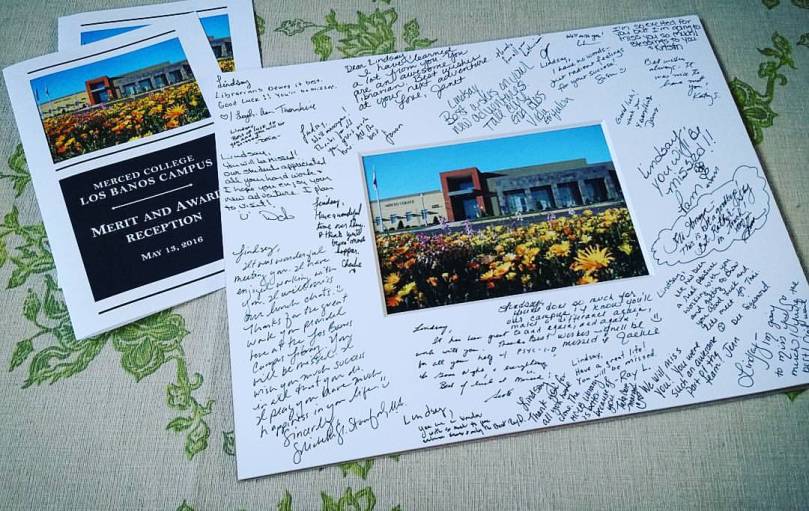
Last Friday was my last campus faculty meeting for the school year and Los Banos Campus‘ Merit and Awards Ceremony. A couple of weeks before the official Merced College graduation ceremony, we honor Los Banos students who are graduating (this was my second and last year to read the names), scholarship recipients (I was on the committee in 2014/2015 and 2015/2016), and Student of the Month and Year winners (I was on the committee in 2014/2015 and 2015/2016). We also honor a staff member as the Los Banos Campus Classified Staff Member of the Year, and one of my good friends, our Student Services Assistant, won the well-deserved honor.

What I didn’t expect was a little going-away recognition. Our faculty lead presented me and a colleague who is moving to the main campus with lovely matted photos of the Los Banos with nice messages written by our colleagues on the mat. We have wonderful staff and faculty members in Los Banos. I am going to miss this tight-knit team. I will definitely be hanging this in my new office.

13247739_10156851688430573_1598678304595753724_o

But it’s not goodbye quite yet. We still have graduation at the end of the month where I will don my Masters hood one last time with my colleagues as we celebrate our students’ successes. I’ve had months to process my move, but I think I’m going to need waterproof mascara.

Citation Tools

A while back, one of my friends from college who now teaches writing where we went to school together sent me a message about a little debate in a writing instruction-related listserv about how university libraries always seem to market citation tools to students, making students become dependent on machines to do the work for them. This is an advertising tactic, but the workshop the library is putting on might actually show students how these tools aren’t 100 percent accurate. This was pretty much what he thought was likely but wanted to see what I thought. I do support these tools when used appropriately. The reality is that a lot of our students do find and use these tools on their own; I might as well give them some pointers.

In instruction sessions, I point out citation tool features in databases, but I always comment that the citations aren’t to be taken at face value. I usually do an example and ask students to point out what is incorrect in hopes that they remember that it isn’t always right. I do support using the tools in order to save time —students can copy-paste and correct by looking at their writer’s guides, which often have sections on citing in APA and MLA; the APA or MLA handbooks; Library handouts; Library LibGuides on APA and MLA; or even by googling Purdue OWL’s APA or MLA Formatting Guides. I even have Purdue OWL linked on my LibGuides for APA and MLA. I also have other citation tools listed in those online guides with a note indicating that these tools are not perfect.

I went on to tell my friend, “Ain’t no one just telling them to use the tools point blank.”

Well, I was wrong. Recently, someone in an academic library listserv was complaining that EBSCOhost needs to get its act together to fix the problems in their citation tool feature because the “nice librarian is telling students to use the feature, and students are getting points marked off.”

I’m just going to say it. You are not doing your job if you are simply telling students to use these tools. That was the gist of the feeling among the people who did a reply-all response. No tool is going to be perfect, but it’s not difficult to live in the happy place I’ve described above. There is so much help available to double-check citations, and if points off is what is going to motivate students to learn or at least take the time to check, so be it. The other challenge is that students, who do seem to understand why we cite, at least when I’ve asked students in class, don’t seem know why there are different styles or why they must be so precise when using a particular format. There needs to be a much deeper conversation, and I am sure this does happen in research instruction and writing instruction courses. It’s just part of getting students familiar with academic culture.

With that said, librarians, what are your favorite tools to help students cite or keep track of citations? While I only list links on my LibGuides to free tools (again, with a word of caution), here are some free and fee-based tools that I know about, though the only one I personally use is Zotero. Diigo does look really interesting, so it may be one I try out for myself. The last citation builder I played with is North Carolina State University Libraries’ Citation Builder.

BibMe

Citation Builder

Cite This for Me

Diigo

EasyBib

KnightCite

Mendeley

NoodleTools

Perrla

RefMe

RefWorks

Son of Citation Machine

Zotero


Local History

I had an epic struggle choosing a major when I was in college. I started off  as a sociology major, then social science (sociology, history, and criminal justice), but all the while I was also taking English classes. Eventually, I realized having essentially three minors as a social science major was probably not the best idea. At the end of the day, how I decided to mark the paperwork as history is that I had one more class done than in English. The reality is that I thought everything was interesting–no wonder LIS was so appealing!

However, before library school, I was in a history MA program for a week…until I found out I’d be able to go to library school. Ultimately, I think I would have stayed on if I had found my little history niche. I was surrounded by people who were really into specific areas–Latin American protest art, Civil War, etc. It’s only now that I have worked in public and college libraries that I realize my little history place is actually local history, and I think it’s more because I know it can be a big challenge to actually do effective history research at the local level. There is so much that is forgotten or boxed up. (Recently, I read a really neat article by history professor Peter Knupfer and his experience in developing and guiding students through a project-centered study on a nearby community’s grapple with desegregation; students in his class were able to appreciate that local history research is difficult because the sources are not readily available.  A service-learning style project like this would be such a cool way to apply the Framework, don’t you think? My librarian heart swoons at the possibilities.)

In the summer of 2009, I volunteered at the Merced County Courthouse Museum and at the UC Merced Library. At the museum, I researched the building of the Japanese Assembly Center during World War II in Merced. My research was used in a documentary called Merced Assembly Center: Injustice Immortalized and in the Densho Encyclopedia. Here is a Merced Sun-Star article that references my research. I also wrote an article eliciting more information from the community in the Merced County Courthouse Museum’s column in the Merced Sun-Star, but there isn’t a digital copy–this is another difficult thing about small local papers and doing local history research. (Speaking of UC Merced and hidden collections, I discovered that UC’s Calisphere collections contain WWII Japanase American Assembly Center newsletters and the beginnings of a Merced Local History collection. Pretty cool!)

While writing up the laundry list of stuff for the new librarian coming on board to know, I began drafting a section about things I didn’t get a chance to do but would have loved to see through at the Los Banos Campus Library at Merced College. One of the things I really wanted to do was create a local history area. Here’s a little write up from American Libraries magazine, “What To Collect?,” from last summer that outlines the kinds of resources a public library might think about collecting to create a Local History Reference Collection (LHRC).

At the Los Banos Campus Library, there is a mishmash of items in the 300s, 500s, 900s, and in reference that deal with Los Banos and Merced County, but I would love for these things to be housed together. I have asked off and on for approval to do this from the main library, but I haven’t ever gotten an answer to any requests. Honestly, it just requires us to make changes in the catalog for location and call number–all we need to do is put a letter in front, like we have R for reference–and redo a few stickers. We don’t have tons and tons since we’re such a small library. The question is what letter should go in front? SC for special collections? LR for local reference? LHRC is just way too long.

Another thing related to this would be to work with the public library and the little local museum to compile some kind of pathfinder for researching local history. The museum is barely functional from what I understand (I never got a chance to visit–working and living in different counties is rough), so I am pretty curious what kind of resources are housed there.

Aerial view of Merced Assembly Center, California, c. 1942. (2015, July 17). Densho Encyclopedia. Retrieved May 5, 2016 from http://encyclopedia.densho.org/sources/en-denshopd-i224-00004-1/

Knupfer, P. Consultants in the classroom: Student/teacher collaborations in community history. The Journal of American History, 99(4), 1161-1175. doi:10.1093/jahist/jas602


Tablets Pt. 2

An update on that tablet project I mentioned back in the fall.

Back in September, I found out I had one week to submit paperwork for a grant offered through student equity funding. I had planned to do a survey about our students’ technology usage in order to make some mobile technology recommendations to my dean, but I had to scrap the whole plan with the unexpected deadline and opportunity.We initially received 33 percent of the funds for 36 Microsoft Surface Pro 3s (at the time, this was the college approved tablet) and a charge cart. However, a little later, the Library received funding for all 36 tablets. The tablets are mostly for library instruction since we don’t have an instructional space, but we decided to circulate 5-10 for in-house use when not being used in the classroom.

We finally got everything delivered at the very end of 2015/beginning of 2016, but, long story short, we just started checking out a few this last week. I am bummed I wasn’t able to use them for instruction. I am also sad that I won’t be seeing this project through since I am heading to a new job in June.

With all the delays and my exit timeline, I forgot all about apps. One of the part-time librarians recently reminded me about apps after I sent her a Storify summary of a Twitter chat about tablets by ACRL’s Instruction Section’s Instructional Technologies Committee. Here’s the accompanying Winter 2016 edition of the Instructional Technologies’ Tips and Trends newsletter. Back when I used to do butcher paper posters in the hallway outside the Library doors with questions for students to respond to on Post-It notes, one of the questions I asked was about apps students use to help them with their work. I didn’t get much of a response, though. After this email conversation, I remembered that I had saved a really cool idea that could be modified a bit to figure out what sorts of free apps might be added to the Surface Pros. It really needs to be guided by our students (we really need a student advisory committee!). In 2014, there was a message in the collib-l listserv from a librarian named Beth Johns about a drop-in workshop she and a colleague did about apps.

One of my colleagues and I experimented with a drop in workshop for students last February. It was called “Sips, Snacks and Apps” and was designed as a “sharing” workshop–the plan was to share information on mobile apps that have an academic purpose (such as library database apps) with students and find out what they use in their academic life.

We didn’t get a huge turnout, but some students were coaxed into attending and thanks to one of our student workers who also wrote for the student newspaper, we had a short article published on the event. Snacks included coffee, tea and lemonade to drink and cookies to eat. We held it in a group study room, but when we do it again (planning for the fall!) we want to hold it in a more public place. This room was not a good location–kind of hidden in the library. I think we will hold it near the library entrance next time. The few who attended, including one faculty member, seemed to enjoy it. It was more about building relationships than the topic of mobile apps. I’ve attached a pdf of one of the flyers.

With this particular topic, it seems that students at our school are not yet using library or academic apps (unless they are just not telling us what they use), but we did find out that those with iPhones sometimes use Siri to figure out alternative keywords when they are researching something, so that was helpful and interesting!

I mentioned to our part-time librarian that what we could do is come up with our own list of apps that work with Windows, and then see what students want from that master list, as well as look into others that are suggested. If were going to stay, I would set up a student advisory committee that includes our student workers and other students. With less than a month left until I leave my job, I do plan to add this tidbit to the notes I’m leaving for the new librarian.

Documenting the Future (& Past)

As of yesterday, I have exactly one month before I leave Merced College, and I have started preparing for the new librarian who will be making the Los Banos Campus Library his or her new work home. (Here is the job ad for the position I am leaving, by the way.)

Last summer, Meredith Farkas’ American Libraries column was about what to do to ensure your projects continue after you’ve left a position, “Future-Proof Your Project.” Documentation is so important when leaving a job. When I got my position, documentation wasn’t necessary because my predecessor (and librarian mentor) was switching to the other campus, so I could easily call to ask questions. I have been working on a Word document that is simply a list of things to know: a little library history, accounts to get set up (LibGuides, Text-a-Librarian, Sirsi Workflows, etc.), collection needs and procedures, things I worked on and things I still wanted to do, etc. I also have a message about how important it is for him or her to make the library his or her own; I have my strengths, and the new person will have other strengths. I also included my personal email and cell phone number. I have nine single-spaced pages so far.

I added the librarians at the other campus as co-owners to all of my LibGuides, so they can share those with the new librarian. I got rid of paper and digital files the new librarian won’t need and re-organized the file drawers.  Our campus has a shared drive, so I am updating the Library folder in there, too, with various folders for electronic copies of handouts, important forms, instruction calendars, and other things I mention in the Word document I am writing up.

I switched all my listserv subscriptions to my Gmail, started forwarding a few emails, and boxed up the things to take home, including a binder full of flyers I made over the last few years for displays, events, and contests.

13072919_10156770974445573_4293123233050030986_o

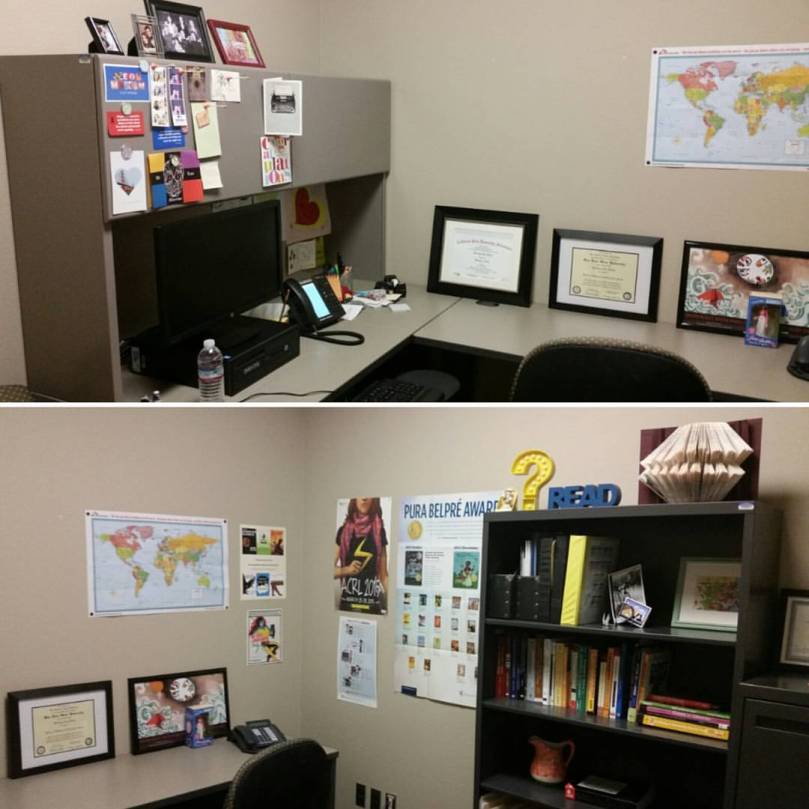
I also started cleaning out my office.

13071947_10156783673190573_7654611409594775529_o

Doing these things has also helped me realize that I was able to accomplish some good things in the three years I was full-time in Los Banos. Ultimately, I am glad I was able to be an energizing force on our small campus. Their librarian wasn’t a shushing, stern type. I was able to make small steps to get a more user-centered space. Culture is the hardest thing to shape, but I made progress. I was able to have some fun displays, contests, and activities, including Game Nights. Through these and other communication efforts, the faculty and student groups began to see and use the library as a campus hub. Our student government even had a campus suggestion box in the Library at one point. And let’s not forget about the food pantry! I feel great that the faculty and staff knew they could count on the Library to help, in both instructional and non-instructional efforts. I was able to build solid relationships in our campus community.

And the students knew they could count on me, too. To quote one of the student comments on my evaluation this year, “Definitely not the crusty old librarian stereotype.” I feel really good about that.