Goodbye Pt. 1

Last Friday was my last campus faculty meeting for the school year and Los Banos Campus‘ Merit and Awards Ceremony. A couple of weeks before the official Merced College graduation ceremony, we honor Los Banos students who are graduating (this was my second and last year to read the names), scholarship recipients (I was on the committee in 2014/2015 and 2015/2016), and Student of the Month and Year winners (I was on the committee in 2014/2015 and 2015/2016). We also honor a staff member as the Los Banos Campus Classified Staff Member of the Year, and one of my good friends, our Student Services Assistant, won the well-deserved honor.

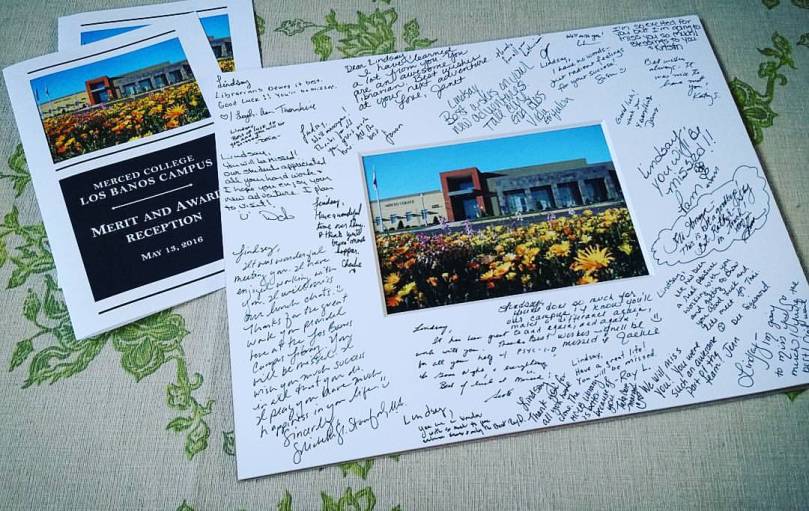
What I didn’t expect was a little going-away recognition. Our faculty lead presented me and a colleague who is moving to the main campus with lovely matted photos of the Los Banos with nice messages written by our colleagues on the mat. We have wonderful staff and faculty members in Los Banos. I am going to miss this tight-knit team. I will definitely be hanging this in my new office.

13247739_10156851688430573_1598678304595753724_o

But it’s not goodbye quite yet. We still have graduation at the end of the month where I will don my Masters hood one last time with my colleagues as we celebrate our students’ successes. I’ve had months to process my move, but I think I’m going to need waterproof mascara.

Evaluating Infographics

I subscribe to communications from the Online Learning Consortium, and a couple of weeks ago, they sent out an infographic about the state of online education. Since I’m interested in online learning (I did my MLIS online, and I have taken a class on teaching online), I took a look at it, and I was surprised that the infographic indicated that 75 percent of undergraduates are age 25 or older. Right now I work at a community college library in Central California, and we have a ton of nontraditional students, but the number of students age 25 and older is 35.6 percent; statewide, the number of community college students who are age 25 or older is 42.9 percent. The 75 percent figure that all undergraduates in the country are nontraditional as claimed by OLC seemed wrong to me. 75 percent?! [Although, I did discover that, according to Choy (2002), if a more broad definition of nontraditional is used, this figure is estimated at 73 percent.]

I seem to be helping a lot of students with fact-checking specific statistics lately.  Thankfully, I can point students to resources like the National Center of Education Statistics (NCES) data, but statistics aren’t easy to look through or interpret, demonstrated by my experience analyzing the infographic.

OLC cited sources at the very bottom of the infographic, but it’s not clear which source goes to which fact. I dug into every single link to try to figure out where this 75 percent thing came from, but I was a little overwhelmed because I am not drawn to charts, lines, and numbers (data scientists and data science/statistics librarians, I bow down). I also recruited the librarians at the other campus to help me, and one of them wrote back to me that they had over-simplified the information as the education statistics are divided by type of college. Here’s what the National Center for Education Statistics’ Characteristics of Postsecondary Students information actually says:

In 2013, a higher percentage of full-time undergraduate students at public and private nonprofit 4-year institutions were young adults (i.e., under the age of 25) than at comparable 2-year institutions. At public and private nonprofit 4-year institutions, most of the full-time undergraduates (88 and 86 percent, respectively) were young adults. At private for-profit 4-year institutions, however, just 30 percent of full-time students were young adults (39 percent were ages 25–34, and 31 percent were age 35 and older).

Not cool OLC.

Evaluating, analyzing, and interpreting information, whether in text, numbers, or images is such an important skill, not just for school purposes; it’s a life skill. One of my good friends who teaches English shared Sheida White’s article “Seven Sets of Evidence-Based Skills for Successful Literacy Performance” (2011) from the now defunct Adult Basic Education and Literacy Journal. In the article, which is based on her book Understanding Adult Functional Literacy: Connecting Text Features, Task Demands, and Respondent Skills (2011), she lists seven skills that are needed for “adolescents and adults to meet the literacy demands of education, work, citizenship, and daily life,” which include text search skills, inferential skills, language comprehension skills, basic reading skills, computation identification skills, computation performance skills, and application skills (p. 40). White writes:

…[S]econdary, post-secondary, and adult education programs typically do not provide explicit classroom instruction in the quantitative literacy skills needed to work with numbers embedded in prose and document texts. In fact, mathematical information is often stripped away from any surrounding authentic texts in schools to produce a cleaner measure of students’ skills in mathematics as a separate domain. This approach, does not reflect the way adolescents and adults typically encounter quantitative problems in their daily lives, including workplaces. (p. 47)

This article changed the way my friend taught her courses. Like many English and communication teachers, she has an assignment where she has students evaluate an advertisement for modes of persuasion, but she started adding in-class assignments where students had to breakdown a passage with numbers to build their own chart. She also has them analyze charts and write down what they think the chart is showing. This was a hard task for some of her lower level students. She and I dreamed of creating a learning community between English, math, and the library resources class (I have never taught it, and we were planning to offer it in Spring 2017, but I’m leaving) to work on some of these and other literacies. (See Jacobson and Mackey’s presentation from ACRL 2013 on metaliteracy and the Metaliteracy blog).

I often think about the assignments I might give if I taught information literacy in a credit class environment. I love the idea of evaluating an infographic or looking at and interpreting a chart. So far, Project CORA doesn’t have an assignment on evaluating infographics but rather has an assignment on designing infographics, but I will do a little more digging elsewhere later. Brain Pickings recently had an article about the new book Jane Jacobs: The Last Interview and Other Conversations, where Jacobs is quoted as saying:

If I were running a school, I’d have one standing assignment that would begin in the first grade and go on all through school, every week: that each child should bring in something said by an authority — it could be by the teacher, or something they see in print, but something that they don’t agree with — and refute it.

I think with some modification a weekly statistics-checking exercise done in PolitiFact (the editor has a Masters in journalism and a Masters in Library and Information Science) fashion might be fun. I know the perfect infographic to start with. 😉

Choy, S. (2002). Nontraditional undergraduates. Retrieved from http://nces.ed.gov/pubs2002/2002012.pdf

Jacobson, T.E., & Mackey, T. (2013). What’s in a name? Information literacy, metaliteracy, or transliteracy? [SlideShare slides]. Retrieved from http://www.slideshare.net/tmackey/acrl-2013

National Center of Education Statistics. (2015, May). The condition of education: Characteristics of postsecondary students. Retrieved from https://nces.ed.gov/programs/coe/indicator_csb.asp

Online Learning Consortium. (2016). 2016 higher education online learning landscape. Retrieved from http://info2.onlinelearningconsortium.org/rs/897-CSM-305/images/OLC2016ONLINELEARNINGIMPERATIVEINFOGRAPHIC.pdf

Popova, M. (2016, May 4). Urbanism patron saint Jane Jacobs on our civic duty in cultivating cities that foster a creative life [Weblog]. Retrieved from https://www.brainpickings.org/2016/05/04/jane-jacobs-last-interview/

White, S. (2011). Seven sets of evidence-based skills for successful literacy performance. Adult Basic Education and Literacy Journal, 5(1), 38-48. Retrieved from http://eric.ed.gov/?id=EJ918178
Citation Tools

A while back, one of my friends from college who now teaches writing where we went to school together sent me a message about a little debate in a writing instruction-related listserv about how university libraries always seem to market citation tools to students, making students become dependent on machines to do the work for them. This is an advertising tactic, but the workshop the library is putting on might actually show students how these tools aren’t 100 percent accurate. This was pretty much what he thought was likely but wanted to see what I thought. I do support these tools when used appropriately. The reality is that a lot of our students do find and use these tools on their own; I might as well give them some pointers.

In instruction sessions, I point out citation tool features in databases, but I always comment that the citations aren’t to be taken at face value. I usually do an example and ask students to point out what is incorrect in hopes that they remember that it isn’t always right. I do support using the tools in order to save time —students can copy-paste and correct by looking at their writer’s guides, which often have sections on citing in APA and MLA; the APA or MLA handbooks; Library handouts; Library LibGuides on APA and MLA; or even by googling Purdue OWL’s APA or MLA Formatting Guides. I even have Purdue OWL linked on my LibGuides for APA and MLA. I also have other citation tools listed in those online guides with a note indicating that these tools are not perfect.

I went on to tell my friend, “Ain’t no one just telling them to use the tools point blank.”

Well, I was wrong. Recently, someone in an academic library listserv was complaining that EBSCOhost needs to get its act together to fix the problems in their citation tool feature because the “nice librarian is telling students to use the feature, and students are getting points marked off.”

I’m just going to say it. You are not doing your job if you are simply telling students to use these tools. That was the gist of the feeling among the people who did a reply-all response. No tool is going to be perfect, but it’s not difficult to live in the happy place I’ve described above. There is so much help available to double-check citations, and if points off is what is going to motivate students to learn or at least take the time to check, so be it. The other challenge is that students, who do seem to understand why we cite, at least when I’ve asked students in class, don’t seem know why there are different styles or why they must be so precise when using a particular format. There needs to be a much deeper conversation, and I am sure this does happen in research instruction and writing instruction courses. It’s just part of getting students familiar with academic culture.

With that said, librarians, what are your favorite tools to help students cite or keep track of citations? While I only list links on my LibGuides to free tools (again, with a word of caution), here are some free and fee-based tools that I know about, though the only one I personally use is Zotero. Diigo does look really interesting, so it may be one I try out for myself. The last citation builder I played with is North Carolina State University Libraries’ Citation Builder.

BibMe

Citation Builder

Cite This for Me

Diigo

EasyBib

KnightCite

Mendeley

NoodleTools

Perrla

RefMe

RefWorks

Son of Citation Machine

Zotero


Local History

I had an epic struggle choosing a major when I was in college. I started off  as a sociology major, then social science (sociology, history, and criminal justice), but all the while I was also taking English classes. Eventually, I realized having essentially three minors as a social science major was probably not the best idea. At the end of the day, how I decided to mark the paperwork as history is that I had one more class done than in English. The reality is that I thought everything was interesting–no wonder LIS was so appealing!

However, before library school, I was in a history MA program for a week…until I found out I’d be able to go to library school. Ultimately, I think I would have stayed on if I had found my little history niche. I was surrounded by people who were really into specific areas–Latin American protest art, Civil War, etc. It’s only now that I have worked in public and college libraries that I realize my little history place is actually local history, and I think it’s more because I know it can be a big challenge to actually do effective history research at the local level. There is so much that is forgotten or boxed up. (Recently, I read a really neat article by history professor Peter Knupfer and his experience in developing and guiding students through a project-centered study on a nearby community’s grapple with desegregation; students in his class were able to appreciate that local history research is difficult because the sources are not readily available.  A service-learning style project like this would be such a cool way to apply the Framework, don’t you think? My librarian heart swoons at the possibilities.)

In the summer of 2009, I volunteered at the Merced County Courthouse Museum and at the UC Merced Library. At the museum, I researched the building of the Japanese Assembly Center during World War II in Merced. My research was used in a documentary called Merced Assembly Center: Injustice Immortalized and in the Densho Encyclopedia. Here is a Merced Sun-Star article that references my research. I also wrote an article eliciting more information from the community in the Merced County Courthouse Museum’s column in the Merced Sun-Star, but there isn’t a digital copy–this is another difficult thing about small local papers and doing local history research. (Speaking of UC Merced and hidden collections, I discovered that UC’s Calisphere collections contain WWII Japanase American Assembly Center newsletters and the beginnings of a Merced Local History collection. Pretty cool!)

While writing up the laundry list of stuff for the new librarian coming on board to know, I began drafting a section about things I didn’t get a chance to do but would have loved to see through at the Los Banos Campus Library at Merced College. One of the things I really wanted to do was create a local history area. Here’s a little write up from American Libraries magazine, “What To Collect?,” from last summer that outlines the kinds of resources a public library might think about collecting to create a Local History Reference Collection (LHRC).

At the Los Banos Campus Library, there is a mishmash of items in the 300s, 500s, 900s, and in reference that deal with Los Banos and Merced County, but I would love for these things to be housed together. I have asked off and on for approval to do this from the main library, but I haven’t ever gotten an answer to any requests. Honestly, it just requires us to make changes in the catalog for location and call number–all we need to do is put a letter in front, like we have R for reference–and redo a few stickers. We don’t have tons and tons since we’re such a small library. The question is what letter should go in front? SC for special collections? LR for local reference? LHRC is just way too long.

Another thing related to this would be to work with the public library and the little local museum to compile some kind of pathfinder for researching local history. The museum is barely functional from what I understand (I never got a chance to visit–working and living in different counties is rough), so I am pretty curious what kind of resources are housed there.

Aerial view of Merced Assembly Center, California, c. 1942. (2015, July 17). Densho Encyclopedia. Retrieved May 5, 2016 from http://encyclopedia.densho.org/sources/en-denshopd-i224-00004-1/

Knupfer, P. Consultants in the classroom: Student/teacher collaborations in community history. The Journal of American History, 99(4), 1161-1175. doi:10.1093/jahist/jas602


Tablets Pt. 2

An update on that tablet project I mentioned back in the fall.

Back in September, I found out I had one week to submit paperwork for a grant offered through student equity funding. I had planned to do a survey about our students’ technology usage in order to make some mobile technology recommendations to my dean, but I had to scrap the whole plan with the unexpected deadline and opportunity.We initially received 33 percent of the funds for 36 Microsoft Surface Pro 3s (at the time, this was the college approved tablet) and a charge cart. However, a little later, the Library received funding for all 36 tablets. The tablets are mostly for library instruction since we don’t have an instructional space, but we decided to circulate 5-10 for in-house use when not being used in the classroom.

We finally got everything delivered at the very end of 2015/beginning of 2016, but, long story short, we just started checking out a few this last week. I am bummed I wasn’t able to use them for instruction. I am also sad that I won’t be seeing this project through since I am heading to a new job in June.

With all the delays and my exit timeline, I forgot all about apps. One of the part-time librarians recently reminded me about apps after I sent her a Storify summary of a Twitter chat about tablets by ACRL’s Instruction Section’s Instructional Technologies Committee. Here’s the accompanying Winter 2016 edition of the Instructional Technologies’ Tips and Trends newsletter. Back when I used to do butcher paper posters in the hallway outside the Library doors with questions for students to respond to on Post-It notes, one of the questions I asked was about apps students use to help them with their work. I didn’t get much of a response, though. After this email conversation, I remembered that I had saved a really cool idea that could be modified a bit to figure out what sorts of free apps might be added to the Surface Pros. It really needs to be guided by our students (we really need a student advisory committee!). In 2014, there was a message in the collib-l listserv from a librarian named Beth Johns about a drop-in workshop she and a colleague did about apps.

One of my colleagues and I experimented with a drop in workshop for students last February. It was called “Sips, Snacks and Apps” and was designed as a “sharing” workshop–the plan was to share information on mobile apps that have an academic purpose (such as library database apps) with students and find out what they use in their academic life.

We didn’t get a huge turnout, but some students were coaxed into attending and thanks to one of our student workers who also wrote for the student newspaper, we had a short article published on the event. Snacks included coffee, tea and lemonade to drink and cookies to eat. We held it in a group study room, but when we do it again (planning for the fall!) we want to hold it in a more public place. This room was not a good location–kind of hidden in the library. I think we will hold it near the library entrance next time. The few who attended, including one faculty member, seemed to enjoy it. It was more about building relationships than the topic of mobile apps. I’ve attached a pdf of one of the flyers.

With this particular topic, it seems that students at our school are not yet using library or academic apps (unless they are just not telling us what they use), but we did find out that those with iPhones sometimes use Siri to figure out alternative keywords when they are researching something, so that was helpful and interesting!

I mentioned to our part-time librarian that what we could do is come up with our own list of apps that work with Windows, and then see what students want from that master list, as well as look into others that are suggested. If were going to stay, I would set up a student advisory committee that includes our student workers and other students. With less than a month left until I leave my job, I do plan to add this tidbit to the notes I’m leaving for the new librarian.

Documenting the Future (& Past)

As of yesterday, I have exactly one month before I leave Merced College, and I have started preparing for the new librarian who will be making the Los Banos Campus Library his or her new work home. (Here is the job ad for the position I am leaving, by the way.)

Last summer, Meredith Farkas’ American Libraries column was about what to do to ensure your projects continue after you’ve left a position, “Future-Proof Your Project.” Documentation is so important when leaving a job. When I got my position, documentation wasn’t necessary because my predecessor (and librarian mentor) was switching to the other campus, so I could easily call to ask questions. I have been working on a Word document that is simply a list of things to know: a little library history, accounts to get set up (LibGuides, Text-a-Librarian, Sirsi Workflows, etc.), collection needs and procedures, things I worked on and things I still wanted to do, etc. I also have a message about how important it is for him or her to make the library his or her own; I have my strengths, and the new person will have other strengths. I also included my personal email and cell phone number. I have nine single-spaced pages so far.

I added the librarians at the other campus as co-owners to all of my LibGuides, so they can share those with the new librarian. I got rid of paper and digital files the new librarian won’t need and re-organized the file drawers.  Our campus has a shared drive, so I am updating the Library folder in there, too, with various folders for electronic copies of handouts, important forms, instruction calendars, and other things I mention in the Word document I am writing up.

I switched all my listserv subscriptions to my Gmail, started forwarding a few emails, and boxed up the things to take home, including a binder full of flyers I made over the last few years for displays, events, and contests.

13072919_10156770974445573_4293123233050030986_o

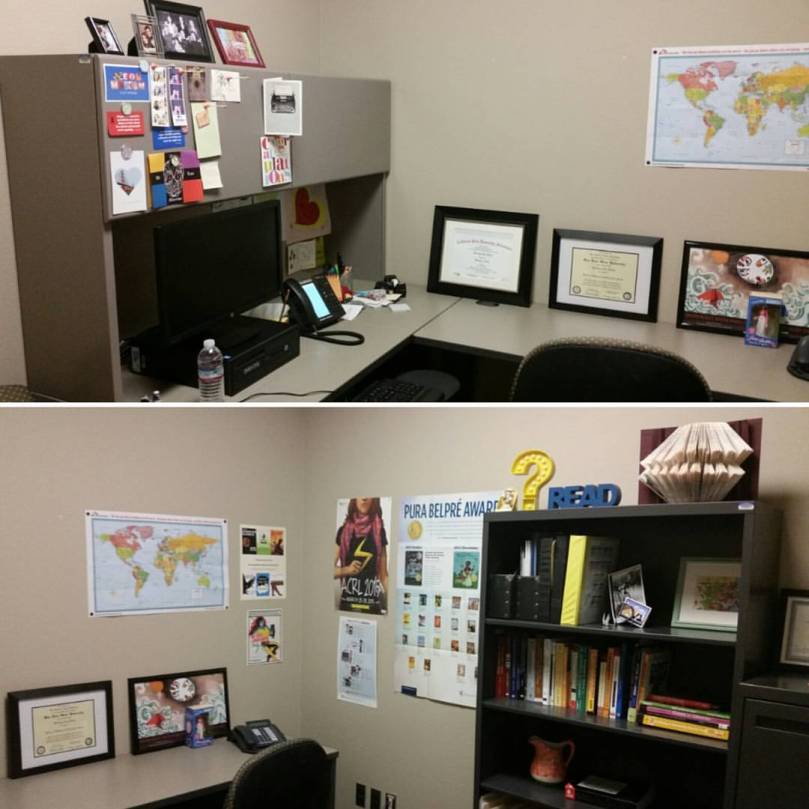
I also started cleaning out my office.

13071947_10156783673190573_7654611409594775529_o

Doing these things has also helped me realize that I was able to accomplish some good things in the three years I was full-time in Los Banos. Ultimately, I am glad I was able to be an energizing force on our small campus. Their librarian wasn’t a shushing, stern type. I was able to make small steps to get a more user-centered space. Culture is the hardest thing to shape, but I made progress. I was able to have some fun displays, contests, and activities, including Game Nights. Through these and other communication efforts, the faculty and student groups began to see and use the library as a campus hub. Our student government even had a campus suggestion box in the Library at one point. And let’s not forget about the food pantry! I feel great that the faculty and staff knew they could count on the Library to help, in both instructional and non-instructional efforts. I was able to build solid relationships in our campus community.

And the students knew they could count on me, too. To quote one of the student comments on my evaluation this year, “Definitely not the crusty old librarian stereotype.” I feel really good about that.

New Job!

Since I officially signed paperwork on Friday, I can share with the online world. (This actually is only partially true because I revealed on Facebook a few weeks ago.) I got a new job!

I’m the new instruction librarian at University of California Merced. I am really pleased to have a more specialized role and am looking forward to improving my instruction efforts. I start in June. I applied in October and interviewed in November and December. I informally accepted the offer right as winter break at Merced College, the community college where I currently work, ended. I am starting in June, so I can finish out the semester at the Los Banos Campus. I’m the only librarian during the day, so it was important for me to be here to get our students through the research rush in March and April.

Many people have asked me why I am leaving. There are some good things about my current job, but I’ve known for a couple of years that I was going to need to fill other desires I have for my career. The questions largely stem from the knowledge that I am leaving for a position where I will be working more for slightly less pay than what I make right now. I am leaving a 10-month tenure track faculty role for a 12-month non-faculty librarian position.

I do what I do because I want to help students on their educational path, but I also need to feel useful and that I am growing professionally. I will miss my librarian colleagues at the other campus and my colleagues in Los Banos, as well as assisting students from a variety of ages and experiences, but my personal happiness and growth are important. I am forever grateful to Merced College for giving me the opportunity to launch my professional career, first as an adjunct faculty member and then as a full-time faculty member, but it’s time for something new. I am nervous but excited.


Battery Recycling at the Library

It’s taken two years, but I am finally getting a battery recycling tube rolling in the library!

I had this idea back in 2014. I started working at my alma mater part-time in 2013, half a year before I got a full-time position at Merced College, and I noticed that they had a battery recycling tube. I asked about it, and they let me know that someone in the facilities department comes to collect it, as they handle recyclables. After my first full-time semester at the Los Banos Campus, I found out that this is exactly how it’s handled at the community college as well. I talked to our chemistry lab technician, who handles the batteries on our campus, and he was all for the library serving as a collection spot. However, I had issues trying to order the tube. Faculty in my community college district are allotted $200ish every year for supplies, so this is coming from that account. It would have been loads easier if I had just bought it myself and then gotten reimbursed, but I didn’t really want to do that.  The battery recycling idea just kind of sunk for a while, and then when I wanted to inquire again, our technician got a new job.

Because of the upcoming changes in my work life, this term I am focusing on finishing projects, not starting new ones, but just as I was about to hit the delete button on the old emails, I thought I should at least try one more time. I talked to our new chemistry lab technician, and she was all for it. Initially, I wanted to order this. The purchasing department recommended some cheaper, smaller tins, but once they found out what I was trying to do, they suggested this, which is similar to what I wanted but with handles! Kudos to all! I am pleased to check that off another small project during my time at the little library.

When I started, we didn’t even have paper recycling! During that first semester, I got a big bin for the faculty/staff end in the library and one for students. The students took right to it. I’m hoping the battery recycling goes equally as well.


December 2015 & January 2016 Library Displays

The last day of the fall semester was December 18th, and the spring semester started on January 19th, the day after Martin Luther King, Jr.’s birthday.

I don’t really have a whole lot of time in December as students are hurriedly finishing final papers. Our library media technician pulled some winter and holiday items out for a quick display, which always stresses me because we don’t have a whole lot of variety when it comes to holidays. I always forget to have the main library order me some children’s titles about Hannukah, Kwanzaa, and Ramadan, and I vow to ask by the end of today. We have a part-time child development instructor at our site, so we have a small children’s collection specifically for an assignment involving multiculturalism. As someone who worked as a bilingual (Spanish/English) library assistant in the children’s department at a public library, I desperately need to make this a priority before embarking on the next chapter in my library career (more on that soon). Because of those changes, my display game this term will be even simpler. I decided to forgo linking the titles in Smore and will just be posting photos.

Sure enough, I didn’t even have time to link the titles I used for the refugee display I had in December anyway. I was really pleased–people checked items out!

Refugees

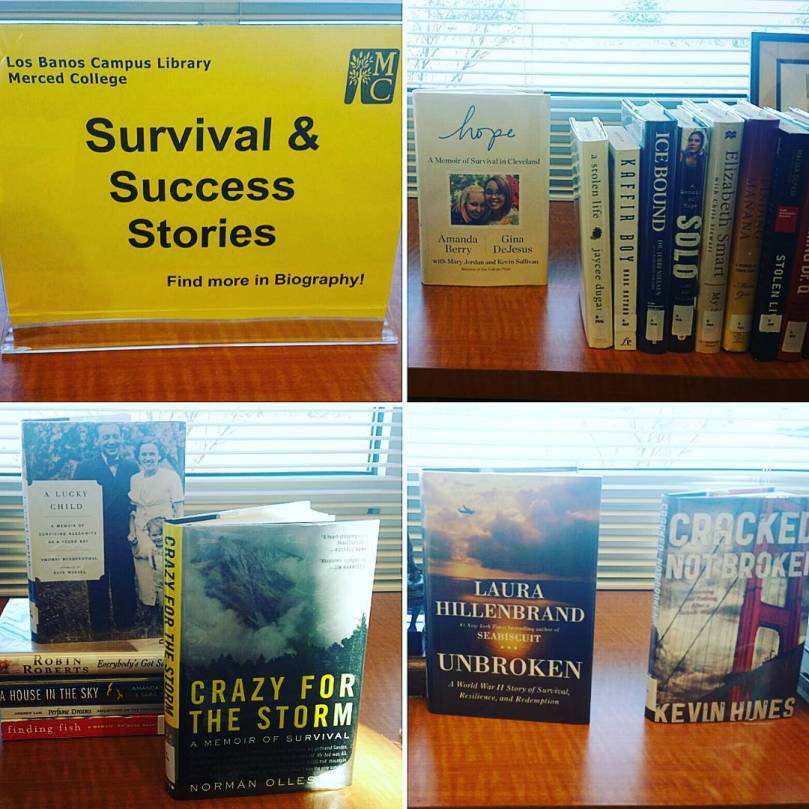
For the latter half of January, I had some Martin Luther King, Jr. books out, and I also highlighted some of our biographies (I did a little cleaning in this section, and I think I am done for now) about survival, failure, and success.

MLK

Survival


November 2015 Library Displays

So it’s February, but here are the displays I had up in November.

I love highlighting Native American Heritage Month. This year, I focused on items that relate to California and CA’s Central Valley.

Native American Heritage Month

Although I am Mexican-American, Día de los Muertos is not something my family does, mostly because my mom’s side is not Catholic. I really enjoy how much interest develops around the display. Here’s the online display, which I especially like. I re-used last year’s Día de los Muertos sign. One of the evening librarians made the tissue paper flowers during Hispanic Heritage Month, so I re-used a few.

Dia de los Muertos

For Veterans Day, the library media bookstore technician (she is now full-time–the first full-time staff position our little library has ever had!) re-used a banner we had last year for people to honor those who have served in the military. It’s blue butcher paper with white stars attached. People are encouraged to write in a veteran’s name with markers i leave on the windowsill. We put the banner in the hallway outside the library. The technician also put together the display we had inside the library. She also advertised the city’s second annual Veterans Day parade.

Veterans Day

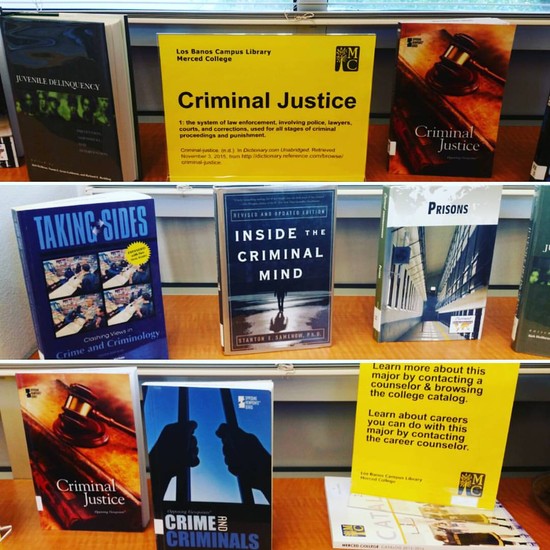
I had one Major Idea display about criminal justice (you can read more about this display series in my August 2015 Library Displays post). I stopped doing this series in November because the space I was using is where I moved our children’s and young adult section. Our history section is out of control, and it was getting way too full, so I moved things around to create room before tackling the 900s this semester.

Criminal Justice