Libraries sometimes get a lot of negative beef when it comes to getting rid of books. This isn’t done haphazardly. It’s part of our jobs to make room for newer materials and changing tastes based on demographics. In the case of a small community college campus, some years, it seems like all the writing courses are focused on food politics. Other semesters, the hot topic is social media, terrorism, gangs, etc. Materials also become out of date. Every time I get a new copy of one of those Opposing Viewpoints books, I send back the oldest version to the main library to be discarded.
Libraries don’t have infinite room. Just like a closet, you need to clean out libraries to make room for classics, items that actually get used, items that are up to date, and new items. In libraries, we call this weeding. (The featured image on top includes a photo of books that were on our shelves that had seen better days.)
Collection management, I have learned, is not my favorite part of my job as a campus librarian. It’s a lot of work, and I don’t really have the right training to run reports on our integrated library system (ILS) to actually check when items were last checked out; I key in every book individually without a scanner (I need to ask the campus dean if we can buy one) to find out those statistics.
This year, to help me in the weeding process, I created weeding slips.
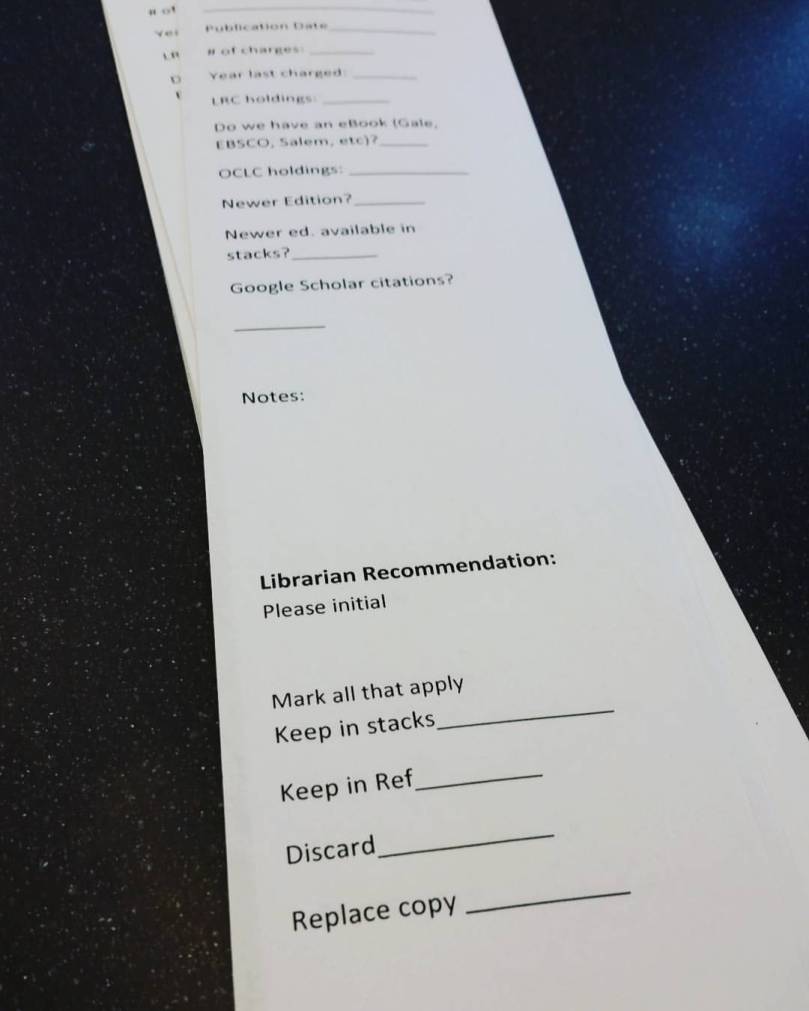
They are based on the slips used by librarians at California State University Stanislaus, my undergraduate alma mater. (In addition to my full-time job, I also work at CSU Stanislaus one or two Sundays a month during the academic year.) The slips come in handy because I can fill out all the necessary criteria I need in order to send books to the main library for possible deselection. The librarians at the main library take a look at the notes on the slips, and the collection development officer, the library director (not my boss), makes the final decision. These is also a section on the slip where I indicate whether or not the main library has a copy of what I am sending, which also helps their weeding process. When they weed books, they also check to see if our campus has a copy. It’s been an effective system thus far.
Part of the weeding process also includes inviting faculty in the specific discipline to look over the items for potential weeding. I don’t get a lot traction on that front, so I do a two-week call. If no one comes, I send them on to the main library.
I weeded certain areas this fall, but the true masterpiece was the fiction section. Here is the before and after. I forgot to take a photo of the fiction section before I started weeding, but the photo on top is the biography section, which looks very similar to what fiction looked like before the weeding process. Now imagine both sides of the bookcase looking like the bottom photo. We now have breathing room!

With the new empty space, my plan is to put just a few books face-out on the shelves, like in bookstores. I do a lot of displays along the outer edge of the library, on our lower reference shelves, and it does encourage some circulation, but I like the idea of displaying books directly on the circulating shelves. I have students who tell me they like to browse when I notice them at the shelves and check to see if the students need help finding something. Because of the browsing behavior, I plan to make some signs in our signature lemon yellow to advertise putting items on hold from the other campus. I also want to advertise the eBook app available through the county library system, as well as let students know that they can put items on hold from across the county library system to pick up at the local library (a lot of them are surprised when I tell them they have access to way more than what is physically available at the local library). I did a hug sign re-haul last year, but I want to experiment with putting a few signs face-out on the shelves.
I also plan to tackle the biography and 900s (geography and history) sections in the spring semester.
 Lindsay Ann Davis