Exciting News!

I have some really exciting news!

I just found out that my request for 36 Microsoft Surface Pro 3 tablets for my small library was funded, at 33 percent of the request, through Merced College’s student equity funds! $16,000! The dean of my campus, the Los Banos Campus, says the rest of the amount will be funded with other monies.

Why Microsoft Surface Pro 3? They are the district-approved tablets. Why 36? There is a really cool charging cart that fits 36 tablets.

The library at my campus doesn’t have a library instruction room like the other campus, and I often have to fit sessions around the computer labs that are scheduled for other classes. Often, I go to classrooms without any computers, so students don’t get to play with databases during library research sessions.

When the tablets aren’t in use for classes, students will be able to check them out to use in the library. We only have 17 computers available in the library for 1,800 students, and our statistics were around 18,000 computer uses for 2014-2015. This does not include statistics for the open computer lab across the hall.

The Student Equity committee for the college created a document of goals for both campuses, so part of the application for funding had to show how the proposed project helped meet those goals. I also incorporated how the project met the college’s strategic plan and institutional learning outcomes and how it fit with the goals of the Learning Resource Center’s program review and student learning outcomes. I think my request was also funded, in part, because it serves an instructional purpose. I included a lot of evidence in the document, and my dean was impressed with what I put together.

I have been on pins and needles waiting for a response from the committee. I am so pleased! If we go off of the timeline I created for the project, we will begin our tablet service in Spring 2016.

The start of my third full-time academic year has been fantastic! My three-year review process also begins this coming Tuesday, so I am feeling pretty good.

Participatory Culture & Vernacular Collections at the Library

I have a bad habit of collecting links through the save feature on Facebook. However, I seem to notice a penchant for public art. Consider this Colossal post about an artist who bought billboard and this NPR article about kids’ art taking over billboards in Times Square. I love members of communities being able to take part in their communities. Participatory culture is something I have been trying to cultivate in the community college library.

In Fall 2013, I did half of the Hyperlinked Library MOOC through San José State University, my MLIS alma mater. It allowed me to explore a little more about user experience, and it really got my excited about the possibilities for participatory culture in libraries. In one class discussion, I shared about the display space kids in the community are able to use to display collections of all kinds in the children’s department of the Stanislaus County Library (I worked as a bilingual Spanish/English library assistant in the children’s department for a couple of years). Kids ages 4 and up can sign up for either a display table or display case to show off rocks, soap, dolls, books, trains, cars, PEZ dispensers, LEGO creations, etc. The collections were very unique and customers of all ages love looking at new arrrivals. The collections stay in a locked case or table for two weeks. It truly is one of the coolest things that allow kids in our community to really feel that the library is theirs. (As it turns out, the idea of displaying everyday items is a thing. I did a little research, and these are called vernacular museums. I have to do a little more reading about them, but I did contact a professor from Pine Manor College about her work last year.)

I also think this idea would work well in even an academic library if locked displays cases are available. The University Library at my undergraduate alma mater, California State University Stanislaus, sort of has this with their Warrior Book Contest, which is essentially a topical bibliography students can submit. Winners can have some of their books put on display, and it’s always really interesting to see the winners’ lists and displays. I have a friend from college who won one year. I have tried a similar tactic to have individual students sign up to do book and online resource displays at the community college library, but it hasn’t worked out so far. We only have one student club on campus, so I am going to check with them this semester. But the idea of displaying collections doesn’t have to just be books and online resources. It could be action figures or Hello Kitty memorabilia. College can be fun.

Smore

I am obsessed with Smore. Smore is a fast way to make flyers and newsletters online. Last year, I started using Smore for our new book lists. (In the pre-Lindsay years, the library media technician and clerks sent out a typed list of titles in email–attached as a Word document. In my first year, I started sending out monthly email updates that included the hyperlinked titles of new books.) Recently, someone asked about newsletters on a library listserv, and I was able to share a book list as an example. I got some nice feedback on the one I shared there, which inspired me to do a library newsletter beyond book titles.

I didn’t do one before because every Tuesday, the faculty lead at our small campus sends out a newsletters called Tuesday Tidbits (it used to be the Monday Memo) in which different faculty members submit committee updates and other news. This first month, I had so much to update, I decided to do one giant newsletter rather than submit to Tuesday Tidbits. Now that I sent an initial newsletter, I probably will do the Tidbits route more often than our own newsletter.

In my last post about displays, I also talked about the new series I am doing called Major Idea. I post our displays to Facebook (Instagram is my next frontier) and in the faculty emails I send out,  but I also decided to put the materials I put on display in a hyperlinked list via Smore, sort of like a pathfinder. My giant library newsletter also links to the display materials lists for the Major Idea displays for psychology and art history and our Women’s Equality Day and water and drought displays.

I was pretty thrilled by the feedback I got from our newsletter. What I love about Smore is that it allows you to see how many views you get, too. Smore only allows you to make five flyers so free, but the educator account is just $60 a year. It is so worth it!

Psychology

August 2015 Library Displays

This isn’t anything mind blowing as far as libraries go, but I really believe in the power of displays in showcasing not only resources but also getting library users to discover a new topic or idea they might not think up on their own.

My library is two thousand square feet, and our campus serves about 1800 students. We don’t have a lot of space for displays, but I use all the nooks and crannies and sometimes a book cart parked by the research help desk. I mostly use the lower reference shelving underneath a giant window, which, unfortunately, is in the back of the library, but it’s closest to the main bank of study tables.

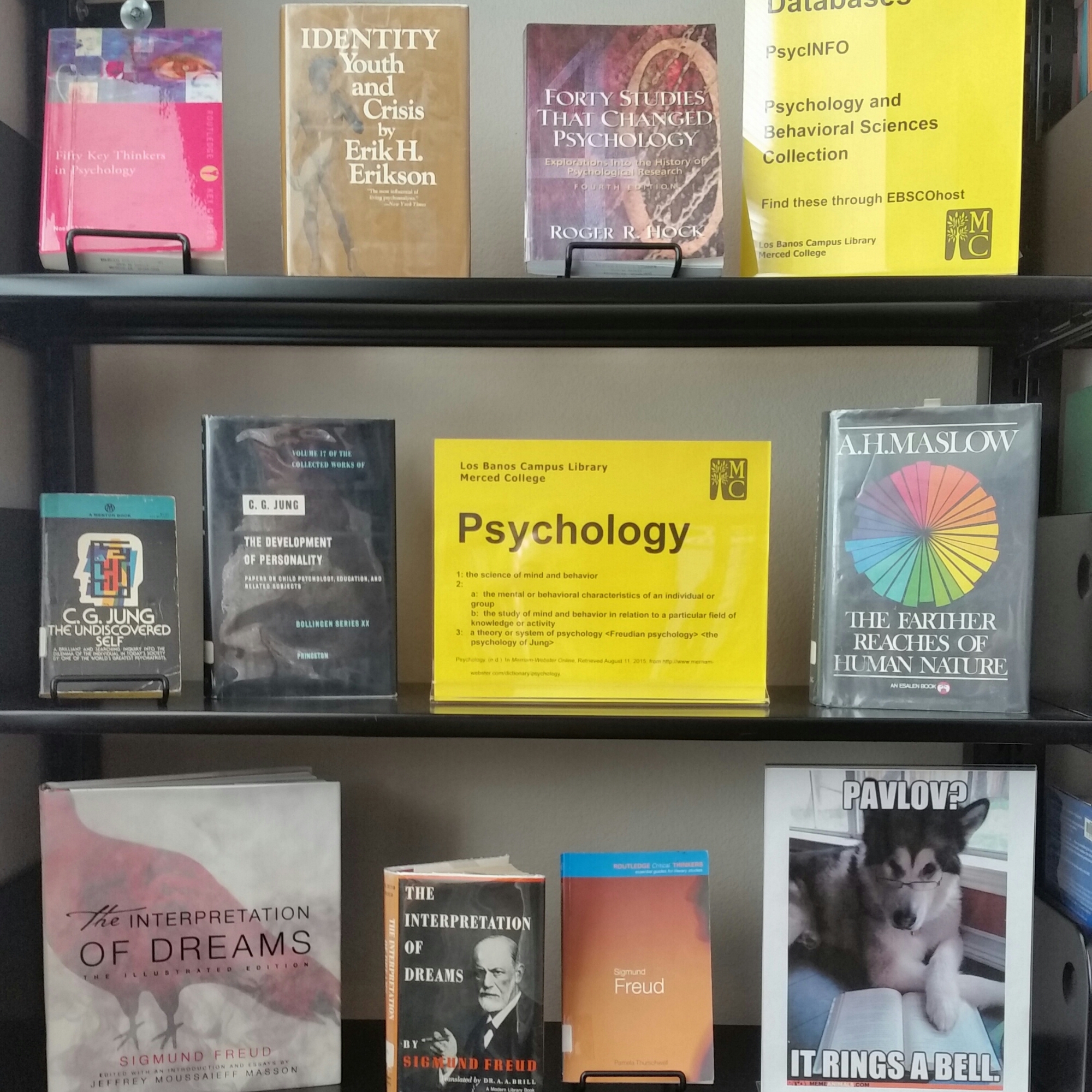
There is a section within the higher reference shelving I’ve carved out with shifting and weeding. It’s the space I have dubbed Major Idea in which I’ll be displaying books and databases related to a topic or idea within a major offered by the college. First up is psychology.

It’s not pictured, but I also am advertising the services offered by the academic counselors and our new career counselor for those interested in the psychology major and/or careers in psychology. I also have a college catalog on display. (When I went to check on the display the next day, the illustrated Interpretation of Dreams had been checked out! )

Psychology

August 18th was the 95th anniversary of the 19th Amendment of the U.S. Constitution. August 26th is Women’s Equality Day, which celebrates the 19th Amendment’s ratification.

Women's Equality Day

Since I snapped this photo, I’ve shuffled things around and also added resources about the Voting Rights Act of 1965. The Act banned racial discrimination in elections, which enfranchised more women and men of color, especially in the South. It’s an incomplete story without this bit of history.

Here is the online flyer for Women’s Equality Day and the Voting Rights Act of 1965.

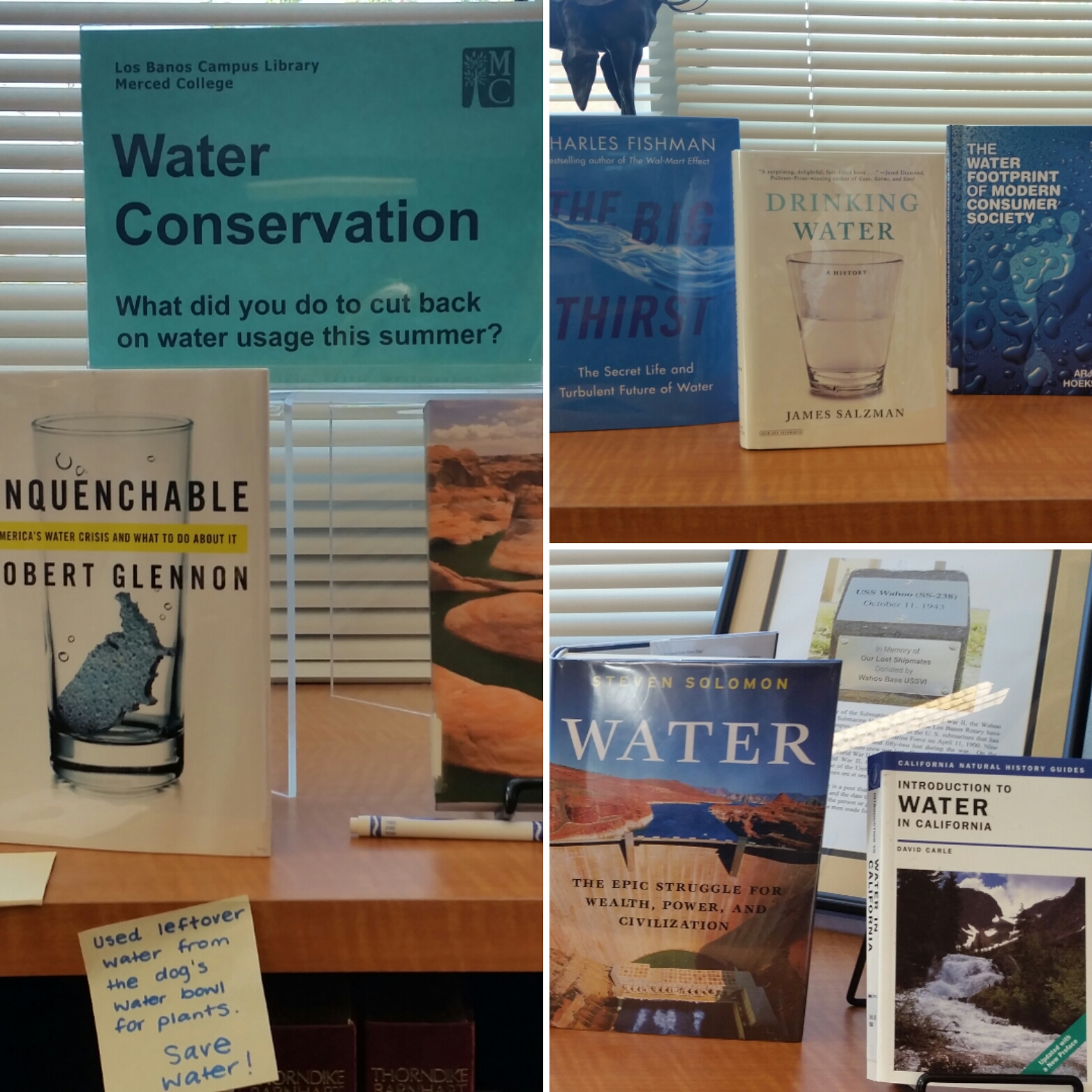
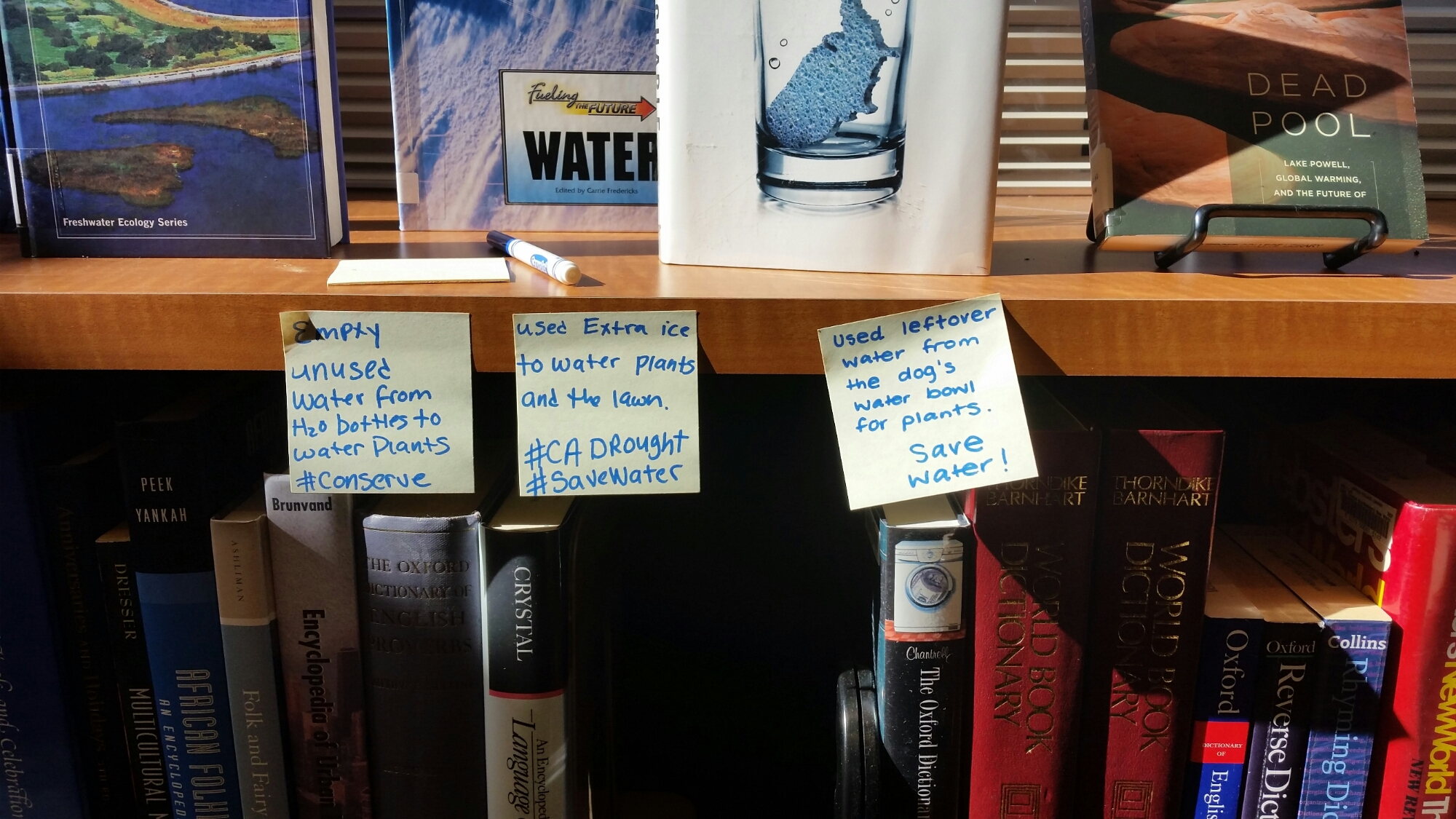
Since we’re in California’s Central Valley, drought has been ever-present the last few years. Both college campuses have brown lawns, and we’re proud! I put up a display about water and drought materials, a quick list of relevant websites and databases, and I incorporated some interactivity by asking how students cut back on water usage this summer. Since it’s in an awkward spot, I didn’t expect more answers beyond my own example on a Post-It, but I was pleasantly surprised.

Water Conservation Drought Websites Drought Ideas

This year, I’m going to see if I can get our student workers and staff to participate in some displays. Now that I have evening colleagues, I asked one of them if she’d like to do the Banned Books display this September. It’s always a fun one to do, but September is just really busy with many other events, displays, and information

Coloring Party and Other Ideas for Finals

During finals this year, I had coloring pages available. I only printed a few out the first day (some design I could download for free online), and the next day, one of the student assistants said I needed to print out way more because “people really like them.”

I have noticed an upswing in talk about the relaxing powers of coloring lately. Even NPR and Quartz have chimed in, and I think I remember seeing something on Huffington Post. It’s rare that I go to the local Barnes and Noble (I am a library user, after all), but I went a couple of days ago and was so surprised by all of the coloring books on display.

Long live coloring! I will still be offering coloring pages during finals, but I think in addition to my once a term game day/night, we need to have a craft and coloring party, too. I will definitely be talking to our student workers about it in August.

While I can’t remember where I downloaded the mandala image I used during this past academic year, there is a Facebook page, Coloring Pages for Adults, that offers free, downloadable pages to color. With back to school sales around the corner, now is also a good time to buy colored pencils and sharpeners. We have electric sharpeners in the library, but for a bigger event, we’d be in the Student Lounge, so we’d need little sharpeners. Right now, I can tell you for a fact that Target has a 12-pack of Crayola colored pencils for 97 cents.

I know there are some academic libraries with the big bucks and staff for massages, pet therapy, and coffee and cookies, etc., but even the smallest of libraries like mine can do something to help students de-stress during exam season. Puzzles and games are a great idea if you have the space. Our game night, for example, doesn’t happen in the Library because we are only two thousand square feet. Another option for small libraries might be to provide a crossword puzzle or word search. Origami supplies are not that expensive and don’t require a lot of room. We had Origami Yoda for Star Wars Day in May. I just put up paper and instructions by the checkout desk. I also do Starbursts “for a burst of energy” and mini Crunch Bars for “crunch time” near the doors. I do purchase those on my own because I only have a couple of hundred dollars I can use for the library from the college, and candy adds up so quickly.

Be creative, and, as I’ve learned, don’t get down because you can’t bring puppies or kitties to campus.

Small Font Purpose

While I was planning the idea of blogging to help me through work while on a road trip though the southwest at the end of May/beginning of June, I came across a New York Times article called “The Small, Happy Life.” It’s had me thinking for over a month now. What really hits home is the following:

Terence J. Tollaksen wrote that his purpose became clearer once he began to recognize the “decision trap”: “This trap is an amazingly consistent phenomena whereby ‘big’ decisions turn out to have much less impact on a life as a whole than the myriad of small seemingly insignificant ones.”

Tollaksen continues, “I have always admired those goal-oriented, stubborn, successful, determined individuals; they make things happen, and the world would be lost without them.” But, he explains, he has always had a “small font purpose.”

Creativity at Work

Everyone Was An Artist in Kindergarten” is a nice, short reminder that “[c]reativity is as much about the ability to come up with ideas as it is about the courage to act on those ideas.”

I kind of lied about not knowing what I enjoy in librarianship, but it’s kind of hard to explain because, honestly, it’s not specific to LIS. My sister, who is majoring in child development, said what I like is “creating environments,” which is early childhood educator speak for setting up learning spaces.

Last summer, I took a class on user experience, one that I didn’t get a chance to take in graduate school, after I completed half of the Hyperlinked Library MOOC in Fall 2013. I started a brand new job, and it was too hard to complete all the modules, but they left a deep impression on me.

I hands down really believe in “thinking like a startup.” I have tried a lot of different things in the library at my campus without concern for whether they actually will work (these things don’t cost money). And trust me, I have failed a lot, but it’s through failure that you realize what will or won’t work. You just have to try, work through your ideas with others who might not really get what you’re trying to do, and have the tenacity to keep trying.

I remember one of the student assistants asking me what the goal was when I started our first campus game night in Fall 2014. “We’re just going to hangout, and get to know people.” I didn’t think lots of people would come, but, hey, we have no campus life besides one student club. What have we got to lose? As it turns out, the students I approached to plan a game night were thrilled. The first time we put one on, we had faculty and the dean attend and play games! The dean played Cards Against Humanity with students, and she had fun. Although we didn’t get any faculty the second time, people asked how it went the next day. We only have about 15 students each time, but for a campus with no campus life and one that’s located off a highway, it’s great.

Another thing I started that I worried might not work were interactive posters outside the library doors across from the open computer lab. Every two weeks, I make a banner out of butcher paper, ask a question, and then I supply Post-It notes and washable markers for students to write responses. It’s so low-tech, but, much to my delight, students participate. I did learn that the plainer the Post-Its the better, though; cool colors get stolen. I did have some people who liked to report the inappropriate responses and gather them up with a note at my desk or have a word with me, but that’s the part where you just smile and say thank you. (Inside, you get a little crazy and imagine yourself ripping the pieces into teeny tiny little pieces and flinging them like confetti…)

I also got a little bit of backlash against providing Starbursts and Crunch Bars during finals week because there were a few candy wrappers on the ground, but it was one of those moments where I just had to say it was just for the week, and it was pretty easy to just throw them away. (I can only handle so much, guys.)

For me, being able to be creative in my work is really important. I didn’t really realize how important this was, but when I look back on school assignments and projects I liked the most, it involved making something, mostly visuals or something related to art (this was before STEM and STEaM times). I also realize that why I really loved one of my first library jobs as a bilingual story time teller was the thematic planning. During Halloween one year, I put together a black and white story time that included a shadow puppet show and a chalk and construction paper craft. I only worked 14 hours a week in that position, and I prepped my little heart out for that program.

Even though I sometimes wonder about the value of the extra details I place on interactivity and participation when things don’t go right, I have to remind myself that some people do notice. Needless to say, I was thrilled when the history/political science professor approached me about setting up a Constitution Day quiz in the Library. It’s a 15-question Scantron that students put into a large glass jar at the check-out desk; those who score the highest are placed into a drawing for a Starbucks gift card. You can also bet that I put together a Constitution Day book display.

As someone who was naturally good at the school thing and who is an academic librarian, I do get nervous that my dream doesn’t necessarily include publishing scholarly literature (part of it is that I don’t have a specific research area of interest). I just don’t really see myself doing that kind of scholarly life, and I think I have been struggling with how the reconcile that in the midst of all this great work former classmates are doing in their lives.

While my spring semester was a little rough, the highlight of my fall semester was the dean indicating that my greatest asset is creativity during my second-year review. I suppose I am doing something right.