An Honor

I had a huge surprise during our in-service day at Merced College on Friday. Convocation is a day devoted to updates, speakers, meetings, and recognition. This year, they announced there was a tie for Distinguished Full-Time Faculty Member of the Year for 2022-2023. One of the honorees is a very dedicated psychology and sociology professor at the Los Baños Campus where I first started my academic librarian career. I am really happy for him because he truly does deserve the commendation.

My eyes nearly popped out of my head when I discovered I was the second honoree!

Light-skinned woman with long brown hair and blond highlights in a white jacket and knee-length denim skirt holding a plaque against a blue background.

Image by Leigh-Ann Thornhill

I’m really, truly so honored to be held in such high esteem by my colleagues across the district. Thank you! 😭💙💛 Librarians do make a difference, and I would be remiss if I didn’t mention that, last year, our Distinguished Part-Time Faculty of the Year was a librarian, my colleague Leigh-Ann.

Tracking Asynchronous Library Instruction Usage Presentation

Colored pencils against a green background with the word Analytics above them; a hand is adjusting the letter S.

Photo by Timur Saglambilek from Pexels

In April, I had the opportunity to share how I have been tracking asynchronous library instruction through a poster titled “Tracking Asynchronous Library Instruction Usage” at the Association of College and Research Libraries 2024 Distance and Online Learning Virtual Poster Session. My thanks to ACRL DOLS for accepting my proposal as part of the program!

This is the abstract:

When tracking the reach of the Merced College Library’s online instruction in Canvas became unwieldy, the librarians turned to LibWizard tutorials for use as assignments in Canvas modules. As modules are re-launched by individual faculty who have asked for content, librarians are able to monitor usage for the specific LibWizard assignments and tabulate information to input in LibInsights. While there is room for improvement, this has been successful for the small library faculty team.

(I would embed the poster here, but, apparently, WordPress doesn’t support Google Slides, so you’ll need to visit it at the DOLS website.)

Fast Forward

Asphalt street with a painted white arrow pointing forward

Image by joffi from Pixabay

It’s been three years and one day since my last post, and so much has happened with work and life, that I think I’ll just have to drop snippets here and there to kind of sort of attempt to capture the gist. Coming back to community college did mean sacrificing conferences and professional development within the library world, but I’m making a difference, albeit slowly, with local matters.

I taught a three-unit credit course as a hybrid in Fall 2022, LRNR 30 Information Concepts and Research Skills. It was my first time teaching a credit course (most of my teaching is as a guest in the context of other courses), and my class was small, but I worked hard on it, and the few students I had did make it fun. I actually had students conduct mini diversity audits on a portion of the library collection as the course project.

As a librarian, though, teaching the course wasn’t part of my load, so I taught it as overload. It was just too hard on my family life to do again in the spring semester as my daughter was 1.5 years old. I might consider teaching it again as a summer class online (no competing work) or in-person during a spring semester (fall is overwhelming), but I would need to make some bigger changes and also change my current work priorities. Also, our course really doesn’t have a good return on investment; there are so few librarians to cover the regular work, and while our course fulfills a general education requirement for the California State University, it will no longer count starting in 2025. California is moving to a single general education pathway for transfer admission to the California State University and University of California (Cal-GETC), which is great news for students, but our class will now only count as an elective, and students have a lot of choices when it comes to electives. One of my colleagues and I do have ideas, but given our staffing, we’re staying put for a little while.

After getting a local $25,000 grant the previous academic year, in Fall 2022, a colleague and I also launched Merced College’s first attempt to incentivize faculty to move to Zero Textbook Cost (ZTC) resources, the ZTC/OER Faculty Incentive Program. The program ran out of money at the end of Fall 2023, which was projected. We had a librarian vacancy all of 23-24 as my colleague who was our Open Educational Resources (OER) lead resigned from her position last August, so I just couldn’t do much more last year. I haven’t even put the student or faculty results from our Spring 2023 or Fall 2023 surveys into a report, which covers the inaugural class of faculty. This is one of my goals for Fall 2024. Luckily, the training my colleague and I created will get reused. I need to make some changes to the training, but it seems like I will be able to launch it and use other money for faculty stipends this academic year. I also served as the college’s ASCCC OERI liaison in 23-24 and got Creative Commons certified in December 2023.

It’s been a little slow-going as there aren’t many folks available to dedicate time to OER with all of our college’s initiatives. Our community college also has an inclusive access program–the program was implemented right after my colleague and I received news about our grant. While I have been contributing where I can, I don’t think I can do much more solo.

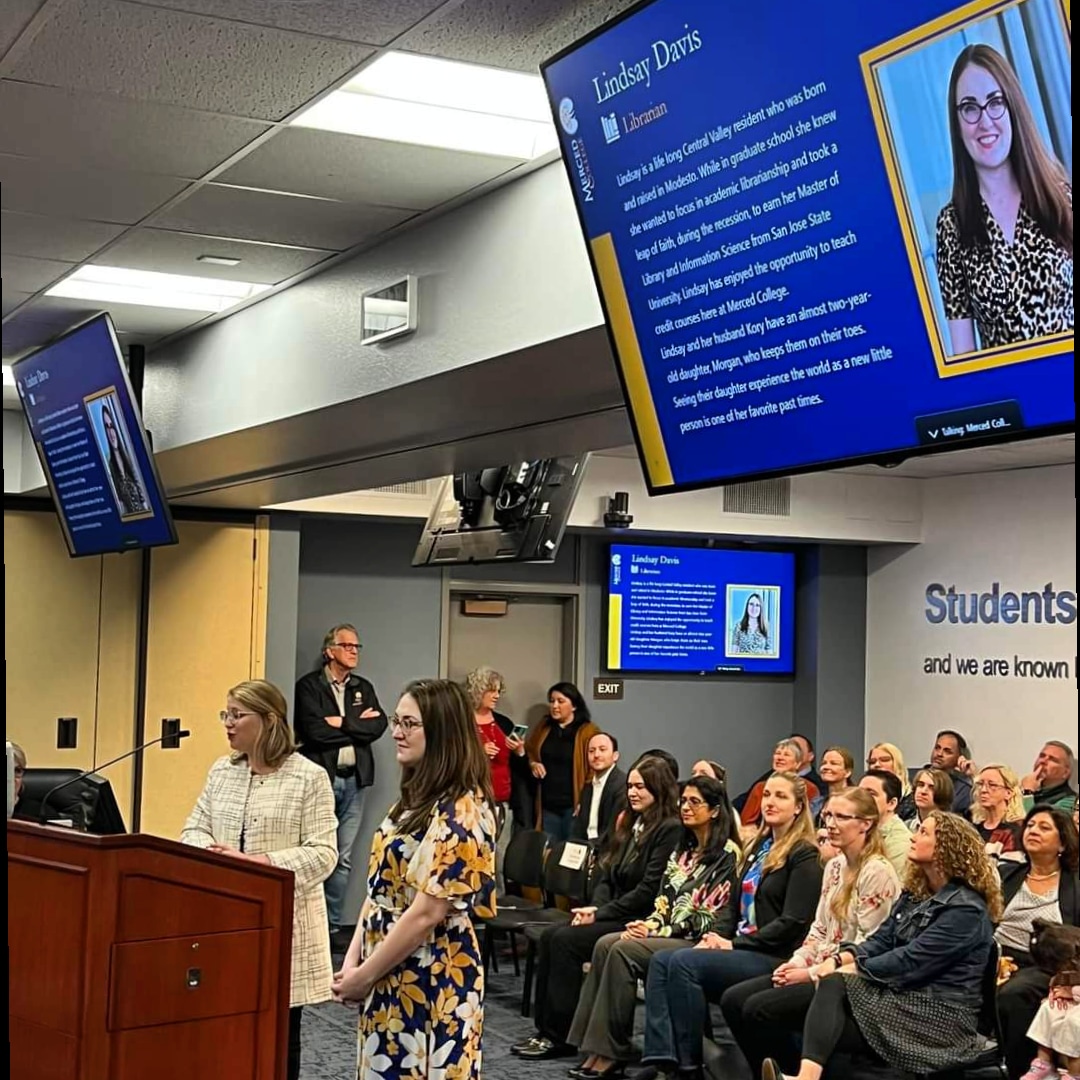
I got tenure in Spring 2023! You would think I’d share this first, but it was not something I was very worried about given the process. It still feels really good to have this behind me, though.

Woman with long brown hard in glasses standing next to a podium with a crowd in the background

I’m embarrassed to share this in a blog post, but I also got nominated for Distinguished Full-Time Faculty of the Year this spring. The other candidates really are top-knotch, so, in this case, just being nominated really is nice. We already voted on this at the end of this spring semester, and I think they already let the winner know in advance of the reveal this next Friday during our in-service day.

My little baby is now a big three years old! My husband and I couldn’t be more proud of our bright little girl. This summer, I also got LASIK! I’m still a little nearsighted, which was the plan since I didn’t have a whole lot of tissue to work with, but it’s kind of amazing what I can see now. It’s been just over a month since I had the procedure.

Here’s to 24-25! I’m hoping to keep up in this space a little more.

Resource Radar: American Prison Newspapers, 1800-2020

Photo by AbsolutVision on Unsplash

I have so much to write about, but I’ll have to start with a fascinating JSTOR webinar I attended about a project to digitize American prison newspapers. The project is led by Reveal Digital, which has been part of ITHAKA since 2012. Their mission is to publish Open Access primary sources from historically excluded groups. Currently, the prison newspaper project is about 45 percent funded, and as the collection is being digitized, only those libraries who have contributed to the fund can access the content via JSTOR. Once the project is fully funded, it will be open access!

Merced College offers courses to students who are incarcerated. These classes are taught in person, but, because of COVID-19, they are correspondence courses this semester. I think this will be a particularly exciting collection for our faculty who teach in the surrounding state prisons and those who teach about mass incarceration on campus.

(If you’re an academic librarian, you may also be interested in the Merced College Library’s correspondence reference service for these students. My colleague Karrie Bullock serves as the lead for this service. It was partially modeled after San Francisco Public Library’s prison reference service. Karrie and I attended a presentation led by SFPL librarians Jeanie Austin and Rachel Kinnon and intern Rosa Hall called “What If Patrons Can’t Access the Internet?: Reference by Mail for Patrons Who Are Incarcerated” during the CLA Conference in 2019, and she got lots of great ideas from the session.)

During the JSTOR webinar I attended, which I discovered was the last of a three-part series, I also learned about the Prison Journalism Project (PJP), which provides an online platform and journalism education to help”incarcerated and incarceration-impacted writers tell stories about their communities.” The original vision was to establish journalism education programs in prisons, but when COVID-19 hit, the founders began an online publication on Medium asking for submissions from those in prison. With the help of the American Prison Writing Archive, they received a substantial number of submissions on a variety of topics. In April, the Prison Journalism Project migrated to their own website where they publish writing and artwork by prisoners, formerly incarcerated people, and friends and family who have been impacted by incarceration.

The organization offers submission guidelines, FAQs, writing prompts, and handouts to guide writers. While these are available online, physical copies are also sent to prisons. Submissions can be emailed or sent through JPay or through the US mail. Stories are scanned and then transcribed and edited by volunteers. (The PJP is currently seeking volunteers to help transcribe or edit stories!) PJP publishes about 10 stories a week. Writers retain copyright of their work, and every writer also gets a portfolio page. On the website, stories are tagged by state and topics. The co-founders are also working to develop a toolkit for educators, which will include a textbook in comic book format.

I also learned about the San Quentin News and the podcast Ear Hustle in this webinar. One of the co-hosts of the podcast is actually inside San Quentin. I had never heard of either of these before, but I’m glad to have more resources to learn from those who are incarcerated or were formerly incarcerated. These resources are also potentially very valuable for reference work!

You can find all three of the JSTOR webinar recordings related to the American Prison Newspaper project below. I will need to watch the others soon.

You do have to share your name and email to watch the recordings.

Zooming through the Summer

Zoom call on a MacBook Pro laptop with a green ceramic mug on the left

Photo by Chris Montgomery on Unsplash

I clearly had no know idea how the rest of the 2019-2020 would turn out. I can’t possibly update the last 6+ months, but let’s just say that it’s been quite a workload since March. I can’ t believe it’s nearly July!

If you recall, I took on my role precisely to improve instructional services, and COVID-19 highlighted many of the critiques I have been making since returning to Merced College. While I was able to get more support, we’re 10-month faculty, so I’ll have to start some of this advocacy work again in August.

I worked remotely from March 20 until the end of the spring semester. (The week we went remote was fraught with tension; it involved some disparity between the library faculty and the faculty in other discipline.) I was able to make a OneSearch tutorial. (I actually had to make it twice; once in a trial of SideCar, and then a second time in LibWizard when we finally got the add-on to our Springshare subscription in May.) I was also able to make three Canvas modules:

  • Understanding & Finding Databases
  • Selecting Databases by Subject
  • Using Basic Search Strategies

I wish I would have had time to help our librarians get up to speed on LibWizard and Canvas to be able to split up the other materials that we need to make, but we all just didn’t have time. I started an instruction guide in the fall, and I have been adding more documentation and materials in preparation for Fall 2020, as we’ll do some of this work when we come back in August, though it will more than likely be remote.

Prior to the spring semester ending, a colleague and I also started working to populate the library website. The website got a big update a couple of years ago, but there were places that hadn’t been developed yet. We’ll continue to work on it remotely this summer and in the early fall. Our College also created a hub for students within Canvas for student and academic services, and my colleague and I were also able to provide a lot of input for the library’s hub space.

Summer school is online, and the library remains closed to the campus community. We are offering curbside pick-up, but, to be quite honest, print is not the big draw for learners. (I have a lot to say about this, but tenure track…). I did elect to work a couple weeks of summer school to staff the library chat, where the majority of questions have dealt with textbooks on reserve. This is such a huge deal in community college libraries, and while folks do use OER here, it’s not as far-reaching. My last day of summer school is on Tuesday. As part of my advocacy efforts, I was also given 75 hours of additional time this summer to work on instructional projects. I have worked some of these hours already adapting an MLA Canvas module. When summer school is over, I’ll pick this up again. I’ll also be working on an APA and evaluation module.

I’m also taking a 9-week online course through Merced College to be “certified” to teach online as part of the California Virtual Campus Open Educational Initiative (CVC-OEI). The course helps faculty design the first six weeks of a fully online course. While I’m not scheduled to teach the library’s three-unit course LRNR 30 Information Concepts and Research Skills this fall, teaching a course for credit is a long-time dream of mine, and I would like to teach it in the next couple of years. Week 5 starts this week. It’s quite the workload, but it’s going well considering that I’m not exactly adapting a class I’ve taught before. My favorite unit so far is the accessibility unit because it reminded me of things I have learned before but forget to practice. It also helped me fix some LibGuides and other Canvas issues. I’m glad I decided to take the class.

I hope to have a few more updates this summer.

Endings & Beginnings

An image of a split fortune cookie with a fortune that reads,

June 1 marked my third year at UC Merced, and it was the same day I was offered a Reference Librarian position at Merced College. If you’ve been here long enough, I worked for Merced College before but at the small campus one hour west in Los Baños. My first day at Merced College will be August 6.

I am grateful to have had the opportunity to work at UC Merced. During these last three years, I learned so much from my instruction colleagues, and I have become a more confident teacher. I’m now ready to take on the challenge of leading and expanding research education at the community college where I started my professional career just a few years ago. I’m excited to pursue some of the goals my former/soon-to-be current colleagues and I could only dream about six years ago.

I’m back.

Lifelong Learning, but not a Library Post

Image of black and brown metal fabric scissors resting on top of assorted swatches of fabric

Photo by Karly Santiago on Unsplash

One of my intentions is to write a little more often here, and although I tend to keep this blog as a work journal more for my own benefit, I was smart not to do any specific branding, so I feel safe straying from time to time.

My husband and I just celebrated 10 years of marriage on January 3rd. We chose to get married the first Saturday in January to mark our new start in a new year. My husband’s birthday is also the 6th, the official last day of Christmas, so we’re all about stretching the holiday season to the last drop, it seems. During the first week of January, one of our traditions is making a list of shared goals and individual goals and intentions. We just finished our kitchen remodel in December, so, this year, we have some smaller home improvement goals. We need to install a new fence, add rock to our front yard and backyard, paint some rooms, and finish personalizing our house. We’ve been homeowners for nearly six years, and I’ve really enjoyed making it ours.

In the spirit of (home)making, one of my personal goals is to learn how to use a sewing machine. I want to the freedom to make curtains, table runners, and pillow covers using fabric I actually like versus hunting forever or just settling. This is a big deal for me because I am terrible at sticking to hobbies. (I actually got motivated to do this from a HuffPost article. Number 7, which is “Learn something new,” stopped me in my tracks: “What have you always been interested in learning but felt either too busy or fearful to prioritize? That’s what you should focus on.”) I registered for a sewing class through our local community college’s community education classes. I’m really looking forward to it, though I will most likely have to miss the third class due to a conference.

What’s something you’ve always wanted to learn how to do? I’d love to hear.

National Diversity in Libraries Conference (NDLC) 2016

This was a really great conference, and not just because I went to Universal Studies Hollywood to look at the Harry Potter section of the park when the conference was over. 😉

I’m a bit of a late bloomer when it comes to things like this, so it might not be that exciting for more seasoned folks, but I co-presented a poster for the first time! I am on ACRL’s Instruction Section’s Instruction for Diverse Populations Committee, and during the last year, we have been updating a selected bibliography of resources for inclusive library instruction. A few of us from the committee decided to present a poster on our work to help advertise the bibliography. I met one of my committee colleagues in June at another conference, but it was nice to get to talk with the other group members in person. Working online with this group has been a great experience. This coming year, we’ll be working on the Multilingual Glossary. Click here for the description of our poster.

NDLC Poster

For quick access (the tl;dr version), here are the sessions I attended in a list. The links take you to the descriptions from the program. Below this list, I have included my notes/thoughts for each session. I really need to start doing summaries when they are more fresh in my mind.

Keynote Address

We had the very great honor of hearing a message from Lakota Harden. She spoke a little about her background, including her time at a residential boarding school; her people’s relationship to water; the protests happening against the Dakota pipeline; and unlearning racism and gender discrimination.

Harden took a few questions, as well. Someone asked about preservation and access to items in museums and archives. Harden asked how many of us had visited the National Museum of the American Indian. “How did those things get there?” Talk about living in a post-colonial world view. I didn’t grow up going to museums, so I have always thought of these these places as “fancy”rather than as places that serve to make a spectacle of native culture for the enjoyment of non-native people. But it is true. (Here is Ulali’s song “Museum Cases.”) She explained that when people visit or drive by reservations, they don’t want to see reality and yearn for a romanticized view of Native Americans. This makes me think about the part in Whitehead’s The Underground Railroad where Cora and a few other young black women posed for a museum installation. Harden explained that things were being returned to native populations.

She also spoke about white people’s tendency to “help” as a way to feel better and get an “innocent certificate.” Someone asked how the library community could help native voices. Harden expressed that the act of listening and hearing lifts the weight of the loss of language, devastation, poverty, suicide, alcoholism, and lack of education affecting Native American peoples. Someone else asked about the lack of native representation in children’s literature, and Harden expressed that native communities are dealing with very scary, difficult situations, so it’s not surprising that there is a lack of materials. She asked that we become allies, that we continue to include native voices in our collections and programs, that we go out to meet the native community where they are and listen. “Coming together is a sacred act.”

Identity at Play: Exploring Racial and Identity Theory in Everyday Experiences in Academic Libraries

This panel was slightly different from that described on the program. The focus of the program was on these three questions.

  1. What is identity theory? How do race/ethnicity shape our sense of self?
  2. What does intersectionality mean? How do we unpack it?
  3. How can we apply this framework to our work?

In introducing racial and identity theory, the panelists asked us to think about how identity may play out in the library. Asking for help is simply uncomfortable; it’s a sign of vulnerability. One of the participants shared a story where a student who was not white had waited a really long time to ask a librarian a question related to blackness because she waited for a non-white librarian. I can understand how the student would have been uncomfortable, not just asking for help, but asking for help from someone who may or may not be an ally. The panelists brought up Hall’s chapter in The 21st Century Black Librarian in America (2012), “The Black Body at the Reference Desk: Critical Race Theory and Black Librarianship.” It sounded really familiar, and then I realized I had come across the citation in Hathcock’s article “White Librarianship in Blackface: Diversity Initiatives in LIS” (2015) from In the Library With the Lead Pipe.

In the intersectionality section, the panelists introduced the work of Kimberlé Crenshaw, who coined the term in 1989. The panelists also pointed to Crenshaw’s Washington Post article from September 2015, “Why Intersectionality Can’t Wait.”

In my notes, I also listed the citations below, but I have no context for why I wrote them down.

Bonnet, J.L., & McAlexander, B. (2013). First impressions and the reference encounter: The influence of affect and clothing on librarian approachability. The Journal of Academic Librarianship, 4 (39), 335-346. doi:http://dx.doi.org/10.1016/j.acalib.2012.11.025

Ortega, A.C., & Ramos, M. (2012). Recruiting and mentoring: Proactive mentoring: Attracting Hispanic American students in information studies. In J.L. Ayala & Salvador Guereña (Eds.), Pathways to progress: Issues and advances in Latino librarianship (103-124). Santa Barbara: Libraries Unlimited.

Price (2010)? Why would I write only this? I should use this to show students why taking good notes saves a lot of hair-pulling.

Academic Libraries Spearheading Diversity and Cultural Initiatives on University Campuses

In this lightning round, librarians from four institutions shared what they have been doing on their campuses to support diversity and introducing students to new cultures.

I was very impressed by the programming work at the University of Cincinnati Library. One thing they did was provide students with diversity/inclusion journals at the beginning of the year. These are just composition books, so not at all expensive. During each cultural event or program, the library provided a writing prompt for students to reflect on. The journals were not collected; the intent was to help cultivate a culture of writing. While the librarians shared several wonderful examples of diversity programming and events, there were two that I was very interested in. Around Thanksgiving, the library held an event called Coming Together to Give Thanks. The speakers were students who shared cultural foods, rituals, and traditions from their home countries or ethnic backgrounds. I was also very drawn to the library’s Reading Around the World book club. Click here to find their LibGuide to learn more about it.

At the University of Tennessee Knoxville, there is a campus-wide diversity committee with library representation. I believe there are also campus representatives on the library’s diversity committee. For the last 15 years, the University Libraries have had a three-year diversity residency program. I was very impressed to learn that the library still has a relationship with former residents. The university also has an Office for Diversity and Interculturalism, a Black Issues Conference, and an International Festival. I didn’t write down how the library is involved, which is a bummer, but I can contact the librarians who spoke about these programs and events. The campus and the library seem very engaged in diversity efforts.

Chapman University, which has an emphasis on global citizenship, has a very robust exhibit program focused on diversity in its Leatherby Libraries. Essraa Nawar (check out her TED Talk!), the library development coordinator, explained that she has had great success in pairing fundraising with diversity efforts. I was so blown away by the sorts of donors and exhibits they have had at Chapman that I didn’t even write down a single example.

I was so happy to see folks from California State University Fresno! I’m a CSU graduate–both for my undergraduate and graduate degrees, and Fresno is just south of Merced. I was also very impressed with the Henry Madden Library‘s diversity work both in and outside the library. Click here to see the library’s diversity committee Facebook page. The committee supports the university’s mission to promote and celebrate diversity through library programming and exhibits, LGBTQ Allies, Library Diversity Lounge, Meditation and Prayer Room, and International Coffee Hour Presentations.

Educating the Educators: Proactive Approaches to the Inclusive Classroom

This session was comprised of two individual presentations. The first presentation was given by Paula M. Smith from Penn State Abington and focused on the Global Awareness Dialogue Project (GADP). GADP is a faculty development program that engages faculty in the exchange of ideas about contemporary global issues in education, with an emphasis on non-Western educational systems. The sessions are three hours long and are open to 20 or so faculty members who register for the program.

After Smith introduced the session, we were asked to complete The Numbers Exercise, which was developed by Roxanna Senyshyn and Marianne Brandt. Essentially, it’s a list of simple math problems, but the directions indicate that subtract means to multiply; divide means to add; add means to divide; and multiply means to subtract. So 12 x 2 really means 12-2. After a few minutes, Smith asked how we felt completing the worksheet. I said it was stressful. The idea behind this is that this is the sort of frustration international and immigrant students feel navigating American academic life.

Smith then discussed the types of GADP sessions they have had at the university. In one program,  a panel of international and immigrant students, representing East Asian, African, South Asian, and Middle Eastern backgrounds, were able to tell faculty members about some struggles they have had in the classroom. For example, Chinese students were not familiar with cursive. Students were Googling the characters one by one! The students also said they felt stupid because many of their classmates would leave exams early. Chinese students, if given 30 minutes, will use the whole time. There are also some challenges about what academic integrity means in a western framework. What a wonderful way to include student voices and help faculty foster more inclusive classrooms.

I’m really itching to talk to someone about this, but being so new, I’m not sure it’s appropriate for me. However, the person in charge of Center for Engaged Teaching and Learning is also new. We actually sat next to each other at the new employee orientation.

One neat thing I jotted down that was a result of one of the GADP sessions was that faculty members who speak more than one language started putting little stickers (or signs) on their windows/doors that said, “My name is_____. I speak ________.” How fabulous! I’m thinking about doing that underneath the name plate on my office window.

The second presentation was given by Shannon Simpson from Johns Hopkins University. She helped developed the Toolkit for Inclusive Learning Environments (TILE), which is a toolkit of “best practices [and] a repository of specific examples that all faculty are welcome to replicate or re-use.”

Simpson shared a sample assignment that professors/librarians teaching information literacy, business, marketing, and communication could use. It’s a simple but effective assignment. “In 2014 a food and entertainment public relations firm called Strange Fruit was the subject of a media backlash. Ask the students to Google the term strange fruit to see why.” (I literally gasped out loud that no one at this company knew what this meant!) Students then answer these questions:

  • To what does the term refer?
  • Where did the term originate and who has used it since then?
  • What would you tell this firm if during the media firestorm they had come to you for advice?

During the session, we also did a pair-share in which we came up with groups or people we could partner with to share about TILE, such as a diversity committee, student life/affinity groups, teaching and learning groups, university departments, human resources, provost/president’s office, and other relevant people or groups. I plan to share this resource with the Center for Engaged Teaching and Learning. I will probably also share this resource with some of the writing lecturers I know who I think would be interested in this. I also plan to ask my colleagues from ACRL’s Instruction for Diverse Populations Committee if we can add this resource to the bibliography; the general resources section is a great catch-all.

Why We Stay: The Motivation of Veteran Underrepresented Minority Academic Librarians

I actually met Antonia (Toni) Olivas trying to find where the keynote address was going to be held, and I am glad I was able to attend the session she was moderating. While Olivas was completing her dissertation on motivational theory, she realized she wanted to do a larger project and decided to edit a book. Choosing to Lead: The Motivational Factors of Underrepresented Minority Librarians in Higher Education will be published in early 2017, and I can’t wait to read it.

At the beginning of the session, Olivas briefly discussed Chan and Drasgow’s (2001) Motivation to Lead (MTL), which includes personality, values, self-efficacy, and previous experience. Motivational identities include affective, social normative, and non-calculative. Most minority librarians stay in the profession due to these identities.

This panel was organized around the themes of the chapters in Olivas’ book. The panelists included Shannon Jones, Oscar Baeza, and Binh P Le. Each gave advice or their perspective based on the themes of the chapters. I actually found this to be a very applicable session, and I honestly feel like the advice is helpful for all new and early career librarians.

Chapter 1, for example, is on self-development, and Jones explained that librarians should have a strategic plan for themselves. Write your own SWOT analysis and make a three-year career road map. I haven’t actually done this before. I have had goals and met them and made new goals, but I’ve not ever done this systematically. This is definitely a project I need to undertake this semester, especially as I have started a new job.

Chapter 2 is on knowing yourself. Baeza explained that librarians should know who they are, including knowing their strengths and weaknesses and where they come from. He emphasized family history. I find this to be absolutely true. Every time I begin to think of myself as not being successful, I remind myself that my family is proud of me. That is enough. I am so thankful for the support they have given me, even if they didn’t understand what I was doing.

Chapter 3 is on trust. Le said it plainly, “People need to trust you in order for you to lead.”

Chapter 4 is on family impact. This sort of goes with chapter 2 for me. Jones shared a beautiful story about her grandmother wanting her grandchildren to go to college, to do the things she was not given the opportunity to do as black woman born in 1912. Jones’ grandmother had a seventh grade education. She had a saying that if people wanted to keep things from black people, they would put them in books. She cultivated a culture of reading, taking her grandchildren to the library and teaching them that they should look for answers to questions. It was so touching to hear Jones talk about the impact her grandmother made on her life.

Chapter 5 is on support groups. Jones mentioned that mentors are “for a reason and a season.” I find this to be true. Currently, I realize I am in need of a couple of new mentors. She also mentioned that mentors advise and friends inspire. Certainly, your mentor should be a cheerleader in some ways, but constructive criticism is needed, too.The other thing Jones said that I found particularly inspiring was to be brave enough to walk through doors people open for you. I was intimidated about starting my new job, but then I heard from one of my references about a conversation she had had with the folks here. Without saying too much, I knew it would be both a place where I could help the library meet its goals and mission and also grow as person and professional. Jones also advised that we ought to open doors for others. If you are in the position of being a mentor, be honest, realistic, responsive, and create an exit strategy for the mentorship for both yourself and the person you are mentoring if it doesn’t work out. s

Chapter 6 has to do with involvement. Some of the most fulfilling experiences for me have been participating in campus and national committees. I am really glad that I didn’t shy away from contributing where I could in my previous job, and I am also finding ways to contribute at my new employer, both in the library and university-wide. Le really spoke well when he said committee work is not something we should avoid but actively seek out, even if it means you have to ask how you can contribute if there isn’t a specific call.

Chapter 7 is on preventing burn out. I know this is the area where I struggle. The panelists all emphasized that self-care is essential, and each shared some ways that they blow off steam or find inspiration, from keeping thank you notes to finding non-library people to you can vent to. Jones also advised that we ought to be selective about projects we take on. Some questions to ask yourself include whether an opportunity fits within your plan and/or if you can do it well in addition to your other duties and responsibilities

We skipped a couple of chapters to wrap up the session, but one of the last words of advice I wrote down was that it’s okay to sell yourself and toot your own horn.

The Library as Connector: Creating Collaborative Outreach Opportunities for Diverse Student Populations

I was really interested in attending this session because one of the people on the ACRL committee I am on works at University of Nevada Las Vegas (UNLV), and I also wanted to see my fellow University of California colleagues Roberto Delgadillo and Robin Gustafson from the University Library at UC Davis. This was a fantastic session!

The UNLV University Libraries have done fantastic work with the LGBT community at the university and area high schools. I was impressed, and it was good to know that the library is helping students who may be struggling with their identity find a place where they can be themselves and be successful college students.

The presenters introduced research about why it is important for them to work with LGBTQ students. GLSEN’s National School Climate Survey “… has consistently indicated that a safer school climate directly relates to the availability of LGBT school-based resources and support, including Gay-Straight Alliances, inclusive curriculum, supportive school staff, and comprehensive anti-bullying policies.” The presenters briefly asked if anyone in the audience had seen the Chronicle of Higher Education’s Ask Me video. I have, and it is very moving. In the video, LGBTQ students express what they want their professors to know. Lastly, the presenters shared a book called Student Success in College: Creating Conditions That Matter (2010). Not only can the library “play a big role by providing student access to LGBTQ people, history, and events through library and internet sources,” but we can also build a community where students can pursue education and learning with less fear. Click here to check out the UNLV University Libraries’ LGBTQIA LibGuide.

In order to build community, the University Libraries have had some really neat events. For example, for this year’s REMixed Week (as a culturally mixed person, I was really excited to see this), the Lied Library, in collaboration with UNLV’s  Center for Social Justice, MEChA, Jean Nidetch Women’s Center, Gender and Sexuality Studies, University, and Students Organizing Diversity Activities (SODA), held a paint party and screening of Transvisible: The Bamby Salcedo Story. The library also participated in the Coming Out Carnival and GSA Talent Show. They also held a Banned Books Buffet Book Tasting, which was an interactive, self-paced event that highlighted books censored for various reasons. The library also has helped foster partnerships between the University’s GSA and the GSAs at area high schools.

The presentation from from UC Davis focused on how the library aligned its diversity goals to the campus goals by creating strategic partnerships to empower all students. This presentation was interesting because it included mini presentations from the director for the new Strategic Chicana/o and Latina/o Retention Initiatives and the director for Academic Services in the  the Athletics department at UC Davis, who touched on how the library has been assisting in their efforts to aid Latino students and student-athletes. While the University doesn’t yet have a center for Chicana/o and Latina/o students yet, it does have a Center for African Diaspora Student Success and plans to open a Native American student center and a center for Chicana/o and Latina/o students. (Click here to see a list of multicultural resources available at UC Davis.) In reaching the student-athletes, the library has helped in a life skills class that is designed for athletes but is not required. In the class, the library has given workshops and gone over services, such as the 24/7 chat service. The library also has allowed the football team to have evening study sessions. The Academic Services director from the Athletics Department let participants know that every athletics department has academic services staff and suggested getting in contact to form a collaboration to reach student-athletes.

Goodbye Pt. 1

Last Friday was my last campus faculty meeting for the school year and Los Banos Campus‘ Merit and Awards Ceremony. A couple of weeks before the official Merced College graduation ceremony, we honor Los Banos students who are graduating (this was my second and last year to read the names), scholarship recipients (I was on the committee in 2014/2015 and 2015/2016), and Student of the Month and Year winners (I was on the committee in 2014/2015 and 2015/2016). We also honor a staff member as the Los Banos Campus Classified Staff Member of the Year, and one of my good friends, our Student Services Assistant, won the well-deserved honor.

What I didn’t expect was a little going-away recognition. Our faculty lead presented me and a colleague who is moving to the main campus with lovely matted photos of the Los Banos with nice messages written by our colleagues on the mat. We have wonderful staff and faculty members in Los Banos. I am going to miss this tight-knit team. I will definitely be hanging this in my new office.

13247739_10156851688430573_1598678304595753724_o

But it’s not goodbye quite yet. We still have graduation at the end of the month where I will don my Masters hood one last time with my colleagues as we celebrate our students’ successes. I’ve had months to process my move, but I think I’m going to need waterproof mascara.

Evaluating Infographics

I subscribe to communications from the Online Learning Consortium, and a couple of weeks ago, they sent out an infographic about the state of online education. Since I’m interested in online learning (I did my MLIS online, and I have taken a class on teaching online), I took a look at it, and I was surprised that the infographic indicated that 75 percent of undergraduates are age 25 or older. Right now I work at a community college library in Central California, and we have a ton of nontraditional students, but the number of students age 25 and older is 35.6 percent; statewide, the number of community college students who are age 25 or older is 42.9 percent. The 75 percent figure that all undergraduates in the country are nontraditional as claimed by OLC seemed wrong to me. 75 percent?! [Although, I did discover that, according to Choy (2002), if a more broad definition of nontraditional is used, this figure is estimated at 73 percent.]

I seem to be helping a lot of students with fact-checking specific statistics lately.  Thankfully, I can point students to resources like the National Center of Education Statistics (NCES) data, but statistics aren’t easy to look through or interpret, demonstrated by my experience analyzing the infographic.

OLC cited sources at the very bottom of the infographic, but it’s not clear which source goes to which fact. I dug into every single link to try to figure out where this 75 percent thing came from, but I was a little overwhelmed because I am not drawn to charts, lines, and numbers (data scientists and data science/statistics librarians, I bow down). I also recruited the librarians at the other campus to help me, and one of them wrote back to me that they had over-simplified the information as the education statistics are divided by type of college. Here’s what the National Center for Education Statistics’ Characteristics of Postsecondary Students information actually says:

In 2013, a higher percentage of full-time undergraduate students at public and private nonprofit 4-year institutions were young adults (i.e., under the age of 25) than at comparable 2-year institutions. At public and private nonprofit 4-year institutions, most of the full-time undergraduates (88 and 86 percent, respectively) were young adults. At private for-profit 4-year institutions, however, just 30 percent of full-time students were young adults (39 percent were ages 25–34, and 31 percent were age 35 and older).

Not cool OLC.

Evaluating, analyzing, and interpreting information, whether in text, numbers, or images is such an important skill, not just for school purposes; it’s a life skill. One of my good friends who teaches English shared Sheida White’s article “Seven Sets of Evidence-Based Skills for Successful Literacy Performance” (2011) from the now defunct Adult Basic Education and Literacy Journal. In the article, which is based on her book Understanding Adult Functional Literacy: Connecting Text Features, Task Demands, and Respondent Skills (2011), she lists seven skills that are needed for “adolescents and adults to meet the literacy demands of education, work, citizenship, and daily life,” which include text search skills, inferential skills, language comprehension skills, basic reading skills, computation identification skills, computation performance skills, and application skills (p. 40). White writes:

…[S]econdary, post-secondary, and adult education programs typically do not provide explicit classroom instruction in the quantitative literacy skills needed to work with numbers embedded in prose and document texts. In fact, mathematical information is often stripped away from any surrounding authentic texts in schools to produce a cleaner measure of students’ skills in mathematics as a separate domain. This approach, does not reflect the way adolescents and adults typically encounter quantitative problems in their daily lives, including workplaces. (p. 47)

This article changed the way my friend taught her courses. Like many English and communication teachers, she has an assignment where she has students evaluate an advertisement for modes of persuasion, but she started adding in-class assignments where students had to breakdown a passage with numbers to build their own chart. She also has them analyze charts and write down what they think the chart is showing. This was a hard task for some of her lower level students. She and I dreamed of creating a learning community between English, math, and the library resources class (I have never taught it, and we were planning to offer it in Spring 2017, but I’m leaving) to work on some of these and other literacies. (See Jacobson and Mackey’s presentation from ACRL 2013 on metaliteracy and the Metaliteracy blog).

I often think about the assignments I might give if I taught information literacy in a credit class environment. I love the idea of evaluating an infographic or looking at and interpreting a chart. So far, Project CORA doesn’t have an assignment on evaluating infographics but rather has an assignment on designing infographics, but I will do a little more digging elsewhere later. Brain Pickings recently had an article about the new book Jane Jacobs: The Last Interview and Other Conversations, where Jacobs is quoted as saying:

If I were running a school, I’d have one standing assignment that would begin in the first grade and go on all through school, every week: that each child should bring in something said by an authority — it could be by the teacher, or something they see in print, but something that they don’t agree with — and refute it.

I think with some modification a weekly statistics-checking exercise done in PolitiFact (the editor has a Masters in journalism and a Masters in Library and Information Science) fashion might be fun. I know the perfect infographic to start with. 😉

Choy, S. (2002). Nontraditional undergraduates. Retrieved from http://nces.ed.gov/pubs2002/2002012.pdf

Jacobson, T.E., & Mackey, T. (2013). What’s in a name? Information literacy, metaliteracy, or transliteracy? [SlideShare slides]. Retrieved from http://www.slideshare.net/tmackey/acrl-2013

National Center of Education Statistics. (2015, May). The condition of education: Characteristics of postsecondary students. Retrieved from https://nces.ed.gov/programs/coe/indicator_csb.asp

Online Learning Consortium. (2016). 2016 higher education online learning landscape. Retrieved from http://info2.onlinelearningconsortium.org/rs/897-CSM-305/images/OLC2016ONLINELEARNINGIMPERATIVEINFOGRAPHIC.pdf

Popova, M. (2016, May 4). Urbanism patron saint Jane Jacobs on our civic duty in cultivating cities that foster a creative life [Weblog]. Retrieved from https://www.brainpickings.org/2016/05/04/jane-jacobs-last-interview/

White, S. (2011). Seven sets of evidence-based skills for successful literacy performance. Adult Basic Education and Literacy Journal, 5(1), 38-48. Retrieved from http://eric.ed.gov/?id=EJ918178