Citation Tools

A while back, one of my friends from college who now teaches writing where we went to school together sent me a message about a little debate in a writing instruction-related listserv about how university libraries always seem to market citation tools to students, making students become dependent on machines to do the work for them. This is an advertising tactic, but the workshop the library is putting on might actually show students how these tools aren’t 100 percent accurate. This was pretty much what he thought was likely but wanted to see what I thought. I do support these tools when used appropriately. The reality is that a lot of our students do find and use these tools on their own; I might as well give them some pointers.

In instruction sessions, I point out citation tool features in databases, but I always comment that the citations aren’t to be taken at face value. I usually do an example and ask students to point out what is incorrect in hopes that they remember that it isn’t always right. I do support using the tools in order to save time —students can copy-paste and correct by looking at their writer’s guides, which often have sections on citing in APA and MLA; the APA or MLA handbooks; Library handouts; Library LibGuides on APA and MLA; or even by googling Purdue OWL’s APA or MLA Formatting Guides. I even have Purdue OWL linked on my LibGuides for APA and MLA. I also have other citation tools listed in those online guides with a note indicating that these tools are not perfect.

I went on to tell my friend, “Ain’t no one just telling them to use the tools point blank.”

Well, I was wrong. Recently, someone in an academic library listserv was complaining that EBSCOhost needs to get its act together to fix the problems in their citation tool feature because the “nice librarian is telling students to use the feature, and students are getting points marked off.”

I’m just going to say it. You are not doing your job if you are simply telling students to use these tools. That was the gist of the feeling among the people who did a reply-all response. No tool is going to be perfect, but it’s not difficult to live in the happy place I’ve described above. There is so much help available to double-check citations, and if points off is what is going to motivate students to learn or at least take the time to check, so be it. The other challenge is that students, who do seem to understand why we cite, at least when I’ve asked students in class, don’t seem know why there are different styles or why they must be so precise when using a particular format. There needs to be a much deeper conversation, and I am sure this does happen in research instruction and writing instruction courses. It’s just part of getting students familiar with academic culture.

With that said, librarians, what are your favorite tools to help students cite or keep track of citations? While I only list links on my LibGuides to free tools (again, with a word of caution), here are some free and fee-based tools that I know about, though the only one I personally use is Zotero. Diigo does look really interesting, so it may be one I try out for myself. The last citation builder I played with is North Carolina State University Libraries’ Citation Builder.

BibMe

Citation Builder

Cite This for Me

Diigo

EasyBib

KnightCite

Mendeley

NoodleTools

Perrla

RefMe

RefWorks

Son of Citation Machine

Zotero


Local History

I had an epic struggle choosing a major when I was in college. I started off  as a sociology major, then social science (sociology, history, and criminal justice), but all the while I was also taking English classes. Eventually, I realized having essentially three minors as a social science major was probably not the best idea. At the end of the day, how I decided to mark the paperwork as history is that I had one more class done than in English. The reality is that I thought everything was interesting–no wonder LIS was so appealing!

However, before library school, I was in a history MA program for a week…until I found out I’d be able to go to library school. Ultimately, I think I would have stayed on if I had found my little history niche. I was surrounded by people who were really into specific areas–Latin American protest art, Civil War, etc. It’s only now that I have worked in public and college libraries that I realize my little history place is actually local history, and I think it’s more because I know it can be a big challenge to actually do effective history research at the local level. There is so much that is forgotten or boxed up. (Recently, I read a really neat article by history professor Peter Knupfer and his experience in developing and guiding students through a project-centered study on a nearby community’s grapple with desegregation; students in his class were able to appreciate that local history research is difficult because the sources are not readily available.  A service-learning style project like this would be such a cool way to apply the Framework, don’t you think? My librarian heart swoons at the possibilities.)

In the summer of 2009, I volunteered at the Merced County Courthouse Museum and at the UC Merced Library. At the museum, I researched the building of the Japanese Assembly Center during World War II in Merced. My research was used in a documentary called Merced Assembly Center: Injustice Immortalized and in the Densho Encyclopedia. Here is a Merced Sun-Star article that references my research. I also wrote an article eliciting more information from the community in the Merced County Courthouse Museum’s column in the Merced Sun-Star, but there isn’t a digital copy–this is another difficult thing about small local papers and doing local history research. (Speaking of UC Merced and hidden collections, I discovered that UC’s Calisphere collections contain WWII Japanase American Assembly Center newsletters and the beginnings of a Merced Local History collection. Pretty cool!)

While writing up the laundry list of stuff for the new librarian coming on board to know, I began drafting a section about things I didn’t get a chance to do but would have loved to see through at the Los Banos Campus Library at Merced College. One of the things I really wanted to do was create a local history area. Here’s a little write up from American Libraries magazine, “What To Collect?,” from last summer that outlines the kinds of resources a public library might think about collecting to create a Local History Reference Collection (LHRC).

At the Los Banos Campus Library, there is a mishmash of items in the 300s, 500s, 900s, and in reference that deal with Los Banos and Merced County, but I would love for these things to be housed together. I have asked off and on for approval to do this from the main library, but I haven’t ever gotten an answer to any requests. Honestly, it just requires us to make changes in the catalog for location and call number–all we need to do is put a letter in front, like we have R for reference–and redo a few stickers. We don’t have tons and tons since we’re such a small library. The question is what letter should go in front? SC for special collections? LR for local reference? LHRC is just way too long.

Another thing related to this would be to work with the public library and the little local museum to compile some kind of pathfinder for researching local history. The museum is barely functional from what I understand (I never got a chance to visit–working and living in different counties is rough), so I am pretty curious what kind of resources are housed there.

Aerial view of Merced Assembly Center, California, c. 1942. (2015, July 17). Densho Encyclopedia. Retrieved May 5, 2016 from http://encyclopedia.densho.org/sources/en-denshopd-i224-00004-1/

Knupfer, P. Consultants in the classroom: Student/teacher collaborations in community history. The Journal of American History, 99(4), 1161-1175. doi:10.1093/jahist/jas602


Tablets Pt. 2

An update on that tablet project I mentioned back in the fall.

Back in September, I found out I had one week to submit paperwork for a grant offered through student equity funding. I had planned to do a survey about our students’ technology usage in order to make some mobile technology recommendations to my dean, but I had to scrap the whole plan with the unexpected deadline and opportunity.We initially received 33 percent of the funds for 36 Microsoft Surface Pro 3s (at the time, this was the college approved tablet) and a charge cart. However, a little later, the Library received funding for all 36 tablets. The tablets are mostly for library instruction since we don’t have an instructional space, but we decided to circulate 5-10 for in-house use when not being used in the classroom.

We finally got everything delivered at the very end of 2015/beginning of 2016, but, long story short, we just started checking out a few this last week. I am bummed I wasn’t able to use them for instruction. I am also sad that I won’t be seeing this project through since I am heading to a new job in June.

With all the delays and my exit timeline, I forgot all about apps. One of the part-time librarians recently reminded me about apps after I sent her a Storify summary of a Twitter chat about tablets by ACRL’s Instruction Section’s Instructional Technologies Committee. Here’s the accompanying Winter 2016 edition of the Instructional Technologies’ Tips and Trends newsletter. Back when I used to do butcher paper posters in the hallway outside the Library doors with questions for students to respond to on Post-It notes, one of the questions I asked was about apps students use to help them with their work. I didn’t get much of a response, though. After this email conversation, I remembered that I had saved a really cool idea that could be modified a bit to figure out what sorts of free apps might be added to the Surface Pros. It really needs to be guided by our students (we really need a student advisory committee!). In 2014, there was a message in the collib-l listserv from a librarian named Beth Johns about a drop-in workshop she and a colleague did about apps.

One of my colleagues and I experimented with a drop in workshop for students last February. It was called “Sips, Snacks and Apps” and was designed as a “sharing” workshop–the plan was to share information on mobile apps that have an academic purpose (such as library database apps) with students and find out what they use in their academic life.

We didn’t get a huge turnout, but some students were coaxed into attending and thanks to one of our student workers who also wrote for the student newspaper, we had a short article published on the event. Snacks included coffee, tea and lemonade to drink and cookies to eat. We held it in a group study room, but when we do it again (planning for the fall!) we want to hold it in a more public place. This room was not a good location–kind of hidden in the library. I think we will hold it near the library entrance next time. The few who attended, including one faculty member, seemed to enjoy it. It was more about building relationships than the topic of mobile apps. I’ve attached a pdf of one of the flyers.

With this particular topic, it seems that students at our school are not yet using library or academic apps (unless they are just not telling us what they use), but we did find out that those with iPhones sometimes use Siri to figure out alternative keywords when they are researching something, so that was helpful and interesting!

I mentioned to our part-time librarian that what we could do is come up with our own list of apps that work with Windows, and then see what students want from that master list, as well as look into others that are suggested. If were going to stay, I would set up a student advisory committee that includes our student workers and other students. With less than a month left until I leave my job, I do plan to add this tidbit to the notes I’m leaving for the new librarian.

Documenting the Future (& Past)

As of yesterday, I have exactly one month before I leave Merced College, and I have started preparing for the new librarian who will be making the Los Banos Campus Library his or her new work home. (Here is the job ad for the position I am leaving, by the way.)

Last summer, Meredith Farkas’ American Libraries column was about what to do to ensure your projects continue after you’ve left a position, “Future-Proof Your Project.” Documentation is so important when leaving a job. When I got my position, documentation wasn’t necessary because my predecessor (and librarian mentor) was switching to the other campus, so I could easily call to ask questions. I have been working on a Word document that is simply a list of things to know: a little library history, accounts to get set up (LibGuides, Text-a-Librarian, Sirsi Workflows, etc.), collection needs and procedures, things I worked on and things I still wanted to do, etc. I also have a message about how important it is for him or her to make the library his or her own; I have my strengths, and the new person will have other strengths. I also included my personal email and cell phone number. I have nine single-spaced pages so far.

I added the librarians at the other campus as co-owners to all of my LibGuides, so they can share those with the new librarian. I got rid of paper and digital files the new librarian won’t need and re-organized the file drawers.  Our campus has a shared drive, so I am updating the Library folder in there, too, with various folders for electronic copies of handouts, important forms, instruction calendars, and other things I mention in the Word document I am writing up.

I switched all my listserv subscriptions to my Gmail, started forwarding a few emails, and boxed up the things to take home, including a binder full of flyers I made over the last few years for displays, events, and contests.

13072919_10156770974445573_4293123233050030986_o

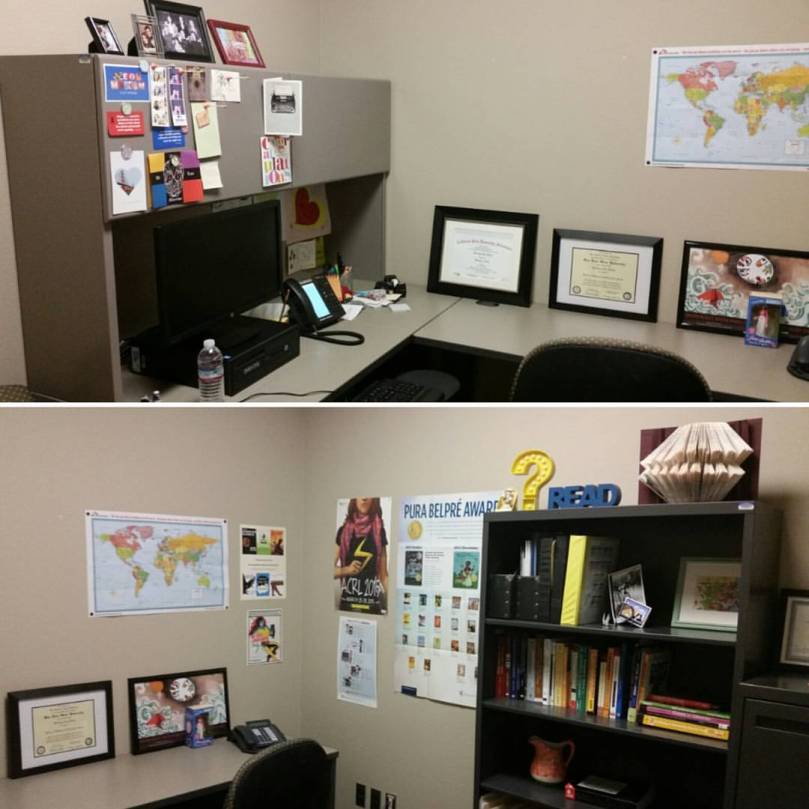
I also started cleaning out my office.

13071947_10156783673190573_7654611409594775529_o

Doing these things has also helped me realize that I was able to accomplish some good things in the three years I was full-time in Los Banos. Ultimately, I am glad I was able to be an energizing force on our small campus. Their librarian wasn’t a shushing, stern type. I was able to make small steps to get a more user-centered space. Culture is the hardest thing to shape, but I made progress. I was able to have some fun displays, contests, and activities, including Game Nights. Through these and other communication efforts, the faculty and student groups began to see and use the library as a campus hub. Our student government even had a campus suggestion box in the Library at one point. And let’s not forget about the food pantry! I feel great that the faculty and staff knew they could count on the Library to help, in both instructional and non-instructional efforts. I was able to build solid relationships in our campus community.

And the students knew they could count on me, too. To quote one of the student comments on my evaluation this year, “Definitely not the crusty old librarian stereotype.” I feel really good about that.

New Job!

Since I officially signed paperwork on Friday, I can share with the online world. (This actually is only partially true because I revealed on Facebook a few weeks ago.) I got a new job!

I’m the new instruction librarian at University of California Merced. I am really pleased to have a more specialized role and am looking forward to improving my instruction efforts. I start in June. I applied in October and interviewed in November and December. I informally accepted the offer right as winter break at Merced College, the community college where I currently work, ended. I am starting in June, so I can finish out the semester at the Los Banos Campus. I’m the only librarian during the day, so it was important for me to be here to get our students through the research rush in March and April.

Many people have asked me why I am leaving. There are some good things about my current job, but I’ve known for a couple of years that I was going to need to fill other desires I have for my career. The questions largely stem from the knowledge that I am leaving for a position where I will be working more for slightly less pay than what I make right now. I am leaving a 10-month tenure track faculty role for a 12-month non-faculty librarian position.

I do what I do because I want to help students on their educational path, but I also need to feel useful and that I am growing professionally. I will miss my librarian colleagues at the other campus and my colleagues in Los Banos, as well as assisting students from a variety of ages and experiences, but my personal happiness and growth are important. I am forever grateful to Merced College for giving me the opportunity to launch my professional career, first as an adjunct faculty member and then as a full-time faculty member, but it’s time for something new. I am nervous but excited.


Battery Recycling at the Library

It’s taken two years, but I am finally getting a battery recycling tube rolling in the library!

I had this idea back in 2014. I started working at my alma mater part-time in 2013, half a year before I got a full-time position at Merced College, and I noticed that they had a battery recycling tube. I asked about it, and they let me know that someone in the facilities department comes to collect it, as they handle recyclables. After my first full-time semester at the Los Banos Campus, I found out that this is exactly how it’s handled at the community college as well. I talked to our chemistry lab technician, who handles the batteries on our campus, and he was all for the library serving as a collection spot. However, I had issues trying to order the tube. Faculty in my community college district are allotted $200ish every year for supplies, so this is coming from that account. It would have been loads easier if I had just bought it myself and then gotten reimbursed, but I didn’t really want to do that.  The battery recycling idea just kind of sunk for a while, and then when I wanted to inquire again, our technician got a new job.

Because of the upcoming changes in my work life, this term I am focusing on finishing projects, not starting new ones, but just as I was about to hit the delete button on the old emails, I thought I should at least try one more time. I talked to our new chemistry lab technician, and she was all for it. Initially, I wanted to order this. The purchasing department recommended some cheaper, smaller tins, but once they found out what I was trying to do, they suggested this, which is similar to what I wanted but with handles! Kudos to all! I am pleased to check that off another small project during my time at the little library.

When I started, we didn’t even have paper recycling! During that first semester, I got a big bin for the faculty/staff end in the library and one for students. The students took right to it. I’m hoping the battery recycling goes equally as well.


December 2015 & January 2016 Library Displays

The last day of the fall semester was December 18th, and the spring semester started on January 19th, the day after Martin Luther King, Jr.’s birthday.

I don’t really have a whole lot of time in December as students are hurriedly finishing final papers. Our library media technician pulled some winter and holiday items out for a quick display, which always stresses me because we don’t have a whole lot of variety when it comes to holidays. I always forget to have the main library order me some children’s titles about Hannukah, Kwanzaa, and Ramadan, and I vow to ask by the end of today. We have a part-time child development instructor at our site, so we have a small children’s collection specifically for an assignment involving multiculturalism. As someone who worked as a bilingual (Spanish/English) library assistant in the children’s department at a public library, I desperately need to make this a priority before embarking on the next chapter in my library career (more on that soon). Because of those changes, my display game this term will be even simpler. I decided to forgo linking the titles in Smore and will just be posting photos.

Sure enough, I didn’t even have time to link the titles I used for the refugee display I had in December anyway. I was really pleased–people checked items out!

Refugees

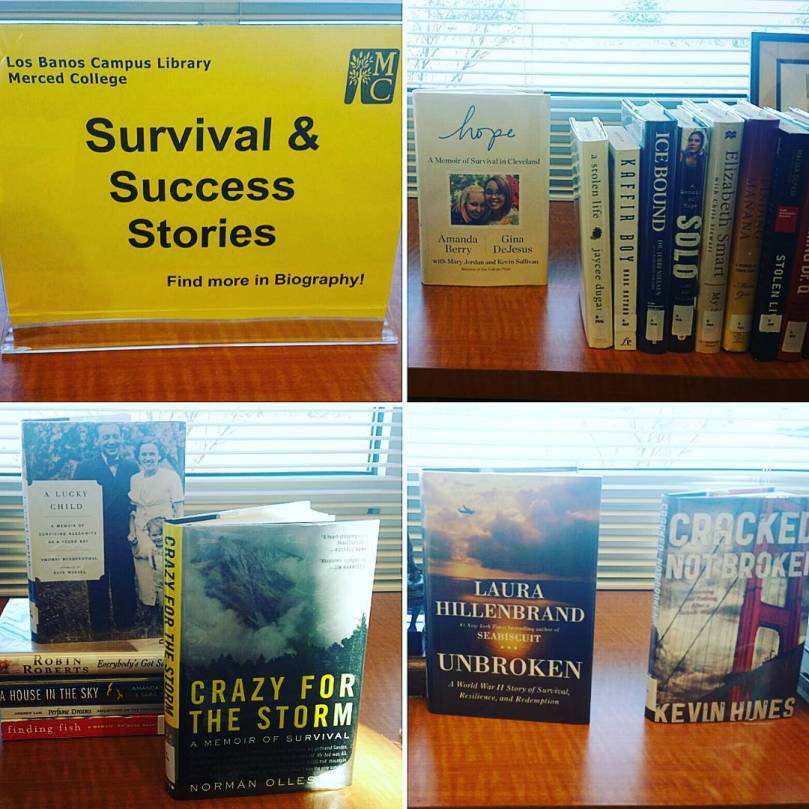
For the latter half of January, I had some Martin Luther King, Jr. books out, and I also highlighted some of our biographies (I did a little cleaning in this section, and I think I am done for now) about survival, failure, and success.

MLK

Survival


November 2015 Library Displays

So it’s February, but here are the displays I had up in November.

I love highlighting Native American Heritage Month. This year, I focused on items that relate to California and CA’s Central Valley.

Native American Heritage Month

Although I am Mexican-American, Día de los Muertos is not something my family does, mostly because my mom’s side is not Catholic. I really enjoy how much interest develops around the display. Here’s the online display, which I especially like. I re-used last year’s Día de los Muertos sign. One of the evening librarians made the tissue paper flowers during Hispanic Heritage Month, so I re-used a few.

Dia de los Muertos

For Veterans Day, the library media bookstore technician (she is now full-time–the first full-time staff position our little library has ever had!) re-used a banner we had last year for people to honor those who have served in the military. It’s blue butcher paper with white stars attached. People are encouraged to write in a veteran’s name with markers i leave on the windowsill. We put the banner in the hallway outside the library. The technician also put together the display we had inside the library. She also advertised the city’s second annual Veterans Day parade.

Veterans Day

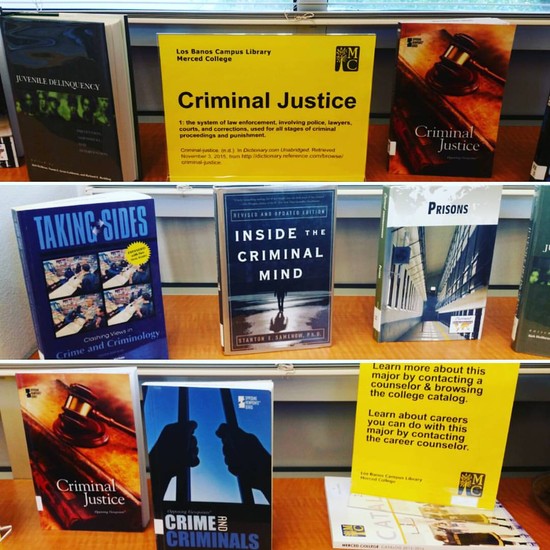
I had one Major Idea display about criminal justice (you can read more about this display series in my August 2015 Library Displays post). I stopped doing this series in November because the space I was using is where I moved our children’s and young adult section. Our history section is out of control, and it was getting way too full, so I moved things around to create room before tackling the 900s this semester.

Criminal Justice

Food Pantries in Community College Libraries

I have been under the weather since before the New Year (a cold, then a sinus infection, and now bronchitis), so I have been a little neglectful lately, but I think tonight’s post will make up for it. I’m excited, anyway.

The campus I work for is right outside the small city’s limits, serving the western side of Merced County, a county known for low levels of education, which is typical of the Central Valley in general. The campus had a headcount of 1,800 students this past fall at census. One quarter of our students are part-time students. Many are parents. We don’t have food service, and we have a very small library, small tutoring center, and small student lounge. We have 19 full-time faculty: 5 English instructors, 4 math instructors, 3 science instructors, 3 counselors, 1 psychology/sociology instructor, 1 history/political science instructor, 1 communications instructor, and 1 librarian (me).

The beauty of working at the smaller campus of a community college is that small teams can often get quicker results and be a little more innovative due to a lack of resources. Because we are so small, we work together quite often and are always thinking of ways to meet our students needs, needs that are not always academic in nature but that certainly affect their ability to stay in school. This past fall, some of the women faculty members got together at an area restaurant before a faculty meeting as a way to begin to get to know our new biology instructor. At the lunch, the chemistry instructor brought up the idea of creating a small food pantry for students in need but wanted ideas for how to make it private and where it should be located. I saw my opportunity.

Our small library has a back workroom. We keep some old periodicals and supplies in there, and it is also our break area with a fridge and table. We also keep off-season textbook reserves in there. When our part-time library media technician retired this past May, I was finally able to throw things out and work with our new full-time technician, formerly our part-time clerk, to get organized and clear the mess. It’s still wasn’t perfect at the time I made this suggestion, but I immediately mentioned to our chemistry professor that we were making room. They could use a small part of our workroom shelving to house a food pantry. Of the two buildings on campus, we are the area that is opened the longest (the front office closes at 4:30 pm on Monday-Friday, and we stay open until 8 pm Monday-Thursday and until 3 on Friday, though our technician doesn’t really leave until 4 pm on Friday), and no unauthorized people can get to the workroom. The idea is that students in need, with their student I.D., can go to any staff or faculty member or administrator, and be walked to the library workroom to get food.

We got permission from our campus dean, and while we haven’t worked out all the logistics quite yet, we decided not to advertise that it is in the library because we want it to be a little more discreet. I didn’t make the graphic for the posters we’re putting up around campus, but they are absolutely fine and will get the job done. I’ll be displaying the information inside and outside the library, and the counselors are also on board.

Interestingly, over the winter break, both The Atlantic and Inside Higher Ed shared posts about student hunger on community college campuses. It rings so true with our student population.

I am proud to introduce the beginning of our campus’ food pantry. Our chemistry instructor stocked us up with some non-perishables during the first week of the spring semester. 12615148_10156408358120573_604629448180132362_o

Small campuses with small libraries with caring faculty can make a world of difference. I am a regular financial giver to area food pantries, and I can’t believe this idea never occurred to me before. I am so thankful for our faculty and the enormous amount of nontraditional collaboration I have been able to do here.

Does your community college, college, or university have a food pantry? How are your faculty involved? How is your library or library faculty and/or library staff involved? Let me know!

UC Merced, which is the closest university to the larger community college campus, has one, and I believe I read somewhere that our community college students who live in Merced can also access it. I would love to do a little research on this topic in our area.

Book Management: Weeding

Libraries sometimes get a lot of negative beef when it comes to getting rid of books. This isn’t done haphazardly. It’s part of our jobs to make room for newer materials and changing tastes based on demographics. In the case of a small community college campus, some years, it seems like all the writing courses are focused on food politics. Other semesters, the hot topic is social media, terrorism, gangs, etc. Materials also become out of date. Every time I get a new copy of one of those Opposing Viewpoints books, I send back the oldest version to the main library to be discarded.

Libraries don’t have  infinite room. Just like a closet, you need to clean out libraries to make room for classics, items that actually get used, items that are up to date, and new items. In libraries, we call this weeding. (The featured image on top includes a photo of books that were on our shelves that had seen better days.)

Collection management, I have learned, is not my favorite part of my job as a campus librarian. It’s a lot of work, and I don’t really have the right training to run reports on our integrated library system (ILS) to actually check when items were last checked out; I key in every book individually without a scanner (I need to ask the campus dean if we can buy  one) to find out those statistics.

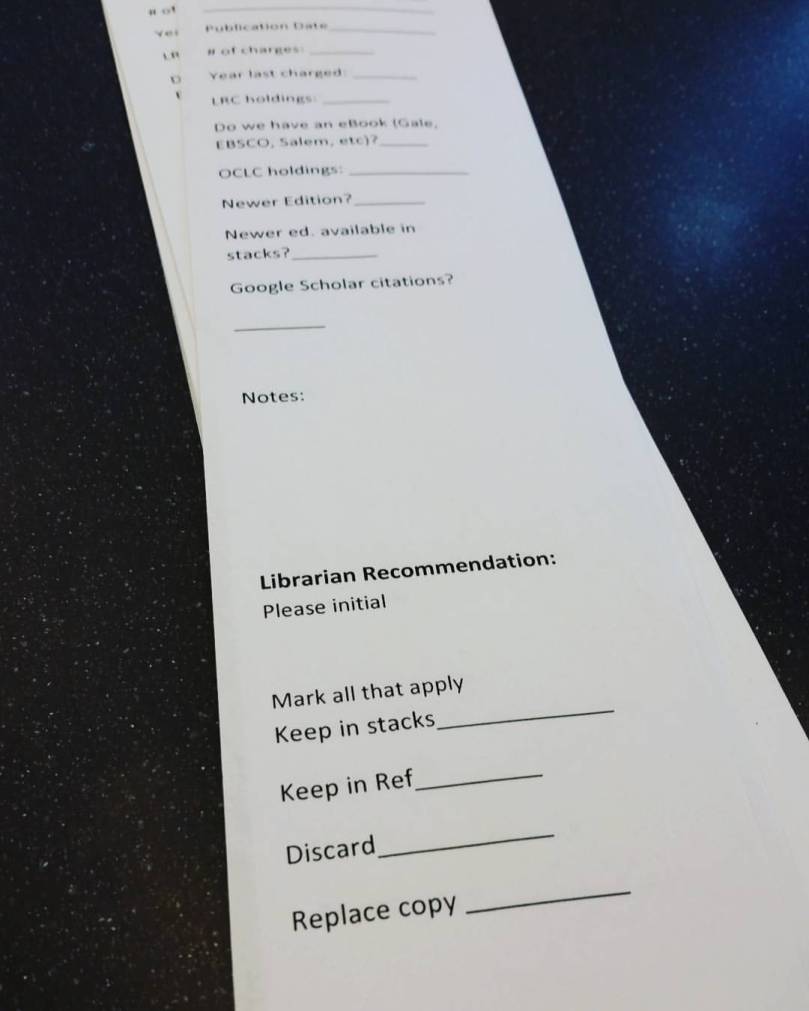
This year, to help me in the weeding process, I created weeding slips.

12339251_10156225714155573_9085277517327917766_o

They are based on the slips used by librarians at California State University Stanislaus, my undergraduate alma mater. (In addition to my full-time job, I also work at CSU Stanislaus one or two Sundays a month during the academic year.) The slips come in handy because I can fill out all the necessary criteria I need in order to send books to the main library for possible deselection. The librarians at the main library take a look at the notes on the slips, and the collection development officer, the library director (not my boss), makes the final decision. These is also a section on the slip where I indicate whether or not the main library has a copy of what I am sending, which also helps their weeding process. When they weed books, they also check to see if our campus has a copy. It’s been an effective system thus far.

Part of the weeding process also includes inviting faculty in the specific discipline to look over the items for potential weeding. I don’t get a lot traction on that front, so I do a two-week call. If no one comes, I send them on to the main library.

I weeded certain areas this fall, but the true masterpiece was the fiction section. Here is the before and after. I forgot to take a photo of the fiction section before I started weeding, but the photo on top is the biography section, which looks very similar to what fiction looked like before the weeding process. Now imagine both sides of the bookcase looking like the bottom photo. We now have breathing room!

12491849_10156337520805573_245962013041574957_o

With the new empty space, my plan is to put just a few books face-out on the shelves, like in bookstores. I do a lot of displays along the outer edge of the library, on our lower reference shelves, and it does encourage some circulation, but I like the idea of displaying books directly on the circulating shelves. I have students who tell me they like to browse when I notice them at the shelves and check to see if the students need help finding something. Because of the browsing behavior, I plan to make some signs in our signature lemon yellow to advertise putting items on hold from the other campus. I also want to advertise the eBook app available through the county library system, as well as let students know that they can put items on hold from across the county library system to pick up at the local library (a lot of them are surprised when I tell them they have access to way more than what is physically available at the local library). I did a hug sign re-haul last year, but I want to experiment with putting a few signs face-out on the shelves.

I also plan to tackle the biography and 900s (geography and history) sections in the spring semester.