#GivingTuesday

#GivingTuesday is upon us! I’ve written about organizations worthy of donation before, and I wanted to mention some of these again, as well as other organizations/groups in my work and home communities that are worthy of your consideration.

Libraries

Earlier this month, my fellow community members voted to renew the 1/8 cent sales tax for the Stanislaus County Library system’s 13 branches. It will go up for renewal again in 12 years. The volunteers behind the Save Stanislaus Libraries campaign worked tirelessly to get the word out, and Measure S was passed with over 80 percent approval.

Say Yes to S yard sign

I encourage you to donate to your local library foundations and friends group or consider donating to EveryLibrary to help other communities’ libraries that are on the ballot.

Now, I haven’t talked to anyone about this yet, but I really want to take part in ALA and REFORMA’s new Adopt a Library program for the Caribbean. If you have a willing organization, this may be a good project to take on!

Colleges & Universities

Going to college was a big deal for me. I recently attended a reception as an alumni of the Rogers Scholars award, which has been in place at my alma mater since 1991. The students’ stories really resonated with me.

Rogers Scholars Luncheon & Reunion invitation

A couple of years ago, the plant my dad worked at closed down, so he took an early retirement. Up until my dad retired, both of my parents were cannery workers. As in they operated machinery. My dad was a dryer operator, and my mom runs a machine that covers fruit cups with plastic film. My mom is an immigrant from Mexico who received little education; she went up to the equivalent of the eighth grade. Growing up, I knew I needed to go to college to have more options than my parents, but I was so stressed out about the cost, I opted to go to school locally. I was able to finish school with zero debt by living at home and receiving scholarships and grants.

I know what a difference scholarships can make in a student’s life, which is why I give to my undergraduate alma mater’s One Purpose campaign. When I worked at Merced College, I also made monthly contributions, and now I give to student scholarships at UC Merced. I also need to start making donations to San José State University, my graduate alma mater, and the Hispanic Scholarship Fund (HSF). A very generous HSF donor contributed $11k to my graduate education, and I had also received a scholarship from HSF as an undergraduate. I feel passionately about investing in young people. I hope you’ll consider donating to your alma mater or a local college or university.

Information Sources

I also contribute to my local NPR station, Capital Public Radio; Creative Commons; and the Internet Archive. However, I also want to contribute to Wikipedia. I just love these sources that much. Do you donate to any information sources?

Faith-Based Organizations

When I worked at the Stanislaus County Library, I discovered our town’s local World Relief office, which works to house refugees. A volunteer was showing an Ethiopian man around the library, and I thought it was awesome.  (Bonus: If you’re interested in libraries and refugees, check out Libraries Serve Refugees.)

Hometown Gems

This could get long, folks, but I also wanted to share that a few years ago, a friend and her husband had a wedding anniversary party at our town’s historic State Theater, and, as gifts, we made donations to the theater. A friend of mine recently got married, and, in lieu of gifts, he and his wife chose two organizations where friends and family could donate in their honor–Merced County Courthouse Museum and the Humane Society of Stanislaus County. If you’re in Modesto, consider giving to the McHenry Museum. What are some hometown gems you can’t live without?

Do you have #GivingTuesday plans? I know not everyone is in the place to give, but if you can, do!

5 Immersive Things

Hello. It’s been a while. If you recall, in the spring, I found out that I was accepted into ACRL’s Immersion program, which was held at the end of July at Champlain College in beautiful Burlington, Vermont.

The bad: traveling.

I hadn’t ever been to New England before, so I wasn’t quite prepared for traveling here. I had an absolutely crazy experience traveling both to and from VT. It involved switching airports (Dulles to Reagan) and airlines on the way there after a flight cancellation. I ended up sharing a hotel room with a librarian from Oregon State University who happened to be on the same cancelled flight. If I remember correctly, the new flight was also delayed. On the way home, the flight was delayed, which meant I wasn’t going to make my connection. I ended up staying overnight but had some treats with a new librarian friend from American University to help cure my travel woes. I was down to wearing exercise pants and a t-shirt. (I also broke a pair of sandals during my week, too!) With all my extra time, I ended up reading three books. I was so happy when my husband picked me up at the airport in Sacramento.

The good: friends and learning.

I met some new librarian friends, learned new theories and teaching ideas, and then I learned that I know more than I thought, too. I have more to learn from the resources mentioned throughout the program. I haven’t cracked open that binder in a while.

Below are five things Immersion helped cement in my mind, though they aren’t necessarily earth-shattering.

  • We have assumptions about teaching and learning that are counter-productive.
    • Ex: Curricular integration of IL is the gold standard—> we tend to view one-shot workshops as sub-par learning experiences.
      • I never thought about this before. I personally view one-shots as sub-par, but learning can and does happen in single lessons. I’m not sure if this helps, though. I put a lot of pressure on myself because I think of the teaching I do as the one and only opportunity I have to show the value of librarians to students.
      • Pick one place to be “transformational” in.
        • This has to do with the GeST windows model. During Immersion, we were taught not to think of any window as better than another, but my colleagues didn’t necessarily read it that way. I need to do some re-reading.
    • Ex: Teaching is a calling—> we become overly critical.
      • Teaching is hard. Teaching is even harder when you’re a guest teacher. As a librarian, I don’t have the same rapport with students the way the classroom instructor does, and I don’t have the benefit of knowing what has really been done in or out of class to prepare for research instruction.
  • Discussion is not always discussion.
    • Is it really “serial questioning”?
      • Social constructivism: discovery-based, student-focused, authentic, collaborative, cooperation in small groups, etc.
      • This explains why I didn’t enjoy “class discussions” in college. They were never really discussions.
  • Assessment helps you design your class.
    • What do you want students to be able to do? How will they show you?
      • Plan activities accordingly.
  • Activity does not equal active learning.
    • Active learning requires that students apply/reflect.
  • Negotiate for 2-3 measurable learning outcomes.
    • Sometimes faculty can make decisions if you provide a list of suggestions/possibilities.
      • I like this strategy because it shows faculty how much variety exists and that not everything can be accomplished in one session.
      • It really makes me think that instruction menus are more useful as negotiation tools for librarians than as a guide for instructors. I like having a menu as a reference for myself.

I wasn’t quite willing to put this in my list above because I have a lot to mull over about it, but a question I wrote down in my notes is, “What are we asking students to give up?” This hit home to me even more when one of the Immersion instructors asked me why the pre-assignment I was working on for a potential class needed to be in Credo Reference. “If you really want them to do it, why not Wikipedia?” I mean, really, why not? It was pretty liberating. I also brought up this question to my colleagues post-Immersion, and it reminded them of the C&RL News article “Library Instruction for First-Year Students: Following the Students’ Path,” in which the author shares that she started using Google Scholar in instruction sessions. The author uses the term “desire lines”; library folks will quickly see the UX practice here. I really think this is something to think about a little more, and I’d love to do something related to this question of what we’re asking students to give up when we teach research skills and concepts. (If you’re reading this, and you’d like to partner on something, shoot me a message!)

#WeNeedMixedBooks

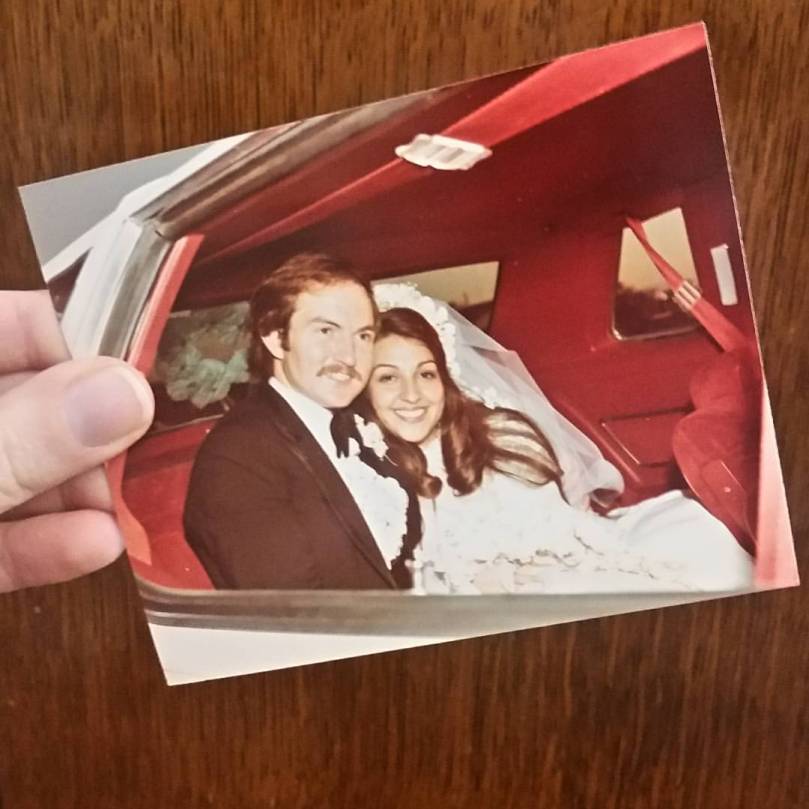
Today is Father’s Day, and just last week, it was the 50th anniversary of the Loving decision. The anniversary gave me some time reflect on my mixed heritage. My dad is white and originally from Arkansas (he moved to CA in the 1970s), and my mom came to the U.S. from Mexico as a young adult. (My mom has been a citizen since the 1980s.) My parents got married in 1979. Here is one of their wedding photos.

Parents' wedding photo

Growing up, I didn’t know many mixed families, just mine, but that appears to be changing! It dawned on me recently that I have several friends raising children who are of mixed heritage. Here are some relevant articles on Loving, as well as the growing numbers of Americans who are mixed:

My sister and I started our school experience as Spanish-speakers; as the youngest, my brother didn’t have the same challenge. I didn’t realize we were “different” until elementary school, when kids didn’t believe some of my first cousins and I were related. Or worse, this woman who asked my mom if I was adopted. There is nothing wrong with adoption, but the question was to point out difference, and it was a terrible position to put her in, as well as for her child who was old enough to understand. I’ve seen and heard a lot from folks who are comfortable in addressing their fellow white person, as well as those who are comfortable speaking in Spanish as though I’m not there or can understand, not to mention the feeling that you don’t fit into neatly arranged categories. (This is just meant as a summary, and I’m also not going to get into my privilege as a very white and now graduate-educated Latina; I’m well aware.)

Books would have definitely helped with my identity issues, and, fortunately, times seem to be changing a bit. Prior to becoming an academic librarian, I worked as a bilingual (Spanish/English) library assistant in the children’s department of the Stanislaus County Library, and I about cried when I came across a picture called Marisol McDonald Doesn’t Match. With the Loving anniversary, a friend of mine tagged all her friends in interracial marriages and partnerships, which prompted a very cool string of comments and photos. Our mutual friend made a special tribute about her marriage and family, and, from our exchange,  I found out that she had shown photos of my family to her daughter who is also half-Latina and half-white. I mentioned the Marisol McDonald book, and I let my friend know I would do a search for some more kids’ books. Although there is a disparity in representing children from a variety of backgrounds in children’s books in general (see the #weneediversebooks campaign), The Washington Post‘s “Where Are All the Interracial Children’s Books? points out that there aren’t many picture books that feature mixed children. I started doing some searching for pictures books about mixed families and children, and I was surprised to find a small but growing body of books (note that the lists below often share titles).

Now, this is somewhat of a side note, but I think Mixed Remixed, which is “a film, book & performance festival celebrating stories of the mixed-race and multiracial experience,” is so interesting! I had never heard of it before. I took a peek at some resources, I found this really cool list of TED Talks linked on the Mixed Remixed website, “6 TED Talks, By, For, and About Biracial and Mixed-Race Folks.”

I’m also glad to have found an online community of librarians who identify as POC that I can reach out to thanks to a librarian friend. Some members of the group mentioned that I ought to listen to The Mash-Up Americans podcast and the  Other: Mixed Race in America podcast. Code Switch also recently had an episode called A Prescription for ‘Racial Imposter Syndrome,'” which another librarian mentioned that she really identified with as a mixed person who grew up with her white parent. It has been great to hear about the multicultural families some of these librarians are raising, as well.

ACRL 2017 Conference

Back at the end of March, I attended ACRL 2017 in Baltimore. I hadn’t attended ACRL before, and I was able to go with two of my colleagues in Access Services. There were a few sessions and events I enjoyed at ACRL, including Roxane Gay’s keynote and hanging out with folks from the Library Marketing and Outreach Interest Group, but I found that I was just really tired and couldn’t get myself going in the mornings. I was wiped out by the last day, so much so that I also missed the Librarian of Congress’ closing remarks. I didn’t even look at any posters, which is also very unlike me. (The three-hour time change may have had something to do with it.) A colleague and I were able to visit Ft. McHenry for about an hour or so before grabbing lunch and hitting the airport back home.

Looking back through the conference booklet, there are quite a few sessions, papers, and posters I want to dig into, but here is what I attended:

Find more conference papers here. Find the conference’s complete proceedings (available as a PDF) here.

ACRL Immersion 2017

Back in the fall semester, I applied to ACRL’s Immersion Program, specifically, the Teacher Track. The program is essentially a week-long boot camp for librarians who teach information literacy skills and concepts. In February, I found out that I was selected for the program! The program is taking place at the end of July at Champlain College in Burlington, Vermont. I’m really looking forward to this action-packed learning experience, and I’m thankful for the support and encouragement from my supervisor.

Title Change

I just got back from ACRL 2017 in Baltimore late on Saturday night, and I’m definitely feeling the jet lag! I’ll write more about the conference later this week, but I wanted to update on my job. We’re getting another instruction librarian position, so our access services librarian is going to make a lateral move at the beginning of the fall semester. This afforded an opportunity for the instruction librarians to update our job descriptions a bit. We all do more or less similar things, and while we don’t have subject specialties, we decided to have one or two things in our descriptions that are slightly different.

I’m now the Instruction & Outreach Librarian, which is really exciting! Though we all do this type of work in our liaison areas and in other work that we do, my title change reflects a new job duty: “Collaborates with Student Affairs to increase students’ awareness and use of library services and resources.” I think my personality and creative spirit are really well suited to this kind of work; I’m just still getting used to our library culture, and I don’t think the various folks in Student Affairs will be used to the idea of partnering more closely with the library, but I hope to build some bridges. Creativity is really important to me, and I’m happy that I have some more wiggle room for it in my work.

This is also a very timely change because Jen Park at Mount Saint Mary College and I are starting our roles as co-conveners for ACRL’s Library Marketing and Outreach Interest Group right after ALA Annual in Chicago.

UC Merced Assessment as Research Symposium

My instruction colleagues and I presented a poster at the UC Merced Assessment as Research Symposium earlier this month, “Assessing the Value of Library Instruction Using Qualtrics Survey Software.

Assesing the Value of Library Instruction Using Qualtrics Survey Software

Here is our abstract:

In fall 2016, the library created two online exit surveys (Option A and Option B) in Qualtrics, an online survey tool, and used the surveys to collect student feedback after library instruction sessions. Library instructors selected a survey to use after each session. Option B survey questions were designed to elicit responses regarding students’ attention, relevance, confidence, and satisfaction levels, per Keller’s ARCS Model of Motivational Design Theory. Option A surveys used similar questions but also asked about students’ comfort level with library instructors. Results from both surveys indicated that students find value in learning about databases and specific search strategies. Option A survey results indicated that over 95 percent of students felt comfortable contacting their library instructor later in the semester. Option B survey results indicated that over 96 percent of students agreed or strongly agreed that participating in a library instruction session increased their research confidence. The evidence suggests that library instruction sessions are beneficial for students and that library instructors are approachable.  Though online exit surveys in general and Qualtrics more specifically may present challenges, there are also benefits for educators.  The library offers recommendations for individuals and programs interested in using this lightweight form of assessment.

I served as lead on the project since I crunched the numbers and interpreted the data from this fall’s instruction surveys. Over the summer I had also crunched and interpreted data from the spring surveys. It’s a time-consuming project, but I have come to enjoy working on it. I anticipate crunching the numbers from this spring’s surveys as well.

A special thank you to our Library Communications Coordinator Breanna Wright for designing our poster. I did a rough sketch using columns in Word with the information we needed and provided redacted Excel data, including charts, and she made it beautiful. We got lots of nice compliments on the design.

Committee Work

It’s been a while since I have updated. I’ve basically been reblogging posts I’ve written for the CJCLS blog and a nice post with a shout-out from the Haggerty Library. I think I will work my way backwards to share what I have been up to. Today’s post is all about committee work for ACRL and the UC Merced Library, which seems fitting since ACRL 2017 is next week! (It’s actually going to be my first time attending the ACRL conference.)

In the fall, ACRL’s College Libraries Section (CLS) sent out an urgent email asking for someone to volunteer to serve as editor of the CLS Newsletter. I became a member of the CLS Communications and Membership Committee and am responsible for producing the fall and spring newsletters. Because of the tight timeline in the fall, I used a MS Publisher template from the previous editor. You can find the Fall 2016 CLS Newsletter here. For the spring newsletter, I will be looking to use something else to produce the newsletter. (If you have suggestions, that would be great!)

And, very unexpectedly, I was asked if I could co-chair the CLS Communications and Membership Committee for 2017/2018! My appointment starts after ALA Annual. I’m a continuing member on the committee, so only my role will change. I will have to find a new CLS Newsletter Editor! I do plan to end my time with CLS and the committee once my appointment is done since I work at a research university with graduate programs.

Back in September, I mentioned that I had started my tenure as the incoming co-convener for ACRL’s Library Marketing and Outreach Interest Group. I have loved working with Bonnie, Chris, Amy, Mark Aaron, and Jen! Jen and I will be leading the group after ALA Annual, and I am equal parts nervous and excited. Our group has grown significantly (nearly 3k have joined the Facebook group!). This year, our group had a lightning round during our regular meeting time at ALA Midwinter 2017 (sadly, I wasn’t able to attend Midwinter). I am excited to announce that we will have a panel discussion at ALA Annual 2017, “Transforming Our Academic Outreach Practices: Reaching Our Students, Faculty, Staff, & Administrators.”I worked on writing up the proposal, and I am so happy we were able to snag a presentation time outside of our regular meeting time. I am so excited for the members who were able to present at Midwinter, as well as those who have been selected to share about their marketing and outreach work at Annual.

I think I wrote about this previously, but my time with the Community and Junior College Libraries Section (CJCLS) and the CJCLS Communications Committee is coming to a close. I wanted to finish out my term even though I changed institution type. It was a good experience. I just have a few more posts left to write and a couple of administrative tasks.

I’m still serving on the Instruction Section’s Instruction for Diverse Populations Committee, but, to be honest, I haven’t done much with the group this year. I missed our last meeting, and I really need to get on the ball with the group again.

UC librarians have an association called Librarians Association of The University of California (LAUC). For this academic year, I’m serving as the local secretary for LAUC-M, which really only involves some elections later in the spring, but I’ve really enjoyed my time serving on the system-wide Research and Professional Development Committee. We just got done awarding spring project and presentation grants to those who were selected for awards. It has been so interesting to read about the applicants’ research projects. We have also been working on putting together a bibliography of the most interesting projects the Committee has helped fund over the last 37 years for LAUC’s 50th anniversary celebration this year, which will be celebrated at UC Irvine in April during the LAUC Statewide Assembly meeting (I’m not sure if I will be going yet).

At the UC Merced Library, I have also enjoyed being a member of our Student Recognition Committee. I’ve been putting together the award letters and taking photos of our monthly winners. We have great student workers, and I have liked getting to know them. I can’t say too much about it yet, but I am also serving on a committee that is developing a Student Research Award for the next academic year.

I’ll probably have a few other updates over the next few days. Thanks for reading!


Woman up!

The Haggerty Library at Mount Mary University was very kind to share my post on their blog! It also reminds me that I need to get back to work on this project. My first spring semester at the UC Merced Library has been much busier than I anticipated, which is very nice on one hand.

haggertylibrary's avatarHaggerty Library & Learning Commons

Archiving the Women's Marches

image from lindsayanndavis.wordpress.com

Happy International Women’s Day! We hope you’re celebrating while on break.

As women’s marches continue this March, leave it to librarians and archivists to start organizing all the content being produced.

Click here to see the beginnings of the Women’s March on Washington Archives Project, which focuses on the historic January march.

Click here to find the Project’s Facebook group and here for their Twitter account.

And here’s one librarian’s handy roundup of interesting articles related to posters from marchers, plus photographs. May we never tire of sharing and marching (unless, you know, we need to, say, on or before January 2020)!

View original post