Citation Tools

A while back, one of my friends from college who now teaches writing where we went to school together sent me a message about a little debate in a writing instruction-related listserv about how university libraries always seem to market citation tools to students, making students become dependent on machines to do the work for them. This is an advertising tactic, but the workshop the library is putting on might actually show students how these tools aren’t 100 percent accurate. This was pretty much what he thought was likely but wanted to see what I thought. I do support these tools when used appropriately. The reality is that a lot of our students do find and use these tools on their own; I might as well give them some pointers.

In instruction sessions, I point out citation tool features in databases, but I always comment that the citations aren’t to be taken at face value. I usually do an example and ask students to point out what is incorrect in hopes that they remember that it isn’t always right. I do support using the tools in order to save time —students can copy-paste and correct by looking at their writer’s guides, which often have sections on citing in APA and MLA; the APA or MLA handbooks; Library handouts; Library LibGuides on APA and MLA; or even by googling Purdue OWL’s APA or MLA Formatting Guides. I even have Purdue OWL linked on my LibGuides for APA and MLA. I also have other citation tools listed in those online guides with a note indicating that these tools are not perfect.

I went on to tell my friend, “Ain’t no one just telling them to use the tools point blank.”

Well, I was wrong. Recently, someone in an academic library listserv was complaining that EBSCOhost needs to get its act together to fix the problems in their citation tool feature because the “nice librarian is telling students to use the feature, and students are getting points marked off.”

I’m just going to say it. You are not doing your job if you are simply telling students to use these tools. That was the gist of the feeling among the people who did a reply-all response. No tool is going to be perfect, but it’s not difficult to live in the happy place I’ve described above. There is so much help available to double-check citations, and if points off is what is going to motivate students to learn or at least take the time to check, so be it. The other challenge is that students, who do seem to understand why we cite, at least when I’ve asked students in class, don’t seem know why there are different styles or why they must be so precise when using a particular format. There needs to be a much deeper conversation, and I am sure this does happen in research instruction and writing instruction courses. It’s just part of getting students familiar with academic culture.

With that said, librarians, what are your favorite tools to help students cite or keep track of citations? While I only list links on my LibGuides to free tools (again, with a word of caution), here are some free and fee-based tools that I know about, though the only one I personally use is Zotero. Diigo does look really interesting, so it may be one I try out for myself. The last citation builder I played with is North Carolina State University Libraries’ Citation Builder.

BibMe

Citation Builder

Cite This for Me

Diigo

EasyBib

KnightCite

Mendeley

NoodleTools

Perrla

RefMe

RefWorks

Son of Citation Machine

Zotero


Local History

I had an epic struggle choosing a major when I was in college. I started off  as a sociology major, then social science (sociology, history, and criminal justice), but all the while I was also taking English classes. Eventually, I realized having essentially three minors as a social science major was probably not the best idea. At the end of the day, how I decided to mark the paperwork as history is that I had one more class done than in English. The reality is that I thought everything was interesting–no wonder LIS was so appealing!

However, before library school, I was in a history MA program for a week…until I found out I’d be able to go to library school. Ultimately, I think I would have stayed on if I had found my little history niche. I was surrounded by people who were really into specific areas–Latin American protest art, Civil War, etc. It’s only now that I have worked in public and college libraries that I realize my little history place is actually local history, and I think it’s more because I know it can be a big challenge to actually do effective history research at the local level. There is so much that is forgotten or boxed up. (Recently, I read a really neat article by history professor Peter Knupfer and his experience in developing and guiding students through a project-centered study on a nearby community’s grapple with desegregation; students in his class were able to appreciate that local history research is difficult because the sources are not readily available.  A service-learning style project like this would be such a cool way to apply the Framework, don’t you think? My librarian heart swoons at the possibilities.)

In the summer of 2009, I volunteered at the Merced County Courthouse Museum and at the UC Merced Library. At the museum, I researched the building of the Japanese Assembly Center during World War II in Merced. My research was used in a documentary called Merced Assembly Center: Injustice Immortalized and in the Densho Encyclopedia. Here is a Merced Sun-Star article that references my research. I also wrote an article eliciting more information from the community in the Merced County Courthouse Museum’s column in the Merced Sun-Star, but there isn’t a digital copy–this is another difficult thing about small local papers and doing local history research. (Speaking of UC Merced and hidden collections, I discovered that UC’s Calisphere collections contain WWII Japanase American Assembly Center newsletters and the beginnings of a Merced Local History collection. Pretty cool!)

While writing up the laundry list of stuff for the new librarian coming on board to know, I began drafting a section about things I didn’t get a chance to do but would have loved to see through at the Los Banos Campus Library at Merced College. One of the things I really wanted to do was create a local history area. Here’s a little write up from American Libraries magazine, “What To Collect?,” from last summer that outlines the kinds of resources a public library might think about collecting to create a Local History Reference Collection (LHRC).

At the Los Banos Campus Library, there is a mishmash of items in the 300s, 500s, 900s, and in reference that deal with Los Banos and Merced County, but I would love for these things to be housed together. I have asked off and on for approval to do this from the main library, but I haven’t ever gotten an answer to any requests. Honestly, it just requires us to make changes in the catalog for location and call number–all we need to do is put a letter in front, like we have R for reference–and redo a few stickers. We don’t have tons and tons since we’re such a small library. The question is what letter should go in front? SC for special collections? LR for local reference? LHRC is just way too long.

Another thing related to this would be to work with the public library and the little local museum to compile some kind of pathfinder for researching local history. The museum is barely functional from what I understand (I never got a chance to visit–working and living in different counties is rough), so I am pretty curious what kind of resources are housed there.

Aerial view of Merced Assembly Center, California, c. 1942. (2015, July 17). Densho Encyclopedia. Retrieved May 5, 2016 from http://encyclopedia.densho.org/sources/en-denshopd-i224-00004-1/

Knupfer, P. Consultants in the classroom: Student/teacher collaborations in community history. The Journal of American History, 99(4), 1161-1175. doi:10.1093/jahist/jas602


Documenting the Future (& Past)

As of yesterday, I have exactly one month before I leave Merced College, and I have started preparing for the new librarian who will be making the Los Banos Campus Library his or her new work home. (Here is the job ad for the position I am leaving, by the way.)

Last summer, Meredith Farkas’ American Libraries column was about what to do to ensure your projects continue after you’ve left a position, “Future-Proof Your Project.” Documentation is so important when leaving a job. When I got my position, documentation wasn’t necessary because my predecessor (and librarian mentor) was switching to the other campus, so I could easily call to ask questions. I have been working on a Word document that is simply a list of things to know: a little library history, accounts to get set up (LibGuides, Text-a-Librarian, Sirsi Workflows, etc.), collection needs and procedures, things I worked on and things I still wanted to do, etc. I also have a message about how important it is for him or her to make the library his or her own; I have my strengths, and the new person will have other strengths. I also included my personal email and cell phone number. I have nine single-spaced pages so far.

I added the librarians at the other campus as co-owners to all of my LibGuides, so they can share those with the new librarian. I got rid of paper and digital files the new librarian won’t need and re-organized the file drawers.  Our campus has a shared drive, so I am updating the Library folder in there, too, with various folders for electronic copies of handouts, important forms, instruction calendars, and other things I mention in the Word document I am writing up.

I switched all my listserv subscriptions to my Gmail, started forwarding a few emails, and boxed up the things to take home, including a binder full of flyers I made over the last few years for displays, events, and contests.

13072919_10156770974445573_4293123233050030986_o

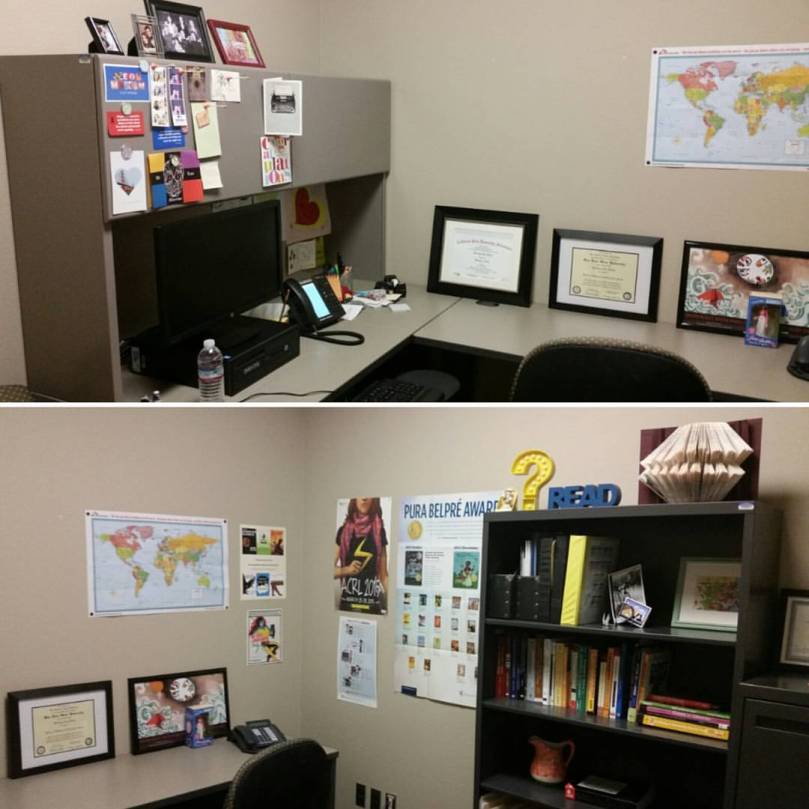
I also started cleaning out my office.

13071947_10156783673190573_7654611409594775529_o

Doing these things has also helped me realize that I was able to accomplish some good things in the three years I was full-time in Los Banos. Ultimately, I am glad I was able to be an energizing force on our small campus. Their librarian wasn’t a shushing, stern type. I was able to make small steps to get a more user-centered space. Culture is the hardest thing to shape, but I made progress. I was able to have some fun displays, contests, and activities, including Game Nights. Through these and other communication efforts, the faculty and student groups began to see and use the library as a campus hub. Our student government even had a campus suggestion box in the Library at one point. And let’s not forget about the food pantry! I feel great that the faculty and staff knew they could count on the Library to help, in both instructional and non-instructional efforts. I was able to build solid relationships in our campus community.

And the students knew they could count on me, too. To quote one of the student comments on my evaluation this year, “Definitely not the crusty old librarian stereotype.” I feel really good about that.

31

It’s been a while. March and April are busy months for me at work, and there was a stretch of time where I was feeling pretty disorganized on top of it. And maybe distracted knowing that I am heading to a new job in June, but, as always, I eventually come around. I bounce back. I turned 31 last Friday, and I can tell you that “bounce back” is my 21-31 theme.

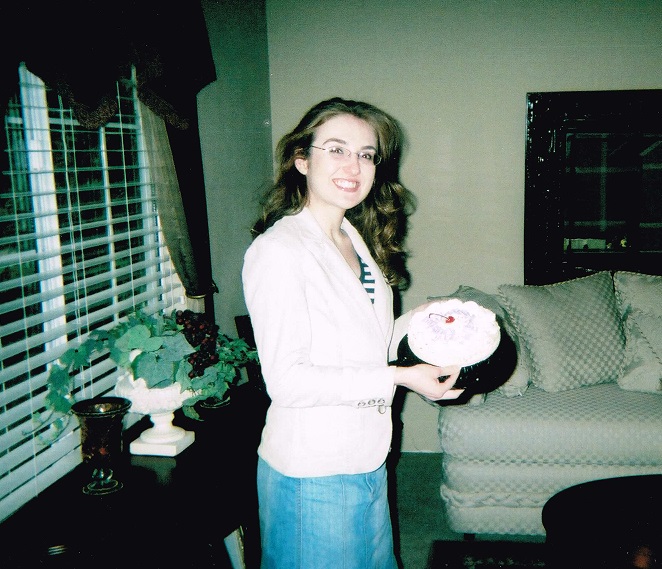
I’ve written about some of this before, but it’s good to reflect. I grew up in a small religious environment that was mostly built around immediate and extended family, and although I went to public school my entire life, I was shy and didn’t really live a life outside of school, home, and church.  When I was 19 and 20, I lost a lot of weight–almost 70 pounds. It started well enough, but by mid-2005, I was dieting excessively and addicted to exercise. I was finally thin and happy for a while, but in 2006, at 21, I was in a very sad, confusing period. I was unsure and insecure. Not that you can really tell in the photo below, taken on my 21st birthday, but I wore sweaters and blazers to cover up my thinness. (And I didn’t even eat any of that cake!) It took me a whole summer, fall, and winter to get out of my funk. I took off the Fall 2006 semester; I just couldn’t concentrate.

21

I didn’t know just how much my life would change that following spring. Around my 22nd birthday, in 2007, I met my now husband online via MySpace. (Hey, now, it was popular back then.) We had our first date on my birthday, and we’ve been together for nine years now.

I graduated from college in 2008. I got married in 2009. I graduated from graduate school in 2011. We bought a house in 2013. I also got my first full-time librarian job in 2013, and now I’m headed to the library at University of California Merced, the first library I ever volunteered at, in June.

At 31, I am really pleased with where I am. I am happy about where I am in my career and in my relationship with my husband. This is also the best I have ever felt about myself. I have come to accept many things about my(INFJ)self. Here’s a little list. 

  • I have a little rebellious streak. I wish I were a Phryne Fisher, but I’m a Dot who is at least brave enough to team up with Miss Fisher. I did go to both D.C. and Vegas by myself, after all.
  • I am creative. I sometimes wonder if I followed the academic path because I didn’t know any other alternatives.
  • I am a reflector.
  • I am always going to be a little shy. For example, my little secret is that I enjoy singing. But I will die first if you think I will ever reveal that side of me. I have the worst stage fright. Comparable to my fear of heights; just ask my husband about when we went to the Grand Canyon.
  • Underneath my reserved exterior, I am actually a little funny. Like, honestly, I did not see that one coming.

Also, rather than hate myself for not living up to certain standards, particularly expectations of others, I just focus on what I can do with the time and energy I have to give away. Lately, that’s taking care of me, which means no longer saying yes to every project or opportunity that comes my way: I quit that OER adult learning MOOC I mentioned I registered for a few posts back, and I am rethinking my plan to go back to graduate school, also mentioned a few posts back, too. Life is too short to do things you think you have to do, though my little overachieving heart is breaking as I type this.

Here’s to 31!

New Job!

Since I officially signed paperwork on Friday, I can share with the online world. (This actually is only partially true because I revealed on Facebook a few weeks ago.) I got a new job!

I’m the new instruction librarian at University of California Merced. I am really pleased to have a more specialized role and am looking forward to improving my instruction efforts. I start in June. I applied in October and interviewed in November and December. I informally accepted the offer right as winter break at Merced College, the community college where I currently work, ended. I am starting in June, so I can finish out the semester at the Los Banos Campus. I’m the only librarian during the day, so it was important for me to be here to get our students through the research rush in March and April.

Many people have asked me why I am leaving. There are some good things about my current job, but I’ve known for a couple of years that I was going to need to fill other desires I have for my career. The questions largely stem from the knowledge that I am leaving for a position where I will be working more for slightly less pay than what I make right now. I am leaving a 10-month tenure track faculty role for a 12-month non-faculty librarian position.

I do what I do because I want to help students on their educational path, but I also need to feel useful and that I am growing professionally. I will miss my librarian colleagues at the other campus and my colleagues in Los Banos, as well as assisting students from a variety of ages and experiences, but my personal happiness and growth are important. I am forever grateful to Merced College for giving me the opportunity to launch my professional career, first as an adjunct faculty member and then as a full-time faculty member, but it’s time for something new. I am nervous but excited.


Book Management: Weeding

Libraries sometimes get a lot of negative beef when it comes to getting rid of books. This isn’t done haphazardly. It’s part of our jobs to make room for newer materials and changing tastes based on demographics. In the case of a small community college campus, some years, it seems like all the writing courses are focused on food politics. Other semesters, the hot topic is social media, terrorism, gangs, etc. Materials also become out of date. Every time I get a new copy of one of those Opposing Viewpoints books, I send back the oldest version to the main library to be discarded.

Libraries don’t have  infinite room. Just like a closet, you need to clean out libraries to make room for classics, items that actually get used, items that are up to date, and new items. In libraries, we call this weeding. (The featured image on top includes a photo of books that were on our shelves that had seen better days.)

Collection management, I have learned, is not my favorite part of my job as a campus librarian. It’s a lot of work, and I don’t really have the right training to run reports on our integrated library system (ILS) to actually check when items were last checked out; I key in every book individually without a scanner (I need to ask the campus dean if we can buy  one) to find out those statistics.

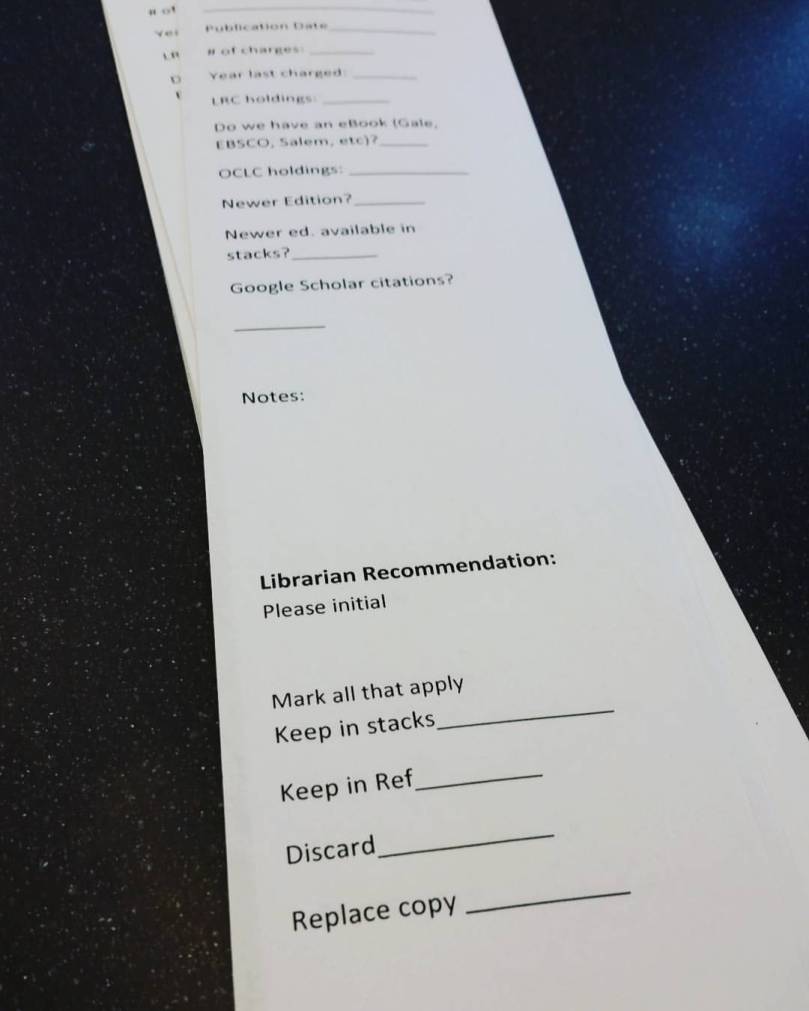
This year, to help me in the weeding process, I created weeding slips.

12339251_10156225714155573_9085277517327917766_o

They are based on the slips used by librarians at California State University Stanislaus, my undergraduate alma mater. (In addition to my full-time job, I also work at CSU Stanislaus one or two Sundays a month during the academic year.) The slips come in handy because I can fill out all the necessary criteria I need in order to send books to the main library for possible deselection. The librarians at the main library take a look at the notes on the slips, and the collection development officer, the library director (not my boss), makes the final decision. These is also a section on the slip where I indicate whether or not the main library has a copy of what I am sending, which also helps their weeding process. When they weed books, they also check to see if our campus has a copy. It’s been an effective system thus far.

Part of the weeding process also includes inviting faculty in the specific discipline to look over the items for potential weeding. I don’t get a lot traction on that front, so I do a two-week call. If no one comes, I send them on to the main library.

I weeded certain areas this fall, but the true masterpiece was the fiction section. Here is the before and after. I forgot to take a photo of the fiction section before I started weeding, but the photo on top is the biography section, which looks very similar to what fiction looked like before the weeding process. Now imagine both sides of the bookcase looking like the bottom photo. We now have breathing room!

12491849_10156337520805573_245962013041574957_o

With the new empty space, my plan is to put just a few books face-out on the shelves, like in bookstores. I do a lot of displays along the outer edge of the library, on our lower reference shelves, and it does encourage some circulation, but I like the idea of displaying books directly on the circulating shelves. I have students who tell me they like to browse when I notice them at the shelves and check to see if the students need help finding something. Because of the browsing behavior, I plan to make some signs in our signature lemon yellow to advertise putting items on hold from the other campus. I also want to advertise the eBook app available through the county library system, as well as let students know that they can put items on hold from across the county library system to pick up at the local library (a lot of them are surprised when I tell them they have access to way more than what is physically available at the local library). I did a hug sign re-haul last year, but I want to experiment with putting a few signs face-out on the shelves.

I also plan to tackle the biography and 900s (geography and history) sections in the spring semester.

Introduction to Teaching Online

I’ve been a little quiet on here. At the end of September I started a month-long online class through @One, Introduction to Teaching Online. The course is being offered through the college I work for and is supported by a grant from the Chancellor’s Office, California Community Colleges.

While I don’t teach the three-unit library research course, the main campus offers two sections, although neither are taught online. For the way my load is (the only librarian during the day), it would work better for me to teach it online, but it would need to get approval through curriculum, etc. I am just starting my third academic year, and it’s only now that I feel like I am ready to add a credit course to my load.

I am also using the class to see what our online instructors needs are regarding library or related services (I did my entire Masters program online, so I already had ideas) and to remind the other faculty members taking the class with me (all the people in the class teach for Merced College) that librarians are faculty. I have been able to market LibGuides and the Library’s soon-to-be-realized Blackboard presence (it will still be in baby mode, but I’m hoping we can work with our faculty lead to make it a bit more robust). One of the math teachers has been very encouraging as I figure out how to approach teaching an entire course since I have only ever taught one-shot research sessions. The class has also has served as a good reminder about effective teaching practices. I can definitely see how taking the class would help give even face-to-face courses a lift. I honestly would love to do the entire certification program.

My class ends next week, and I’m happy because it means I can get a little more sleep. My daily commute is about 2 hours and 45 minutes round trip, and I’m also trying to hit the gym a couple of nights a week. The only thing holding me together is my husband Kory. He has days off in the middle of the week, and while he has always helped a ton, including 99.9 percent of the cooking, he seems to have kicked it up that much more. He is very supportive, and I am grateful.

Exciting News!

I have some really exciting news!

I just found out that my request for 36 Microsoft Surface Pro 3 tablets for my small library was funded, at 33 percent of the request, through Merced College’s student equity funds! $16,000! The dean of my campus, the Los Banos Campus, says the rest of the amount will be funded with other monies.

Why Microsoft Surface Pro 3? They are the district-approved tablets. Why 36? There is a really cool charging cart that fits 36 tablets.

The library at my campus doesn’t have a library instruction room like the other campus, and I often have to fit sessions around the computer labs that are scheduled for other classes. Often, I go to classrooms without any computers, so students don’t get to play with databases during library research sessions.

When the tablets aren’t in use for classes, students will be able to check them out to use in the library. We only have 17 computers available in the library for 1,800 students, and our statistics were around 18,000 computer uses for 2014-2015. This does not include statistics for the open computer lab across the hall.

The Student Equity committee for the college created a document of goals for both campuses, so part of the application for funding had to show how the proposed project helped meet those goals. I also incorporated how the project met the college’s strategic plan and institutional learning outcomes and how it fit with the goals of the Learning Resource Center’s program review and student learning outcomes. I think my request was also funded, in part, because it serves an instructional purpose. I included a lot of evidence in the document, and my dean was impressed with what I put together.

I have been on pins and needles waiting for a response from the committee. I am so pleased! If we go off of the timeline I created for the project, we will begin our tablet service in Spring 2016.

The start of my third full-time academic year has been fantastic! My three-year review process also begins this coming Tuesday, so I am feeling pretty good.

Small Font Purpose

While I was planning the idea of blogging to help me through work while on a road trip though the southwest at the end of May/beginning of June, I came across a New York Times article called “The Small, Happy Life.” It’s had me thinking for over a month now. What really hits home is the following:

Terence J. Tollaksen wrote that his purpose became clearer once he began to recognize the “decision trap”: “This trap is an amazingly consistent phenomena whereby ‘big’ decisions turn out to have much less impact on a life as a whole than the myriad of small seemingly insignificant ones.”

Tollaksen continues, “I have always admired those goal-oriented, stubborn, successful, determined individuals; they make things happen, and the world would be lost without them.” But, he explains, he has always had a “small font purpose.”

Creativity at Work

Everyone Was An Artist in Kindergarten” is a nice, short reminder that “[c]reativity is as much about the ability to come up with ideas as it is about the courage to act on those ideas.”

I kind of lied about not knowing what I enjoy in librarianship, but it’s kind of hard to explain because, honestly, it’s not specific to LIS. My sister, who is majoring in child development, said what I like is “creating environments,” which is early childhood educator speak for setting up learning spaces.

Last summer, I took a class on user experience, one that I didn’t get a chance to take in graduate school, after I completed half of the Hyperlinked Library MOOC in Fall 2013. I started a brand new job, and it was too hard to complete all the modules, but they left a deep impression on me.

I hands down really believe in “thinking like a startup.” I have tried a lot of different things in the library at my campus without concern for whether they actually will work (these things don’t cost money). And trust me, I have failed a lot, but it’s through failure that you realize what will or won’t work. You just have to try, work through your ideas with others who might not really get what you’re trying to do, and have the tenacity to keep trying.

I remember one of the student assistants asking me what the goal was when I started our first campus game night in Fall 2014. “We’re just going to hangout, and get to know people.” I didn’t think lots of people would come, but, hey, we have no campus life besides one student club. What have we got to lose? As it turns out, the students I approached to plan a game night were thrilled. The first time we put one on, we had faculty and the dean attend and play games! The dean played Cards Against Humanity with students, and she had fun. Although we didn’t get any faculty the second time, people asked how it went the next day. We only have about 15 students each time, but for a campus with no campus life and one that’s located off a highway, it’s great.

Another thing I started that I worried might not work were interactive posters outside the library doors across from the open computer lab. Every two weeks, I make a banner out of butcher paper, ask a question, and then I supply Post-It notes and washable markers for students to write responses. It’s so low-tech, but, much to my delight, students participate. I did learn that the plainer the Post-Its the better, though; cool colors get stolen. I did have some people who liked to report the inappropriate responses and gather them up with a note at my desk or have a word with me, but that’s the part where you just smile and say thank you. (Inside, you get a little crazy and imagine yourself ripping the pieces into teeny tiny little pieces and flinging them like confetti…)

I also got a little bit of backlash against providing Starbursts and Crunch Bars during finals week because there were a few candy wrappers on the ground, but it was one of those moments where I just had to say it was just for the week, and it was pretty easy to just throw them away. (I can only handle so much, guys.)

For me, being able to be creative in my work is really important. I didn’t really realize how important this was, but when I look back on school assignments and projects I liked the most, it involved making something, mostly visuals or something related to art (this was before STEM and STEaM times). I also realize that why I really loved one of my first library jobs as a bilingual story time teller was the thematic planning. During Halloween one year, I put together a black and white story time that included a shadow puppet show and a chalk and construction paper craft. I only worked 14 hours a week in that position, and I prepped my little heart out for that program.

Even though I sometimes wonder about the value of the extra details I place on interactivity and participation when things don’t go right, I have to remind myself that some people do notice. Needless to say, I was thrilled when the history/political science professor approached me about setting up a Constitution Day quiz in the Library. It’s a 15-question Scantron that students put into a large glass jar at the check-out desk; those who score the highest are placed into a drawing for a Starbucks gift card. You can also bet that I put together a Constitution Day book display.

As someone who was naturally good at the school thing and who is an academic librarian, I do get nervous that my dream doesn’t necessarily include publishing scholarly literature (part of it is that I don’t have a specific research area of interest). I just don’t really see myself doing that kind of scholarly life, and I think I have been struggling with how the reconcile that in the midst of all this great work former classmates are doing in their lives.

While my spring semester was a little rough, the highlight of my fall semester was the dean indicating that my greatest asset is creativity during my second-year review. I suppose I am doing something right.