Graduate School Part 2?

So I am thinking even more seriously about applying to graduate school for a second Master’s degree. I got my MLIS in December 2011, and for the last couple of years, I have been looking at various instructional design and learning design technology Master’s programs. The impetus was when I took SJSU’s MOOC, the Hyperlinked Library in Fall 2013, though I was only able to do half of the modules, and User Experience through SJSU’s iSchool Open Classes in Summer 2014. I also took Introduction to Teaching Online through @One in Fall 2015.

The MLIS and M.S. in ID go really well together (see Bell’s “MLD: Masters in Library Design, Not Science” and Bertot, Sarin, and Percell’s “Re-Envisioning the MLS: Findings, Issues, and Considerations“). If anything, I am really interested in a certificate option, but then my brain says, well, you could have a whole second graduate degree with just five or so more classes. I have researched and talked to various people about this, and I’m a little bummed I waited so long, but I think I am ready to dive and apply! I have a little more motivation with some upcoming changes in my work life.

To jump start my desire to get into ID, I am taking a MOOC, Instructional Design Service Course: Gain Experience for Good, which starts in February.  This one appeals to me because it’s free, the time commitment is only 2-3 hours a week (way less than the class I did this past fall), and it also deals with OER and adult learners. Many points here!

RUSA, the Reference and User Services Association, is offering Introduction to Instructional Design for Librarians from Mon., Feb. 8th to Sun., March 20th. It costs $175 for ALA members, which I am. If you’re a RUSA member, it’s $130. If you’re a student, it’s $100. It’s a great deal, but there are live chats every Monday at 5 pm.

Sadly, I missed Digital Pedagogy’s the MOOC MOOC: Instructional Design announcement. It started on Mon., Jan. 25th and it ends on Fri., Feb. 12th. However, it looks like you could probably jump in. All the readings are listed!

Library Juice also offers ID, UX, and information literacy related courses. My only reasoning for not wanting to fork over $175-$250 for each of these is that I would rather spend money and time on credit-bearing courses from a university because I am interested in a second Master’s degree. I have no qualms related to MOOCs or paid independent classes or workshops for professional development; it’s just that my needs and interests are different.  The following are some classes scheduled to begin in February, March, and April.

Concepts of User-Centered Design This class started on Mon., Feb 1st, but you can register through the first week.

Online Instructional Design and Delivery

Introduction to Accessibility and Universal Design in Libraries

I also got a list of suggested readings from a listserv.

Michael Allen has several excellent titles regarding instructional design.

Articulate’s Rapid eLearning Blog

Booth, C. (2011). Reflective teaching, effective learning: Instructional literacy for library educators. Chicago, IL: American Library Association.

Brown, A., & Green, T. D.  (2016). The essentials of instructional design: Connecting fundamental principles with process and practice (3rd ed.). Boston, MA: Prentice Hall.

Clark, R. C., & Mayer, R. E. (2011). E-learning and the science of instruction: Proven guidelines for consumers and designers of multimedia learning (3rd ed.). San Francisco, CA: Pfeiffer.Note from someone: Clark & Mayer book E-Learning and the Science of Instruction, though having a few fundamental flaws, is still pretty good. I’d say about 60-75% of the information is quite good. So worth reading. There is now a 4th ed.

Dick, W., Carey, L., & Carey, J. O. (2015). The systematic design of instruction (8th ed.). Boston, MA: Pearson.

Dirksen, J. (2012). Design for how people learn. Berkeley, CA: New Riders.

Heinich, R. (Ed.). (1996). Instructional media and technologies for learning. Englewood Cliffs, NJ: Merrill.

Larson, M. B., & Lockee, B. B. (2014). Streamlined ID: A practical guide to instructional design. New York, NY: Routledge, Taylor, and Francis.

Mayer, R. E. (2012). Multimedia learning (2nd ed.). Cambridge: Cambridge University Press. Note from someone: a little problematic regarding best practices.

Morrison, G.R., Ross, S.M., Kalman, H.K., & Kemp, J.E. (2013). Designing effective instruction (7th ed.). Hoboken: John Wiley & Sons.

Piskurich, G. M. (2015). Rapid instructional design: Learning ID fast and right. Hoboken, N.J.: John Wiley & Sons, 2015.

Trends and Issues in Instructional Design and Technology

Smith, P. L., & Ragan, T. J. (2005). Instructional design. Hoboken, NJ: J. Wiley & Sons.

Wiggins, G. P., & McTighe, J. (2005). Understanding by design (2nd ed.). Alexandria, VA: Association for Supervision and Curriculum Development.

This is obviously not a thorough list. Please share resources.

If you’ve taken the plunge into instructional design in your job or are working on/already have a second Master’s degree in ID post-MLIS, do let me know.  I’d love to hear about your work and experiences.

Food Pantries in Community College Libraries

I have been under the weather since before the New Year (a cold, then a sinus infection, and now bronchitis), so I have been a little neglectful lately, but I think tonight’s post will make up for it. I’m excited, anyway.

The campus I work for is right outside the small city’s limits, serving the western side of Merced County, a county known for low levels of education, which is typical of the Central Valley in general. The campus had a headcount of 1,800 students this past fall at census. One quarter of our students are part-time students. Many are parents. We don’t have food service, and we have a very small library, small tutoring center, and small student lounge. We have 19 full-time faculty: 5 English instructors, 4 math instructors, 3 science instructors, 3 counselors, 1 psychology/sociology instructor, 1 history/political science instructor, 1 communications instructor, and 1 librarian (me).

The beauty of working at the smaller campus of a community college is that small teams can often get quicker results and be a little more innovative due to a lack of resources. Because we are so small, we work together quite often and are always thinking of ways to meet our students needs, needs that are not always academic in nature but that certainly affect their ability to stay in school. This past fall, some of the women faculty members got together at an area restaurant before a faculty meeting as a way to begin to get to know our new biology instructor. At the lunch, the chemistry instructor brought up the idea of creating a small food pantry for students in need but wanted ideas for how to make it private and where it should be located. I saw my opportunity.

Our small library has a back workroom. We keep some old periodicals and supplies in there, and it is also our break area with a fridge and table. We also keep off-season textbook reserves in there. When our part-time library media technician retired this past May, I was finally able to throw things out and work with our new full-time technician, formerly our part-time clerk, to get organized and clear the mess. It’s still wasn’t perfect at the time I made this suggestion, but I immediately mentioned to our chemistry professor that we were making room. They could use a small part of our workroom shelving to house a food pantry. Of the two buildings on campus, we are the area that is opened the longest (the front office closes at 4:30 pm on Monday-Friday, and we stay open until 8 pm Monday-Thursday and until 3 on Friday, though our technician doesn’t really leave until 4 pm on Friday), and no unauthorized people can get to the workroom. The idea is that students in need, with their student I.D., can go to any staff or faculty member or administrator, and be walked to the library workroom to get food.

We got permission from our campus dean, and while we haven’t worked out all the logistics quite yet, we decided not to advertise that it is in the library because we want it to be a little more discreet. I didn’t make the graphic for the posters we’re putting up around campus, but they are absolutely fine and will get the job done. I’ll be displaying the information inside and outside the library, and the counselors are also on board.

Interestingly, over the winter break, both The Atlantic and Inside Higher Ed shared posts about student hunger on community college campuses. It rings so true with our student population.

I am proud to introduce the beginning of our campus’ food pantry. Our chemistry instructor stocked us up with some non-perishables during the first week of the spring semester. 12615148_10156408358120573_604629448180132362_o

Small campuses with small libraries with caring faculty can make a world of difference. I am a regular financial giver to area food pantries, and I can’t believe this idea never occurred to me before. I am so thankful for our faculty and the enormous amount of nontraditional collaboration I have been able to do here.

Does your community college, college, or university have a food pantry? How are your faculty involved? How is your library or library faculty and/or library staff involved? Let me know!

UC Merced, which is the closest university to the larger community college campus, has one, and I believe I read somewhere that our community college students who live in Merced can also access it. I would love to do a little research on this topic in our area.

Copyright and Fair Use & OA and OER

The one thing I did not do in library graduate school was to spend a lot of dedicated time on copyright and other related issues. I’m definitely feeling the crunch, particularly in light of the open access (OA) and open educational resources (OER) movements in higher education. Over the summer, I was very impressed with the University of  Maryland University College‘s move to open digital resources for undergraduate education. Here is Barbara Fister’s overview of recent developments in OA during Open Access Week this past fall. Adding to the recent developments in OA that Fister lists, just today I read that the Oberlin Group, with the backing of liberal arts colleges, launched Lever Press.

In the CJCLS listserv this fall, someone posted the following report, “Opening Public Institutions: OER in North Dakota and the Nation, 2015,” and asked where all the community college librarians were in helping to lead OA/OER on their campuses. Here are some resources some people shared from that listserv, as well as some resources from a question about open textbooks from the ILI listserv:

Affordable Learning Georgia

College Open Textbooks

Lansing Community College’s OER Summit

Lansing Community College’s OER LibGuide

Northwestern Michigan College OER LibGuide 

Open Textbook Library

University of Maryland University College OER LibGuide

OA and OER are subjects I follow, but not to the degree I would like. One of the challenges is that our community college is not part of the Community College Consortium for Open Educational Resources, but according to the website “[i]ndividuals, whether they represent Consortium members or not, are welcome to use and modify materials and resources found on this website, and to participate in webinars and other Consortium activities.” I just got added to the CCCOER Advisory Google Group, so I hope to gain more knowledge. They also have a YouTube channel. I suspect that with the push for distance education in our college district, and some of the buzz that was generated by a student leader about open textbooks to the Academic Senate, we will become more involved. As the newer librarian two years away from tenure, it’s difficult to broach these subjects, but I am preparing. In fact, I took an online “how to teach an online” class this past fall with other faculty members more to see what the faculty were saying regarding content for courses, etc. There is a need for OER there.

Someone also pointed me to SPARC, the Scholarly Publishing and Academic Resources Coalition.

Here are some relevant conferences. The 12th Annual Open Education Conference was in Vancouver this past November, so I plan to take a gander at the website for #OpenEd2015. I was really bummed that San Jose State University’s one-day Open Access Conference 2015 was during a planned mini vacation. I will be on the lookout for this year’s conference dates.

I definitely also need to carve out time to watch the Blended Librarian recorded webcast On Becoming Open Education Leaders. Librarians really are in the fantastic position to lead the movement, and there are some college’s that have specific OER/OA librarians. How neat!

(As I was finishing up this post, someone posted about Project CORA, Community of Online Research Assignments: An Open Access Resource for Faculty and Librarians. I am so excited! This “library” will really enhance my information literacy instruction work!)

Another thing I have been meaning to do over the winter break is to start the the Coursera course Copyright for Educators and Librarians (librarians are educators, but okay). I still have time to begin  before I go back to work, though.

I sense a theme among some of the links I’ve been collecting over the last few months, as well.

Code of Best Practices in Fair Use for the Visual Arts

Code of Best Practices in Fair Use for Online Video 

Digital Media Law Project’s Fair Use webpage

The Berkman Center for Internet & Society and Electronic Information for Libraries (EIFL)‘s Copyright for Librarians

I also find BYU’s Copyright 101 modules to be helpful. The videos don’t really look modern, but they now have captions!

Napa: Eats, Antiques, & Library Tourism

In October, my husband and I went on a romantic getaway to Napa. Neither of us had ever been to Napa, and we only live two hours away. I don’t know why we hadn’t done it before. While there, we saw traces of the damage the earthquake had done in August 2014, but we saw a community that was vibrant and confident.

Our hotel had a homemade chocolate chip cookie hour at 6 pm. Yum!

I really enjoyed the plant life. I don’t have a super green thumb, but I do appreciate nature and am okay with low-maintenance plants.

We ate at Celadon and at The Pear Southern Bistro, checked out the Riverfront, watched an Americana show, and got our antiquing fix at Antiques on Second where we picked up a theater-style bench for our front door area, a corduroy blazer for me, and a couple of vintage necklaces. We also made a quick stop to the Oxbow Public Market. I picked up some cranberry and white polka-dot (I am really into polka-dots) Keds at a chain department store when my feet were giving out from the flats and boots I brought with me.

We also went to Napa Bookmine.

I also, unexpectedly, came across a September 11th Memorial. I noticed a structure of some kind outside a store, and I didn’t realize what it was until I got close to the sign. I was looking at beams from the World Trade Center.

12182510_10156121313570573_8853133339227254863_o

We made an impromptu trip to the Napa County Library, and I was not let down. What a gorgeous, modern library! Study rooms for days, different seating arrangements, lovely signage, and it was busy! People reading, people browsing, and people finishing up activities from the first annual How-To Festival. The staff were above and beyond amazing! I introduced myself and one of the staff members (I am so sad that I can’t remember her name anymore; I meant to send an email about the spectacular customer service we received) showed me a project they did involving a succulent planter made out of a book. I love succulents, so I was very into this! She also gave me a book art example that she had made for the book art activity from earlier that day. You rock, Napa County Library!

This slideshow requires JavaScript.

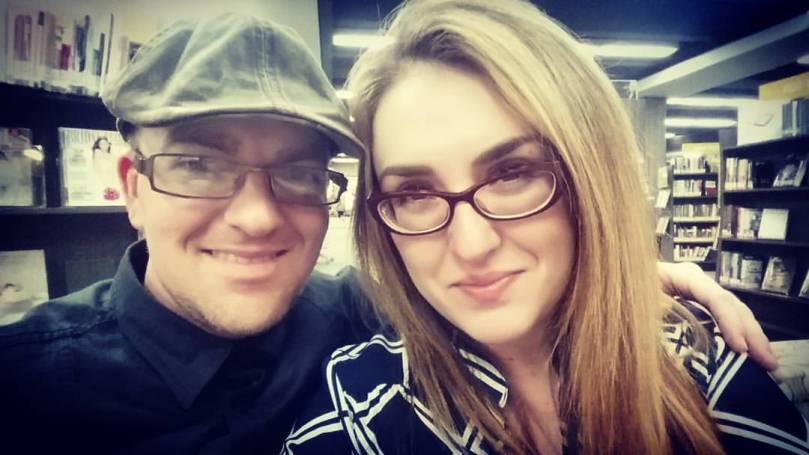
We had a really great trip! We did an epic Souhtwest adventure this past summer, so this getaway was just perfect. Short and sweet! We actually used the photo below for our Christmas cards this year. At the library, where else?

10003800_10156121104510573_5062361498310736290_o (1)

Book Management: Weeding

Libraries sometimes get a lot of negative beef when it comes to getting rid of books. This isn’t done haphazardly. It’s part of our jobs to make room for newer materials and changing tastes based on demographics. In the case of a small community college campus, some years, it seems like all the writing courses are focused on food politics. Other semesters, the hot topic is social media, terrorism, gangs, etc. Materials also become out of date. Every time I get a new copy of one of those Opposing Viewpoints books, I send back the oldest version to the main library to be discarded.

Libraries don’t have  infinite room. Just like a closet, you need to clean out libraries to make room for classics, items that actually get used, items that are up to date, and new items. In libraries, we call this weeding. (The featured image on top includes a photo of books that were on our shelves that had seen better days.)

Collection management, I have learned, is not my favorite part of my job as a campus librarian. It’s a lot of work, and I don’t really have the right training to run reports on our integrated library system (ILS) to actually check when items were last checked out; I key in every book individually without a scanner (I need to ask the campus dean if we can buy  one) to find out those statistics.

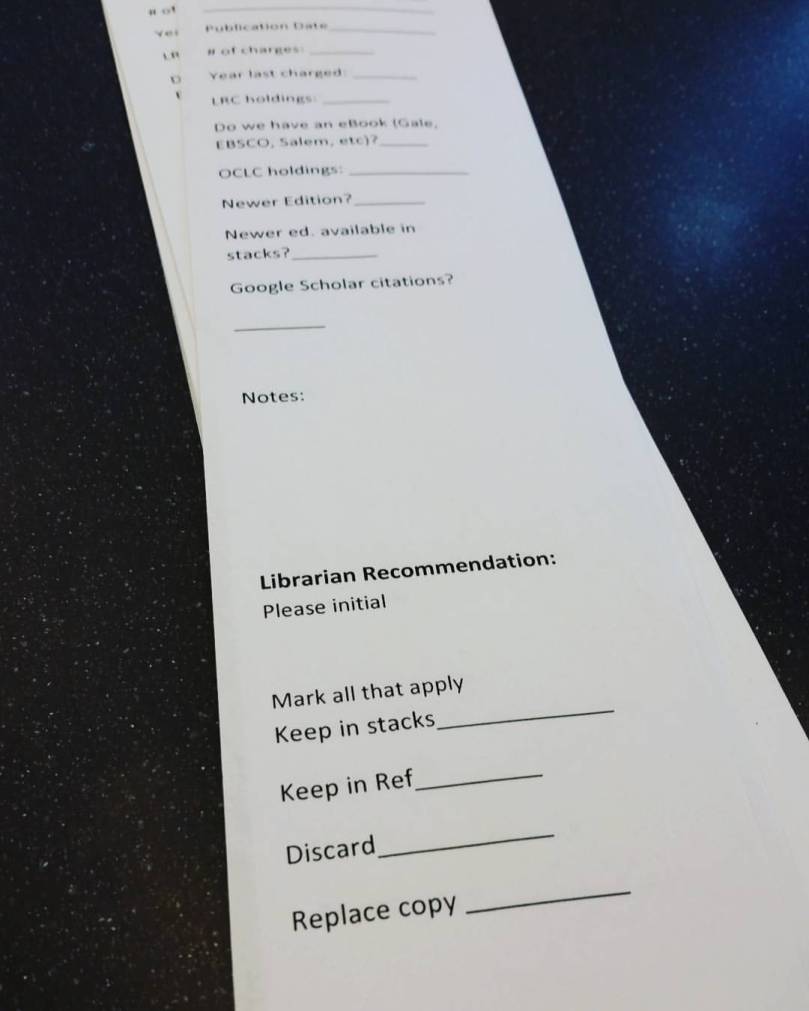
This year, to help me in the weeding process, I created weeding slips.

12339251_10156225714155573_9085277517327917766_o

They are based on the slips used by librarians at California State University Stanislaus, my undergraduate alma mater. (In addition to my full-time job, I also work at CSU Stanislaus one or two Sundays a month during the academic year.) The slips come in handy because I can fill out all the necessary criteria I need in order to send books to the main library for possible deselection. The librarians at the main library take a look at the notes on the slips, and the collection development officer, the library director (not my boss), makes the final decision. These is also a section on the slip where I indicate whether or not the main library has a copy of what I am sending, which also helps their weeding process. When they weed books, they also check to see if our campus has a copy. It’s been an effective system thus far.

Part of the weeding process also includes inviting faculty in the specific discipline to look over the items for potential weeding. I don’t get a lot traction on that front, so I do a two-week call. If no one comes, I send them on to the main library.

I weeded certain areas this fall, but the true masterpiece was the fiction section. Here is the before and after. I forgot to take a photo of the fiction section before I started weeding, but the photo on top is the biography section, which looks very similar to what fiction looked like before the weeding process. Now imagine both sides of the bookcase looking like the bottom photo. We now have breathing room!

12491849_10156337520805573_245962013041574957_o

With the new empty space, my plan is to put just a few books face-out on the shelves, like in bookstores. I do a lot of displays along the outer edge of the library, on our lower reference shelves, and it does encourage some circulation, but I like the idea of displaying books directly on the circulating shelves. I have students who tell me they like to browse when I notice them at the shelves and check to see if the students need help finding something. Because of the browsing behavior, I plan to make some signs in our signature lemon yellow to advertise putting items on hold from the other campus. I also want to advertise the eBook app available through the county library system, as well as let students know that they can put items on hold from across the county library system to pick up at the local library (a lot of them are surprised when I tell them they have access to way more than what is physically available at the local library). I did a hug sign re-haul last year, but I want to experiment with putting a few signs face-out on the shelves.
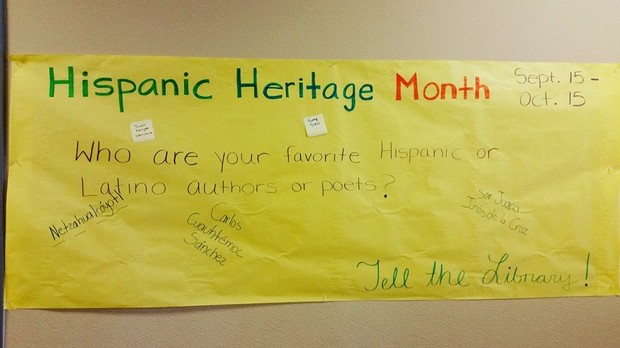
I also plan to tackle the biography and 900s (geography and history) sections in the spring semester.

Refocusing Information Literacy Instruction Under the Framework: Changes & Challenges Presentation

In early December,  I gave a 30 minute presentation, Refocusing Information Literacy Instruction Under the Framework: Changes and Challenges, followed by a 20-minute question and answer session. The link opens to a Google Slides presentation. You can find the works I consulted for this on the last two slides. For more information about the threshold concepts, please see:

ACRL. (n.d.). Annotated bibliography of threshold concepts. Retrieved from http://www.ala.org/acrl/issues/infolit/teaching/thresholdbib

This is a significant presentation in that it is my first academic presentation on an aspect of librarianship. Sure, I do presentations and teaching sessions for students, presentations on introducing library services to new part-time faculty during orientations, and I have taught with a colleague about Google Drive and Google Tools for back-to-work professional development sessions, but this was different because it was presented to library staff and librarians outside the college where I work.


Art + Library = Fun(draising)

Mod Shop

Small Business Saturday is coming up this Saturday, November 28th, and my city puts on a fantastic event downtown that I am always excited about–The Mod Shop: Indie Crafters Market! The stores downtown open their spaces for local artists and artisans to sell their artwork and wares. Here is some history from the local paper.

This year, my sister and sister-in-law will be joining forces to sell cup cozies and purses. Last year, my friend Angela sold stationary (she doesn’t sell anymore, otherwise, I’d post the link to her Etsy shop). Last year and again this year, fellow librarian–and now published poet–Stella Beratlis and our town’s former poet laureate Gillian Wegener will be typing up poems on the spot.

The event always reminds me of a great fundraiser the Friends of the Los Banos (public) Library put on every October–the Small Works of Art Sale. Here is an article about this year’s event from Los Banos’ local paper. Since I began working in Los Banos as the town’s college librarian, I help sell tickets and man tables during the event to show my support. Essentially, the Library closes a little early, so local artists and artisans can show off and sell art and wares, the proceeds of which go to the Friends. There is also wine and delicious goodies. Tickets are just $20 a piece. It’s so great to see members of the community all come together to hang out, buy art, and support their local library.

Textured Forest Painting

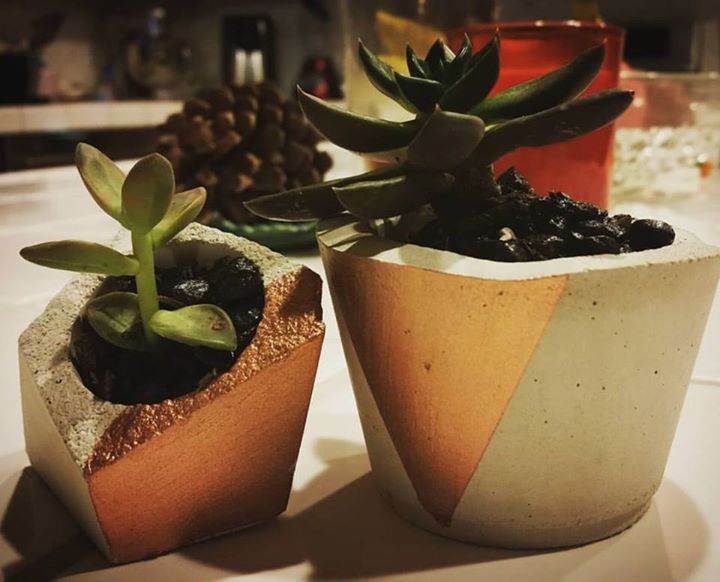
This year, I manned a table of succulents in handcrafted chic concrete pots and some modern wall hangings by United by Form. These were the only wares and artworks not created by someone local, but the artist is a friend of the daughter of one of the Friends’ members. I have a profound love for succulents, so I bought a couple for myself.

United by Form Business Card

Succulent on Block of Wood

Succulents in Concrete and Copper

Wall Hangings

What kind of fundraisers does your library’s Friends’ group do? The Friends of the Los Banos Library also do a Used Book Sale every fall and spring, which I know are popular among many public library Friends’ groups. Is a small works of art sale something you think would work well for your local Friends? Let me know if your Friends’ group decides to put one on.

October 2015 Library Displays

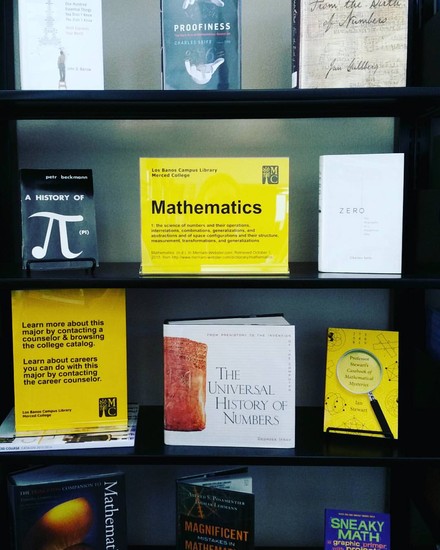
In October, I had two Major Idea displays (see the August 2015 Library Displays post to learn more about what this is), one about math and another about English, which focused on fairy tales as a theme to explore literature studies.

English

Mathematics

October 15th was also the end of Hispanic Heritage Month. See the September 2015 Library Displays post about it here..

I also put together a quick display for Breast Cancer Awareness Month, which included directions for conducting a breast self-exam in both English and Spanish. I snagged up the instructions during an event our campus had last year that had booths from the community, including the local health center.

Breast Cancer Awareness Month

One of our part-time evening librarians put together our Halloween display this year, for which I am very grateful. Here’s the online flyer I made for her display. Since I have more people to rely on in the library and now know what can be delegated, it’s been fun to see others’ creativity.

Halloween

October is always the beginning of research paper season around here, so it’s been busy! I’ll have to share more about that soon.

Introduction to Teaching Online

I’ve been a little quiet on here. At the end of September I started a month-long online class through @One, Introduction to Teaching Online. The course is being offered through the college I work for and is supported by a grant from the Chancellor’s Office, California Community Colleges.

While I don’t teach the three-unit library research course, the main campus offers two sections, although neither are taught online. For the way my load is (the only librarian during the day), it would work better for me to teach it online, but it would need to get approval through curriculum, etc. I am just starting my third academic year, and it’s only now that I feel like I am ready to add a credit course to my load.

I am also using the class to see what our online instructors needs are regarding library or related services (I did my entire Masters program online, so I already had ideas) and to remind the other faculty members taking the class with me (all the people in the class teach for Merced College) that librarians are faculty. I have been able to market LibGuides and the Library’s soon-to-be-realized Blackboard presence (it will still be in baby mode, but I’m hoping we can work with our faculty lead to make it a bit more robust). One of the math teachers has been very encouraging as I figure out how to approach teaching an entire course since I have only ever taught one-shot research sessions. The class has also has served as a good reminder about effective teaching practices. I can definitely see how taking the class would help give even face-to-face courses a lift. I honestly would love to do the entire certification program.

My class ends next week, and I’m happy because it means I can get a little more sleep. My daily commute is about 2 hours and 45 minutes round trip, and I’m also trying to hit the gym a couple of nights a week. The only thing holding me together is my husband Kory. He has days off in the middle of the week, and while he has always helped a ton, including 99.9 percent of the cooking, he seems to have kicked it up that much more. He is very supportive, and I am grateful.