Graduate School Part 2?

So I am thinking even more seriously about applying to graduate school for a second Master’s degree. I got my MLIS in December 2011, and for the last couple of years, I have been looking at various instructional design and learning design technology Master’s programs. The impetus was when I took SJSU’s MOOC, the Hyperlinked Library in Fall 2013, though I was only able to do half of the modules, and User Experience through SJSU’s iSchool Open Classes in Summer 2014. I also took Introduction to Teaching Online through @One in Fall 2015.

The MLIS and M.S. in ID go really well together (see Bell’s “MLD: Masters in Library Design, Not Science” and Bertot, Sarin, and Percell’s “Re-Envisioning the MLS: Findings, Issues, and Considerations“). If anything, I am really interested in a certificate option, but then my brain says, well, you could have a whole second graduate degree with just five or so more classes. I have researched and talked to various people about this, and I’m a little bummed I waited so long, but I think I am ready to dive and apply! I have a little more motivation with some upcoming changes in my work life.

To jump start my desire to get into ID, I am taking a MOOC, Instructional Design Service Course: Gain Experience for Good, which starts in February.  This one appeals to me because it’s free, the time commitment is only 2-3 hours a week (way less than the class I did this past fall), and it also deals with OER and adult learners. Many points here!

RUSA, the Reference and User Services Association, is offering Introduction to Instructional Design for Librarians from Mon., Feb. 8th to Sun., March 20th. It costs $175 for ALA members, which I am. If you’re a RUSA member, it’s $130. If you’re a student, it’s $100. It’s a great deal, but there are live chats every Monday at 5 pm.

Sadly, I missed Digital Pedagogy’s the MOOC MOOC: Instructional Design announcement. It started on Mon., Jan. 25th and it ends on Fri., Feb. 12th. However, it looks like you could probably jump in. All the readings are listed!

Library Juice also offers ID, UX, and information literacy related courses. My only reasoning for not wanting to fork over $175-$250 for each of these is that I would rather spend money and time on credit-bearing courses from a university because I am interested in a second Master’s degree. I have no qualms related to MOOCs or paid independent classes or workshops for professional development; it’s just that my needs and interests are different.  The following are some classes scheduled to begin in February, March, and April.

Concepts of User-Centered Design This class started on Mon., Feb 1st, but you can register through the first week.

Online Instructional Design and Delivery

Introduction to Accessibility and Universal Design in Libraries

I also got a list of suggested readings from a listserv.

Michael Allen has several excellent titles regarding instructional design.

Articulate’s Rapid eLearning Blog

Booth, C. (2011). Reflective teaching, effective learning: Instructional literacy for library educators. Chicago, IL: American Library Association.

Brown, A., & Green, T. D.  (2016). The essentials of instructional design: Connecting fundamental principles with process and practice (3rd ed.). Boston, MA: Prentice Hall.

Clark, R. C., & Mayer, R. E. (2011). E-learning and the science of instruction: Proven guidelines for consumers and designers of multimedia learning (3rd ed.). San Francisco, CA: Pfeiffer.Note from someone: Clark & Mayer book E-Learning and the Science of Instruction, though having a few fundamental flaws, is still pretty good. I’d say about 60-75% of the information is quite good. So worth reading. There is now a 4th ed.

Dick, W., Carey, L., & Carey, J. O. (2015). The systematic design of instruction (8th ed.). Boston, MA: Pearson.

Dirksen, J. (2012). Design for how people learn. Berkeley, CA: New Riders.

Heinich, R. (Ed.). (1996). Instructional media and technologies for learning. Englewood Cliffs, NJ: Merrill.

Larson, M. B., & Lockee, B. B. (2014). Streamlined ID: A practical guide to instructional design. New York, NY: Routledge, Taylor, and Francis.

Mayer, R. E. (2012). Multimedia learning (2nd ed.). Cambridge: Cambridge University Press. Note from someone: a little problematic regarding best practices.

Morrison, G.R., Ross, S.M., Kalman, H.K., & Kemp, J.E. (2013). Designing effective instruction (7th ed.). Hoboken: John Wiley & Sons.

Piskurich, G. M. (2015). Rapid instructional design: Learning ID fast and right. Hoboken, N.J.: John Wiley & Sons, 2015.

Trends and Issues in Instructional Design and Technology

Smith, P. L., & Ragan, T. J. (2005). Instructional design. Hoboken, NJ: J. Wiley & Sons.

Wiggins, G. P., & McTighe, J. (2005). Understanding by design (2nd ed.). Alexandria, VA: Association for Supervision and Curriculum Development.

This is obviously not a thorough list. Please share resources.

If you’ve taken the plunge into instructional design in your job or are working on/already have a second Master’s degree in ID post-MLIS, do let me know.  I’d love to hear about your work and experiences.

Food Pantries in Community College Libraries

I have been under the weather since before the New Year (a cold, then a sinus infection, and now bronchitis), so I have been a little neglectful lately, but I think tonight’s post will make up for it. I’m excited, anyway.

The campus I work for is right outside the small city’s limits, serving the western side of Merced County, a county known for low levels of education, which is typical of the Central Valley in general. The campus had a headcount of 1,800 students this past fall at census. One quarter of our students are part-time students. Many are parents. We don’t have food service, and we have a very small library, small tutoring center, and small student lounge. We have 19 full-time faculty: 5 English instructors, 4 math instructors, 3 science instructors, 3 counselors, 1 psychology/sociology instructor, 1 history/political science instructor, 1 communications instructor, and 1 librarian (me).

The beauty of working at the smaller campus of a community college is that small teams can often get quicker results and be a little more innovative due to a lack of resources. Because we are so small, we work together quite often and are always thinking of ways to meet our students needs, needs that are not always academic in nature but that certainly affect their ability to stay in school. This past fall, some of the women faculty members got together at an area restaurant before a faculty meeting as a way to begin to get to know our new biology instructor. At the lunch, the chemistry instructor brought up the idea of creating a small food pantry for students in need but wanted ideas for how to make it private and where it should be located. I saw my opportunity.

Our small library has a back workroom. We keep some old periodicals and supplies in there, and it is also our break area with a fridge and table. We also keep off-season textbook reserves in there. When our part-time library media technician retired this past May, I was finally able to throw things out and work with our new full-time technician, formerly our part-time clerk, to get organized and clear the mess. It’s still wasn’t perfect at the time I made this suggestion, but I immediately mentioned to our chemistry professor that we were making room. They could use a small part of our workroom shelving to house a food pantry. Of the two buildings on campus, we are the area that is opened the longest (the front office closes at 4:30 pm on Monday-Friday, and we stay open until 8 pm Monday-Thursday and until 3 on Friday, though our technician doesn’t really leave until 4 pm on Friday), and no unauthorized people can get to the workroom. The idea is that students in need, with their student I.D., can go to any staff or faculty member or administrator, and be walked to the library workroom to get food.

We got permission from our campus dean, and while we haven’t worked out all the logistics quite yet, we decided not to advertise that it is in the library because we want it to be a little more discreet. I didn’t make the graphic for the posters we’re putting up around campus, but they are absolutely fine and will get the job done. I’ll be displaying the information inside and outside the library, and the counselors are also on board.

Interestingly, over the winter break, both The Atlantic and Inside Higher Ed shared posts about student hunger on community college campuses. It rings so true with our student population.

I am proud to introduce the beginning of our campus’ food pantry. Our chemistry instructor stocked us up with some non-perishables during the first week of the spring semester. 12615148_10156408358120573_604629448180132362_o

Small campuses with small libraries with caring faculty can make a world of difference. I am a regular financial giver to area food pantries, and I can’t believe this idea never occurred to me before. I am so thankful for our faculty and the enormous amount of nontraditional collaboration I have been able to do here.

Does your community college, college, or university have a food pantry? How are your faculty involved? How is your library or library faculty and/or library staff involved? Let me know!

UC Merced, which is the closest university to the larger community college campus, has one, and I believe I read somewhere that our community college students who live in Merced can also access it. I would love to do a little research on this topic in our area.

Copyright and Fair Use & OA and OER

The one thing I did not do in library graduate school was to spend a lot of dedicated time on copyright and other related issues. I’m definitely feeling the crunch, particularly in light of the open access (OA) and open educational resources (OER) movements in higher education. Over the summer, I was very impressed with the University of  Maryland University College‘s move to open digital resources for undergraduate education. Here is Barbara Fister’s overview of recent developments in OA during Open Access Week this past fall. Adding to the recent developments in OA that Fister lists, just today I read that the Oberlin Group, with the backing of liberal arts colleges, launched Lever Press.

In the CJCLS listserv this fall, someone posted the following report, “Opening Public Institutions: OER in North Dakota and the Nation, 2015,” and asked where all the community college librarians were in helping to lead OA/OER on their campuses. Here are some resources some people shared from that listserv, as well as some resources from a question about open textbooks from the ILI listserv:

Affordable Learning Georgia

College Open Textbooks

Lansing Community College’s OER Summit

Lansing Community College’s OER LibGuide

Northwestern Michigan College OER LibGuide 

Open Textbook Library

University of Maryland University College OER LibGuide

OA and OER are subjects I follow, but not to the degree I would like. One of the challenges is that our community college is not part of the Community College Consortium for Open Educational Resources, but according to the website “[i]ndividuals, whether they represent Consortium members or not, are welcome to use and modify materials and resources found on this website, and to participate in webinars and other Consortium activities.” I just got added to the CCCOER Advisory Google Group, so I hope to gain more knowledge. They also have a YouTube channel. I suspect that with the push for distance education in our college district, and some of the buzz that was generated by a student leader about open textbooks to the Academic Senate, we will become more involved. As the newer librarian two years away from tenure, it’s difficult to broach these subjects, but I am preparing. In fact, I took an online “how to teach an online” class this past fall with other faculty members more to see what the faculty were saying regarding content for courses, etc. There is a need for OER there.

Someone also pointed me to SPARC, the Scholarly Publishing and Academic Resources Coalition.

Here are some relevant conferences. The 12th Annual Open Education Conference was in Vancouver this past November, so I plan to take a gander at the website for #OpenEd2015. I was really bummed that San Jose State University’s one-day Open Access Conference 2015 was during a planned mini vacation. I will be on the lookout for this year’s conference dates.

I definitely also need to carve out time to watch the Blended Librarian recorded webcast On Becoming Open Education Leaders. Librarians really are in the fantastic position to lead the movement, and there are some college’s that have specific OER/OA librarians. How neat!

(As I was finishing up this post, someone posted about Project CORA, Community of Online Research Assignments: An Open Access Resource for Faculty and Librarians. I am so excited! This “library” will really enhance my information literacy instruction work!)

Another thing I have been meaning to do over the winter break is to start the the Coursera course Copyright for Educators and Librarians (librarians are educators, but okay). I still have time to begin  before I go back to work, though.

I sense a theme among some of the links I’ve been collecting over the last few months, as well.

Code of Best Practices in Fair Use for the Visual Arts

Code of Best Practices in Fair Use for Online Video 

Digital Media Law Project’s Fair Use webpage

The Berkman Center for Internet & Society and Electronic Information for Libraries (EIFL)‘s Copyright for Librarians

I also find BYU’s Copyright 101 modules to be helpful. The videos don’t really look modern, but they now have captions!

Refocusing Information Literacy Instruction Under the Framework: Changes & Challenges Presentation

In early December,  I gave a 30 minute presentation, Refocusing Information Literacy Instruction Under the Framework: Changes and Challenges, followed by a 20-minute question and answer session. The link opens to a Google Slides presentation. You can find the works I consulted for this on the last two slides. For more information about the threshold concepts, please see:

ACRL. (n.d.). Annotated bibliography of threshold concepts. Retrieved from http://www.ala.org/acrl/issues/infolit/teaching/thresholdbib

This is a significant presentation in that it is my first academic presentation on an aspect of librarianship. Sure, I do presentations and teaching sessions for students, presentations on introducing library services to new part-time faculty during orientations, and I have taught with a colleague about Google Drive and Google Tools for back-to-work professional development sessions, but this was different because it was presented to library staff and librarians outside the college where I work.


October 2015 Library Displays

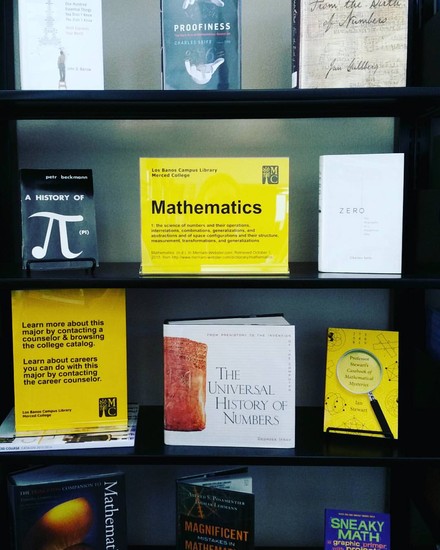
In October, I had two Major Idea displays (see the August 2015 Library Displays post to learn more about what this is), one about math and another about English, which focused on fairy tales as a theme to explore literature studies.

English

Mathematics

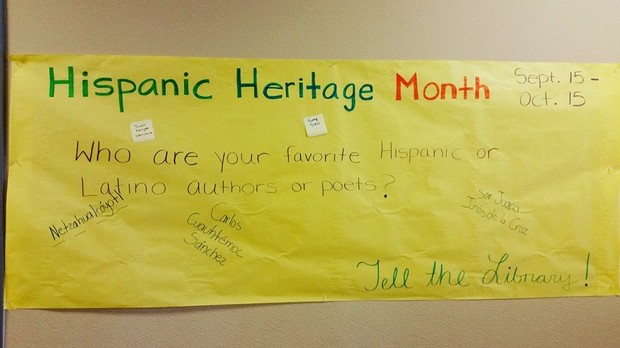
October 15th was also the end of Hispanic Heritage Month. See the September 2015 Library Displays post about it here..

I also put together a quick display for Breast Cancer Awareness Month, which included directions for conducting a breast self-exam in both English and Spanish. I snagged up the instructions during an event our campus had last year that had booths from the community, including the local health center.

Breast Cancer Awareness Month

One of our part-time evening librarians put together our Halloween display this year, for which I am very grateful. Here’s the online flyer I made for her display. Since I have more people to rely on in the library and now know what can be delegated, it’s been fun to see others’ creativity.

Halloween

October is always the beginning of research paper season around here, so it’s been busy! I’ll have to share more about that soon.

Introduction to Teaching Online

I’ve been a little quiet on here. At the end of September I started a month-long online class through @One, Introduction to Teaching Online. The course is being offered through the college I work for and is supported by a grant from the Chancellor’s Office, California Community Colleges.

While I don’t teach the three-unit library research course, the main campus offers two sections, although neither are taught online. For the way my load is (the only librarian during the day), it would work better for me to teach it online, but it would need to get approval through curriculum, etc. I am just starting my third academic year, and it’s only now that I feel like I am ready to add a credit course to my load.

I am also using the class to see what our online instructors needs are regarding library or related services (I did my entire Masters program online, so I already had ideas) and to remind the other faculty members taking the class with me (all the people in the class teach for Merced College) that librarians are faculty. I have been able to market LibGuides and the Library’s soon-to-be-realized Blackboard presence (it will still be in baby mode, but I’m hoping we can work with our faculty lead to make it a bit more robust). One of the math teachers has been very encouraging as I figure out how to approach teaching an entire course since I have only ever taught one-shot research sessions. The class has also has served as a good reminder about effective teaching practices. I can definitely see how taking the class would help give even face-to-face courses a lift. I honestly would love to do the entire certification program.

My class ends next week, and I’m happy because it means I can get a little more sleep. My daily commute is about 2 hours and 45 minutes round trip, and I’m also trying to hit the gym a couple of nights a week. The only thing holding me together is my husband Kory. He has days off in the middle of the week, and while he has always helped a ton, including 99.9 percent of the cooking, he seems to have kicked it up that much more. He is very supportive, and I am grateful.

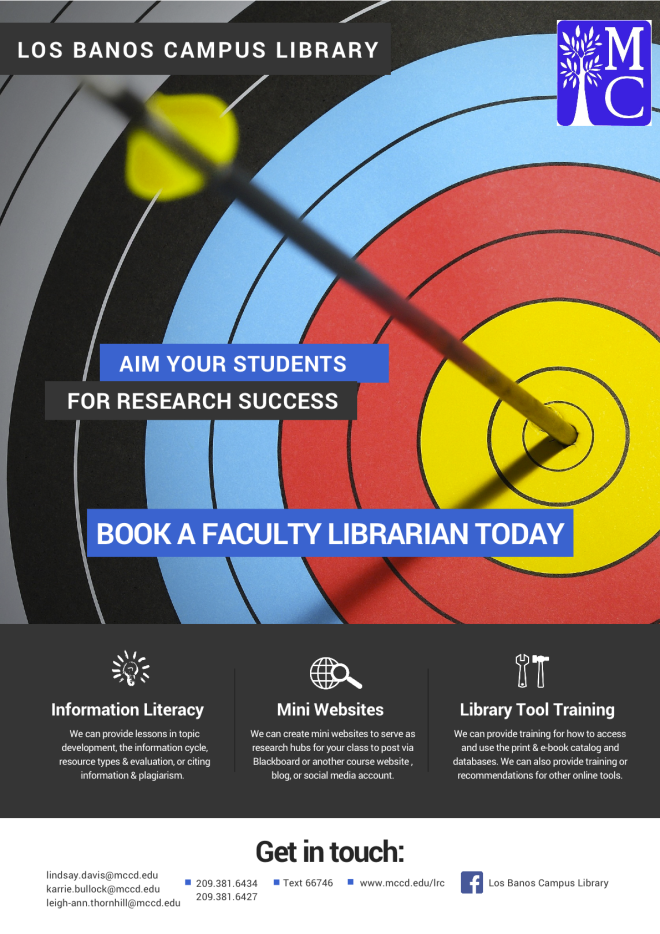
Los Banos Info Flyer (for Faculty)

Just the Highlights

Veronica Arellano Douglas's avatarLibrarian Design Share

Library informational handouts and brochures–the kind we give away at orientations, fairs, and workshops–can easily suffer from the classic librarian pitfall: TOO MUCH INFORMATION. Striking the right balance between needed information and visual interest is a challenge. Lindsay Davis, librarian at the Los Banos Campus Library at Merced College has created informational flyers for students and faculty that touch on all the library “highlights,” those crucial services and bits of information that will make the most impact with library users.

Los Banos Info Flyer (for Students) Flyer for Students

Here’s Lindsay discussing her design:

This is the beginning of my third academic year as the Los Banos Campus Librarian of Merced College, a community college located in California’s Central Valley. When I give an instructional session, I usually give out a handout that covers basic library information printed in black and white on muted yellow card stock (we only have a few color options through duplication…

View original post 283 more words

Committee Work: Blogs and Bibliographies

Faculty members do a lot of committee work for their colleges.  Over the summer, I served on a hiring committee for three positions. This year, I will be once again serving on the Student Success and Support Program Advisory Committee, Institutional Review Board, Student of the Month, and faculty union as a representative for my campus.  My newest committee is serving as the Learning Resource Center’s Academic Senate representative. I also serve on various short-term assignments throughout the year. The faculty lead usually asks me about short-term committees rather than long-term ones because she knows that when I am at a meeting it means I am away from the research help desk, and I don’t have back-up.

However, it is also important for me to serve on committees for professional library associations. I am once again serving of the Association for College and Research Libraries’ (ACRL’s) Community and Junior College Libraries Section’s (CJCLS’) Membership and Communications committee. This year, I will be contributing to the new CJCLS blog! I will be responsible for maintaining a bibliography of scholarship written in the last five years by community and junior college librarians. A call just went out on the CJCLS listserv and on the Community and Junior College Librarians Facebook group. I can’t wait to start receiving citations!

I am also serving as secretary of ACRL’s Instruction Section’s (IS’) Instruction for Diverse Populations committee. We’re responsible for the Library Instruction for Diverse Populations Bibliography.  I will be revising, maintaining, and adding scholarship to the Native American Students and Nontraditional Students sections. I am very excited about this work since I am one of the only community college librarians on this committee. It has also been a long time since I have done this kind of literature review work, so I am thankful to get my feet wet again with an established project.

I am continuing my involvement with ACRL’s Library Marketing and Outreach interest group. I tried to get something going here in the Central Valley last year, but for one reason or another, it didn’t take. I need to give it some more thought as far as trying to establish something here, but it may just be that I join the Northern California team. I get so much inspiration from LMO’s Facebook group. The support and energy there has been great. They even inspired me to submit my DIY work to LibrarianDesignShare.org, and I have always been shy about these kinds of things. (I’ll have more news on this front in another post…)

I promise I am not overdoing it, but I also will be contributing to the Two Year Talk blog.

This is going to be an eventful year! I’m excited to stretch my wings a little more.

Startup Communications

I just really love the honesty in Meredith Farkas’ latest column in American Libraries. In talking about pitching an idea that didn’t take and then one that was a good fit, she reminds shiny new librarians (that means ME!): “The problem wasn’t [XYZ]; it was trying to solve problems that didn’t exist” (Farkas, 2015).

I have always been an ideas person. and I get really excited about all the library things, but the things I do have got to fit our community. I have let projects go because they don’t work, but that’s the nature of this thing–you have to keep figuring it out until you get a sense of what will work at your library. It takes time. (You have to think like a startup.)

For example, last year, to keep the library on the radar, besides my monthly email update, I was also doing a weekly feature called Tech Tuesday where I would share three apps, websites, or other technology tool. It was really time-consuming, and I never really heard back from anyone, so I stopped after a couple of months. What purpose was it serving? Was it just to keep people reminded about the Library in a non-traditional-to-them way? I realized right then that it was pointless to do this. As faculty, we are inundated with emails–committee updates, college advertisements, listservs, etc. I was just adding to the information overload problem and making myself frustrated.

Fast forward to this year. What I did for faculty and staff at the beginning of the semester (about 3 weeks in) was one big online newsletter using Smore. It was bright and colorful, and it had a hilarious video about books that parodied Mark Ronson’s/Bruno Mars’ “Uptown Funk.” I got great feedback! Our small campus also has an email newsletter called Tuesday Tidbits (it used to be called the Monday Memo) where faculty submit updates for committees on which they serve as our campus’ representatives and other relevant campus news. Our faculty lead puts it together. Since more people read that, after I did my initial newsletter and email introduction, I started supplying updates on a weekly basis to Tidbits. In my first update this semester, I also resubmitted the link to my initial online newsletter for those who may have missed it. It seems to be going a lot better doing it this way!

Our college recently started a distance education newsletter for updates related to online education. The distance education coordinator, who is also a history professor, recently asked for people to send ideas they may have for the newsletter. Since I am really into DIY visual content, I asked her if she thought a resource list for online presentation and infographic-making tools might be of value (obviously, this also has value for web-enhanced classes). I didn’t want to start off with “this is what the Library can do for you, etc.” Plus, since this is for the whole district, it’s probably not appropriate for me to do anything like that without talking to my colleagues or our temporary director! I actually would really love to write on the behalf of the Library, but my hope is that maybe the list will show that we should be writing something, perhaps on a rotational basis?

Anyway, the DE coordinator agreed! I submitted my draft last night. Distance education is the hot thing in our college district, so I suspect this might be a great place to spread the word about online library services and librarian expertise. I am hoping this can help solve our district-wide library faculty-instructional faculty communication (image?) problem. We actually do a lot of face-to-face advocating, but since there are only four of us, we only can go so far.